How Fashion Brands Can Use QR Codes Across Buyer Journey
Fashion brands lose visibility once products leave the store. This guide shows how dynamic QR Codes turn garments into connected touchpoints, linking discovery, in-store experiences, post-purchase engagement, and circular resale into a single, data-rich buyer journey.
Every year, fashion houses spend millions on customer acquisition. Yet, the moment a garment leaves the boutique, the brand enters a period of total data blackout. In other words, the product becomes a “Dark Asset.”
For the 5,000 hours a consumer actually wears a jacket, the brand is effectively silenced. There is no feedback loop for garment performance, no data on styling habits, and no direct line to the secondary resale market.
This is where a dynamic QR Code comes into the picture. It is the “phygital” portal required to solve the Dark Asset problem, turning every item into a persistent, two-way communication channel.
In this article, we will move beyond the surface-level applications of this technology to explore how a dynamic QR Code architecture orchestrates the entire buyer journey, from the initial moment of discovery to in-store conversion to the final act of circular resale.
Stage 1: The invisible discovery
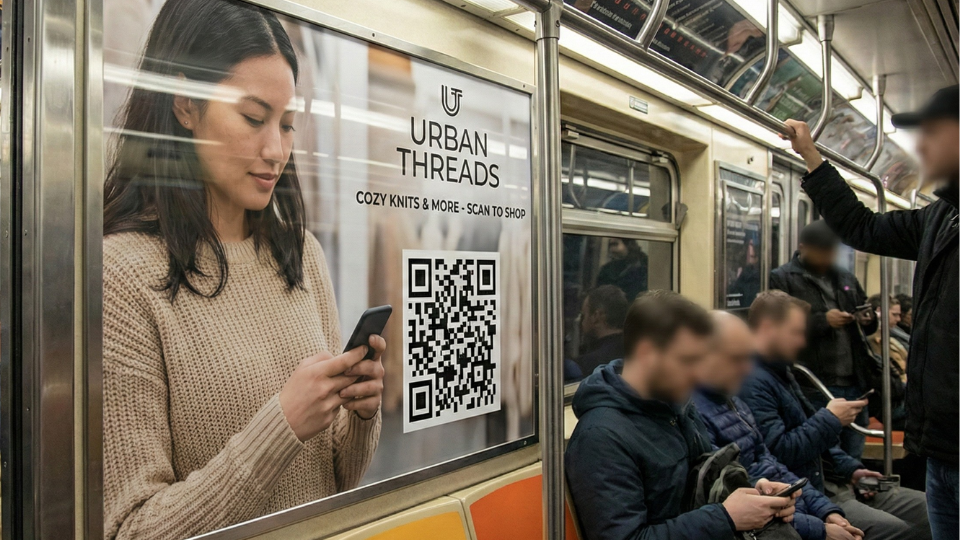
Along with online, discovery in fashion also begins in motion, such as on a subway platform, through a bus window, or on a storefront passed after closing hours. But attribution is a challenge; the brand has seconds to convert that attention into intent, or it disappears entirely.
QR Codes change that by turning momentary curiosity into a deliberate action.
Extending the moment of discovery
When a fashion brand places a QR code on OOH media, the objective should not be “drive traffic,” but to “extend the exact moment of discovery.”
The scan should open a mobile-first lookbook or AR-enabled preview that mirrors what the shopper just saw—same collection, same hero piece, same context. This experience must feel like a continuation of the physical world, not a leap into a website.
A Gen-Z-focused streetwear brand launches a tongue-in-cheek campaign aimed at millennials. Their ads are on billboards, pamphlets, and even city buses. The ad has a QR Code with a single prompt: “Think Gen Z won’t suit you?” Scanning the QR Code opens a mobile experience where users upload a photo and instantly see an AI-generated avatar styled in the brand’s latest drops. People pick and try different Gen Z streetwear, and even place an order directly if they like something.
QR-led discovery for immediate context
The same logic extends to physical storefronts. Window displays, once static after closing time, now function as always-on entry points. Shoppers can scan, view the exact item on display, check availability in nearby locations, or buy for home delivery when their size isn’t in-store.
Furthermore, QR-led discovery works best when it resolves directly to a pre-contextualized product view, filtered by collection, colorway, or local availability. The less cognitive effort required, the more likely curiosity converts into exploration.
Stage 2: The in-store “clienteling” assistant
The store is where purchase intent peaks and where friction hurts the most. However, the QR Code also plays a key role here.
Reducing fitting room friction
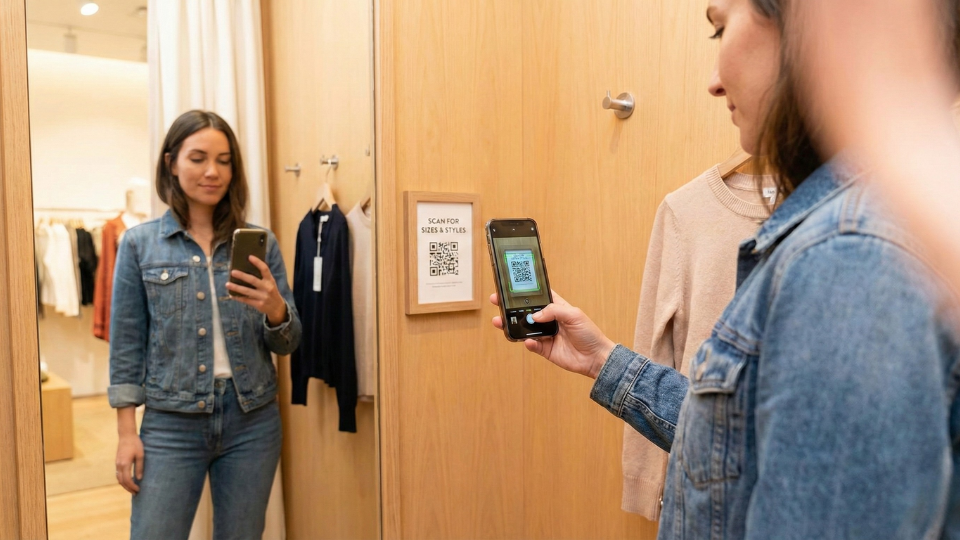
QR Codes inside fitting rooms allow shoppers to request a different size, color, or complementary item without leaving the stall. A scan can also surface “Complete the Look” suggestions, while alerting sales associates on their tablets. The result is fewer interruptions, less waiting, and higher confidence at the point of decision.
This logic extends beyond the fitting room itself. A UX case study by UI/UX designer Sharmishtha Dwivedi explored how QR-based virtual queuing near trial rooms could reduce chaos, anxiety, and cart abandonment in large-format fashion stores.
Based on repeated visits to H&M’s flagship store in Gurgaon, the study identified recurring issues, including unclear wait times, queue jumping, customer frustration, and staff burnout. The proposed solution was deliberately lightweight: a QR Code placed near the trial rooms that shoppers scan to join a virtual queue. Instead of standing in line, customers see their position, estimated wait time, and receive notifications as their turn approaches.
Personalization that adapts in real time
With two-way QR experiences, known loyalty members can be recognized instantly. Scans can surface tier-based pricing, available rewards, or personalized recommendations, bringing online-style personalization into the physical store without requiring staff intervention.
When a size or SKU is unavailable, QR codes enable shoppers to view nearby store inventory or opt for home delivery directly from the fitting room. Meaning, the sale doesn’t stall; instead, it shifts to another channel.
In fact, a report suggests that omnichannel shoppers not just spend 30% more than single-channel customers but also have a 30% higher lifetime value.
Stage 3: Beyond the transaction
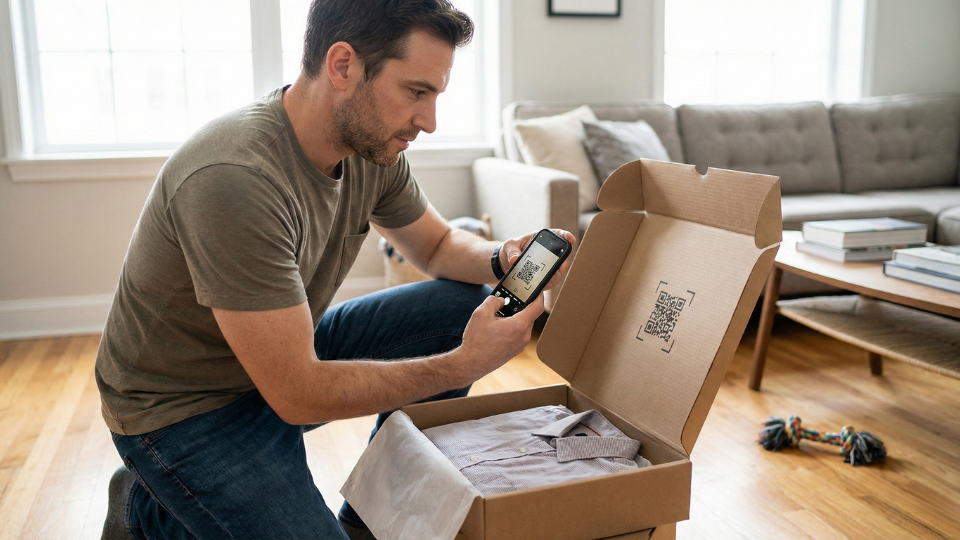
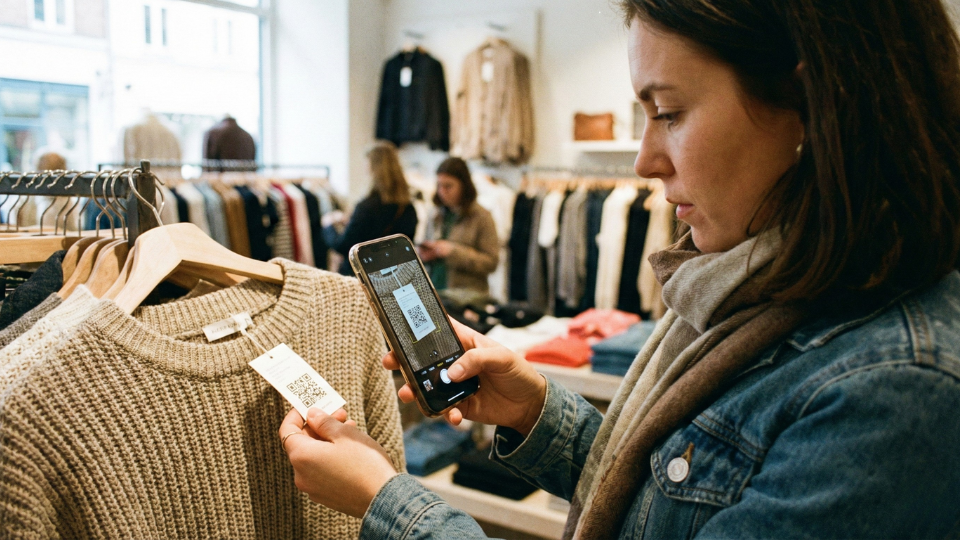
The transaction is often where the brand’s relationship with the customer resets to zero. However, by replacing static care tags with permanent, wash-resistant QR labels (often woven directly into the nape or side seam), the garment becomes a persistent media channel.
- Dynamic utility: The content behind the QR Code must be temporal. A scan in December surfaces “How to layer this wool coat for sub-zero temperatures,” while a scan in April offers “Seasonal storage tips to prevent fiber degradation.”
- The digital care label: Instead of cryptic laundry symbols, use QR Codes to host fabric-specific video care instructions, such as tutorials on stain removal or delicate steaming tailored to that specific fabric composition.
Furthermore, a dynamic QR Code allows brands to harvest Zero-Party Data, information the customer intentionally shares, at a stage that was previously a black hole.
- Post-unboxing feedback: By incentivizing a “first-wear” scan with an extended warranty or styling credits, brands can capture fit satisfaction and emotional sentiment directly into their Customer Data Platform (CDP).
- Product performance analytics: If a brand observes that 40% of customers watch the “How to Repair” video within three months of purchase, it provides an immediate, real-world signal for the design team to address durability issues in the following collection.
Stage 4: Circularity & resale
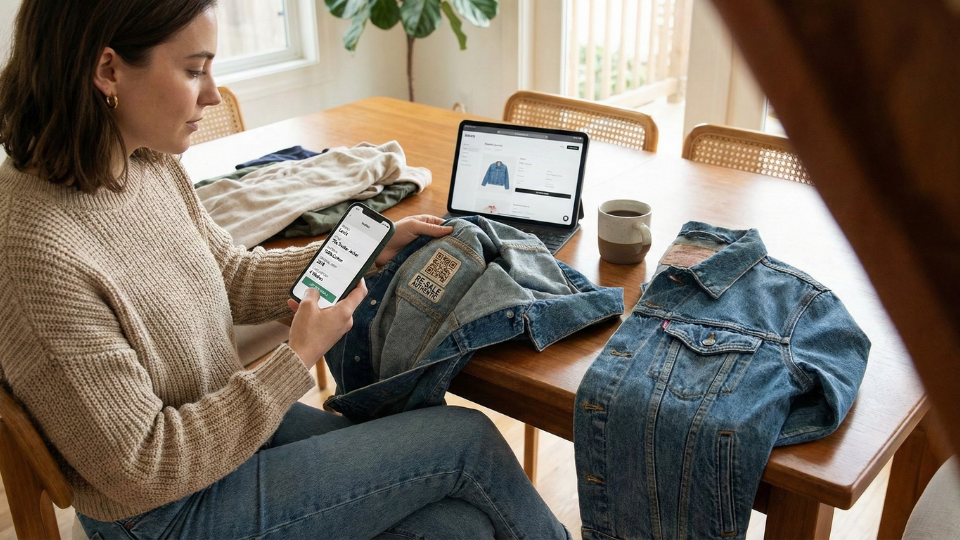
Resale today often happens outside the brand’s ecosystem, stripping away context, authenticity, and data. But brands can change that by using a single, garment-level QR Code to anchor resale internally.
A scan can pre-populate a resale listing with product details, such as style name, material, original drop, and care history, reducing friction for the seller and preserving brand integrity.
Programs like Patagonia’s Worn Wear show what happens when resale is designed into the brand ecosystem. Instead of pushing customers to third-party marketplaces, Patagonia allows owners to trade in or resell used items directly through its platform.
Product details are standardized, authenticity is preserved, and the brand retains visibility into how often items resell, why customers part with them, and how long products actually last.
The result is a resale experience that benefits both the customer and the brand, without damaging the relationship after the initial purchase.
QR Codes can act as a digital material passport, surfacing fiber composition, dye treatments, and construction methods when a garment is scanned at end-of-life. For recyclers, this removes guesswork. For brands, it enables compliance with emerging regulations and provides visibility into how products are actually processed and exit the system.
Not to mention, resale and recycling moments are also high-signal data points. Brands can incentivize scans during resale listing, donation, or recycling drop-off to capture zero-party data, including fit satisfaction, durability feedback, and reasons for letting go. This data feeds directly into the CDP, informing design, sizing, and material decisions in future collections.
The technical architecture
All of this, discovery, clienteling, living labels, resale, only works if the underlying architecture is built for longevity. In fashion, QR Codes are attached to physical products that may exist for years. That changes the technical bar entirely.
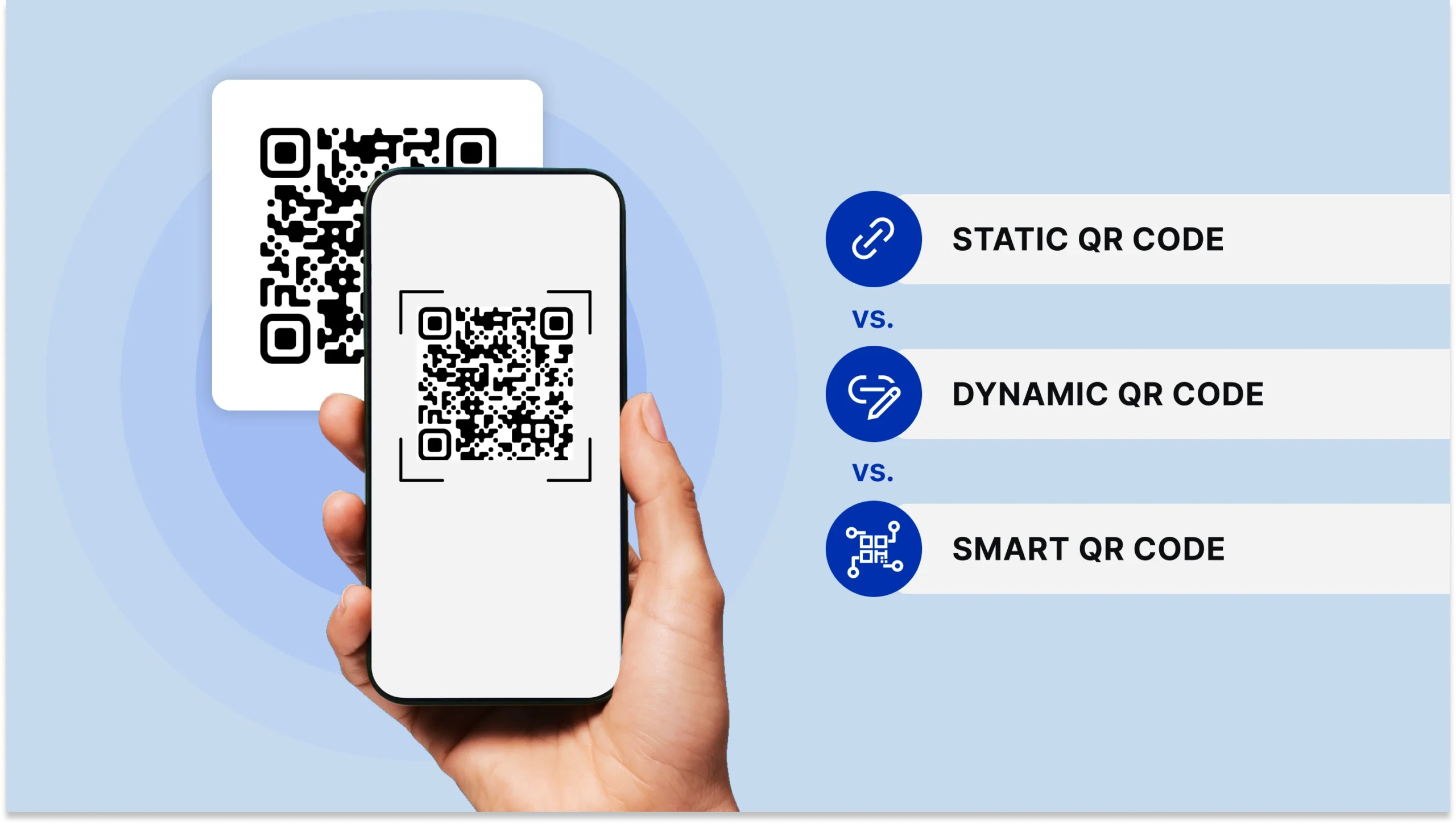
For example, a static QR Code on a garment is a guaranteed failure mode. URLs change, collections sunset, and content evolves. When a static link breaks, the product becomes digitally silent again. Dynamic architecture is the only way to avoid “dead link” syndrome. With dynamic QR Codes, brands can update content, reroute traffic, localize experiences, or repurpose the same garment-level QR across seasons without reprinting or relabeling.
Additionally, fashion brands rightly prioritize aesthetics, but visual customization must also respect technical constraints. Logos, brand colors, and custom shapes can be integrated, but only within safe limits. Error Correction Coding (ECC) levels allow a QR Code to remain readable even when parts are obscured or stylized. Higher ECC enables logo embedding and creative treatments, but over-designing reduces scan reliability.
Furthermore, brands must design for consent, transparency, and minimal data collection, especially under GDPR and CCPA. Best practice is clear disclosure at scan, purpose-limited data use, and opting for aggregated behavioral insights unless users explicitly identify themselves (e.g., loyalty scans).
Opt for a secure, scalable QR solutions provider
Uniqode, an enterprise-grade QR Code solutions provider, is built for brands that treat QR Codes as long-term infrastructure. Its dynamic QR Codes ensure that garment-level links never become obsolete, allowing destinations to be updated, localized, or repurposed over time without changing the physical code.
Linkpages are another core feature that comes with its QR Code. It works like a link-in-bio page and offers brands a flexible, centralized destination where multiple links and resources can he housed, such as product details, care instructions, styling content, resale options, and feedback mechanisms.
Uniqode also offers extensive customization options, enabling brands to align QR Codes with their visual identity (logos, colors, and layouts) while maintaining high scan reliability across fabrics, lighting conditions, and device cameras.
Security and compliance are foundational to Uniqode as well. It supports SAML-based single sign-on with Okta, Azure, and Auth0, enforces multi-factor authentication, and complies with GDPR, SOC 2 Type II, HIPAA, and ISO 27001:2022 standards. Features like anomalous scan detection protect data integrity, giving brands peace of mind at scale.
Frequently Asked Questions
- Can you put a QR Code on clothing
Yes. Fashion brands can place QR Codes directly on clothing using woven labels, printed tags, embroidery, or heat transfers. These QR Codes can link to product details, care instructions, styling tips, authenticity information, or resale options—connecting the physical garment to a digital experience. For reliable scanning, brands typically use high-contrast designs and materials that are wash-resistant, suitable for long-term use.
- How to create a QR Code for clothes
To create a QR Code for clothing using Uniqode, follow these steps:
- Log in to the Uniqode dashboard
- Click on +Create and select QR Codes
- Select QR Code type
- If link, select Website
- Add the link and click Next
- Customize your QR Code, click Next, Finish, and Download
- How to create a stylish QR Code?
Uniqode allows brands to customize QR Codes to match their visual identity. You can apply brand colors, add logos, adjust shapes, and design layouts while maintaining high scannability. Built-in Error Correction ensures the QR Code remains readable even with design elements, making it suitable for use on fabrics, labels, packaging, and printed materials.