QR Codes in Healthcare: Use Cases & HIPAA Compliance Guide
QR Codes in healthcare has drastically improved the way hospitals run. Many hospitals have already leveraged the technology for patient tracking, drug safety, and many other use-cases.
The use cases of QR Codes in healthcare spans beyon just patient registraion.
One question decides whether you can use a QR Code platform in healthcare at all: will the vendor sign a Business Associate Agreement. Hospitals already use QR Codes for patient tracking, drug safety, and equipment information, and that compliance question determines which platforms are even eligible to run any of it.
HIPAA's Business Associate Agreement requirement applies the moment a vendor creates, receives, maintains, or transmits protected health information. A QR Code linking to a patient portal counts. One on a marketing brochure usually doesn't.
Let’s look at how healthcare companies use QR Codes, safety factors to consider and how to create QR Codes easily.
How QR Codes are used in healthcare: 13 use cases with real examples
Hospitals, pharmaceutical companies, and healthcare marketers already put QR Codes to work across a wide range of workflows, from patient check-in to drug safety to facility navigation. Each use case below carries a different answer to the compliance question above: some touch PHI directly, some don't.
1. Appointment scheduling and telehealth access
A QR Code on a discharge summary, a reminder card, or a clinic's front door can link directly to a booking page or a live telehealth session, skipping the phone tag most scheduling still runs on. For a telehealth visit specifically, the code can route straight into the session at the scheduled time rather than a generic homepage the patient has to navigate from.
Because the destination is editable, the same printed code keeps working after a provider changes booking software or a session link expires and gets replaced.
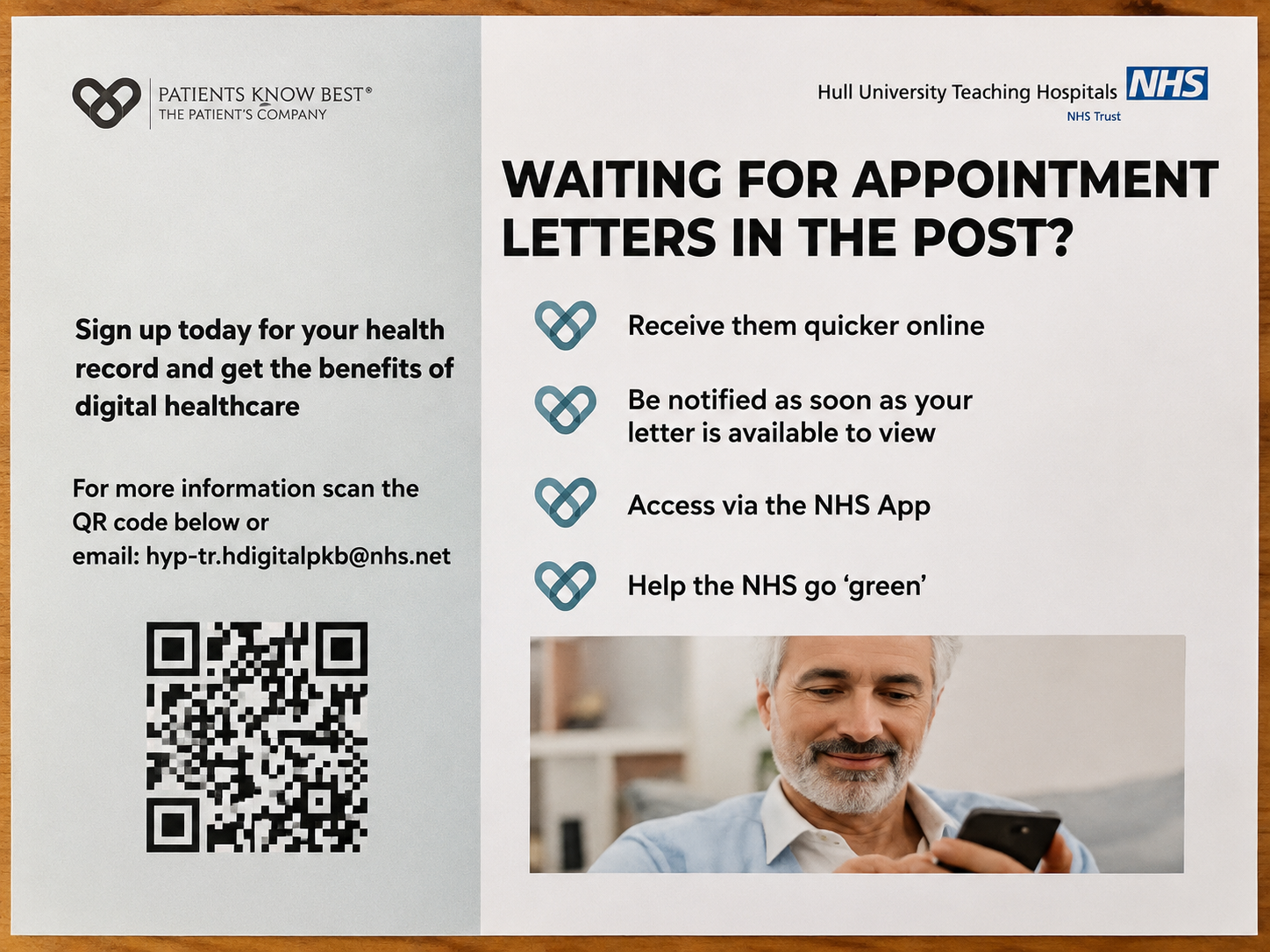
A Hull University Teaching Hospitals leaflet uses a QR Code to help patients ditch paper appointment letters and switch to digital health records accessible through the NHS App.
2. Feedback and satisfaction surveys
You can use QR Codes to collect feedback on services. A QR Code on a discharge form or a room's exit sign can link to a short patient satisfaction survey, capturing feedback while the visit is still fresh instead of days later in an email nobody opens.
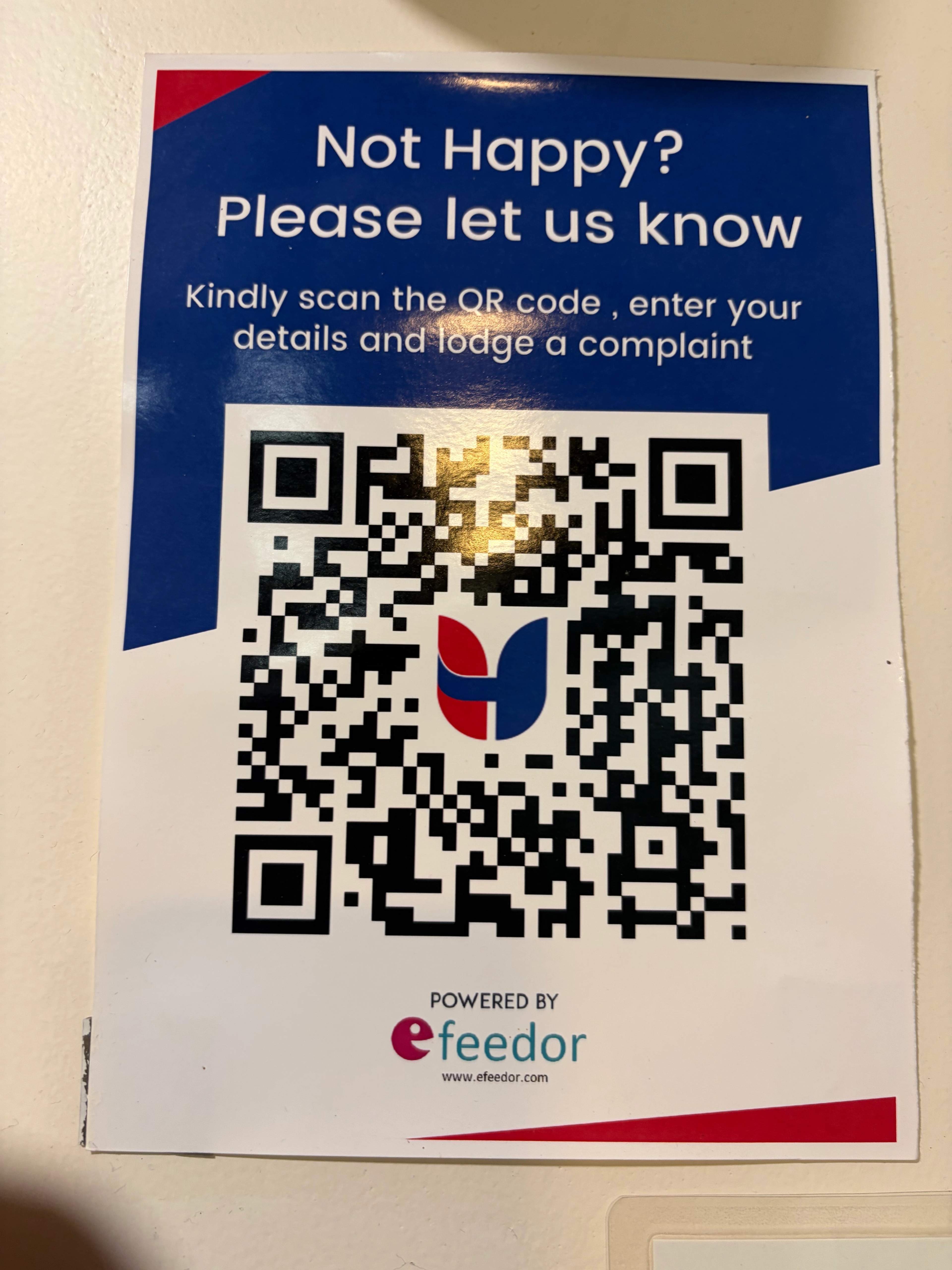
Uniqode's Forms are bundled into the same platform as the QR Code itself, so a survey response and its scan data land in the same dashboard, not two disconnected tools. That link between who scanned and what they said is what turns a stack of comment cards into a pattern a facility can actually act on.
3. In-room service requests
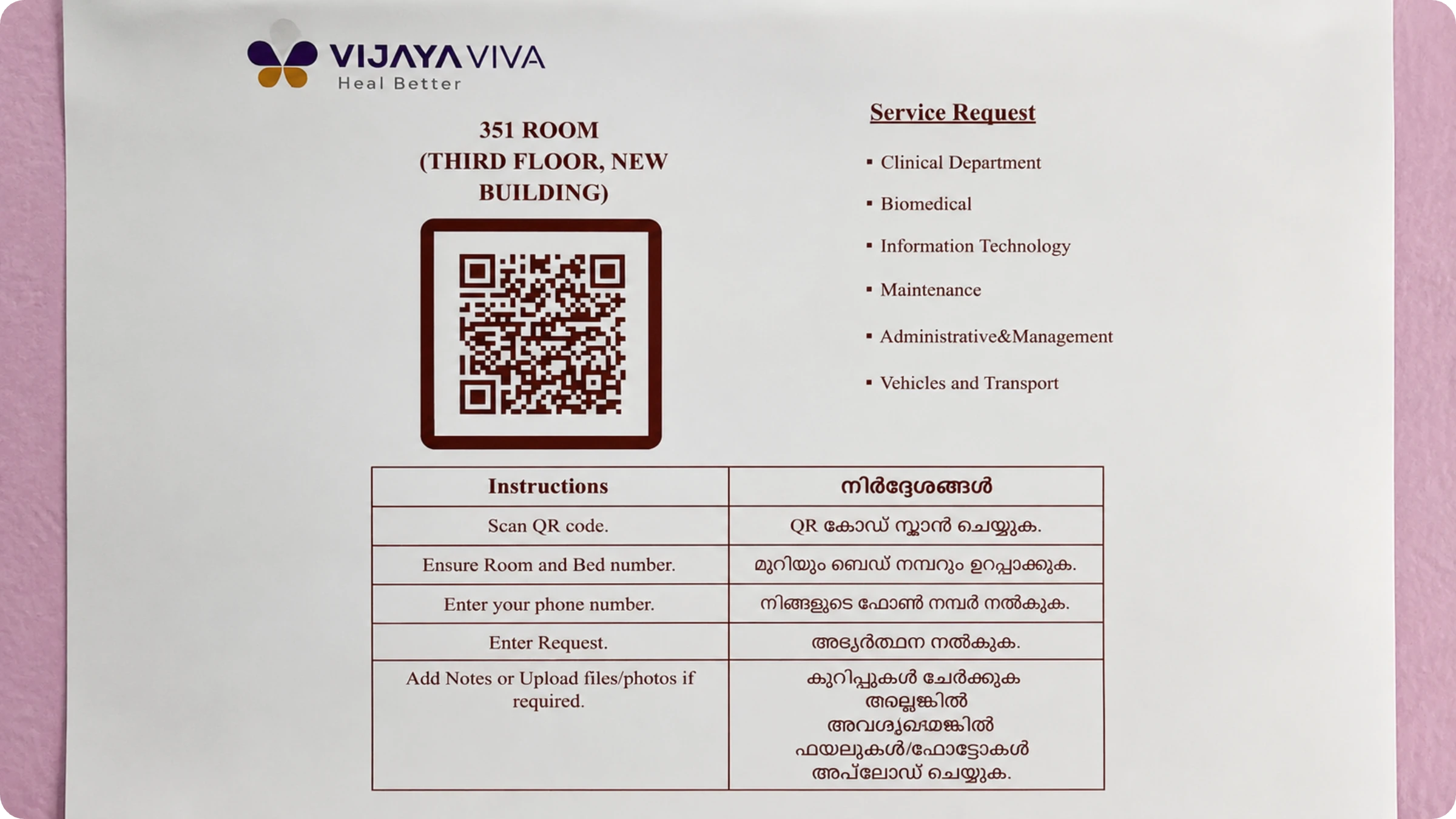
A QR Code posted in a patient room can replace the phone calls and front-desk visits that pull staff away from care. Patients or staff scan the code, confirm the room and bed number, and submit a request directly to the relevant department, whether that's Clinical, Biomedical, IT, or Maintenance, without leaving the room or waiting on hold.
Because the code is dynamic, the destination form can be updated as departments change or workflows shift, without reprinting the sheet on the wall.
4. Patient identification
Patient identification data, name, condition, medication history, becomes protected health information the moment it's digitized, which puts this use case inside the compliance question above.
Healthcare systems are typically built as siloed architectures, so patient data often isn't uniform across departments. According to a study by Harvard Business Review, a platform must make a patient's medical record accessible to every party involved in their care. False identification can lead to an improper diagnosis or a medication error.
QR Codes embedded in medical bracelets and history datasheets give healthcare providers fast, accurate access to patient information, from admission to discharge to medical prescription history.
5. Healthcare marketing
Not every QR Code in a hospital touches PHI. Marketing is the clearest example: leaflets, brochures, and billboards don't carry patient data, so this use case sits outside the compliance requirement covered above.
The healthcare system hasn't heavily invested in marketing, even though hospitals are, in practice, running a business. QR Codes are as useful for healthcare marketing as they are for any other campaign. Healthcare providers and pharmaceutical companies can use QR Codes on brochures, leaflets, and bills handed to visitors and patients. Upon scanning, these codes redirect to a landing page covering hospital infrastructure, cleanliness, success stories, and treatment methods.
QR Codes in healthcare marketing also show up on:
- Newsletters and flyers
- Online advertisements
- Billboards
- Medical publications such as journals and theses
6. Drug safety
Pharmaceutical companies work hard to maintain authenticity and eliminate defects in drug manufacturing, since counterfeiting is a global threat. QR Codes on medicine packages disclose the manufacturing process, expiry date, and drug contents, and alert caregivers to exact dosage and timing during administration.
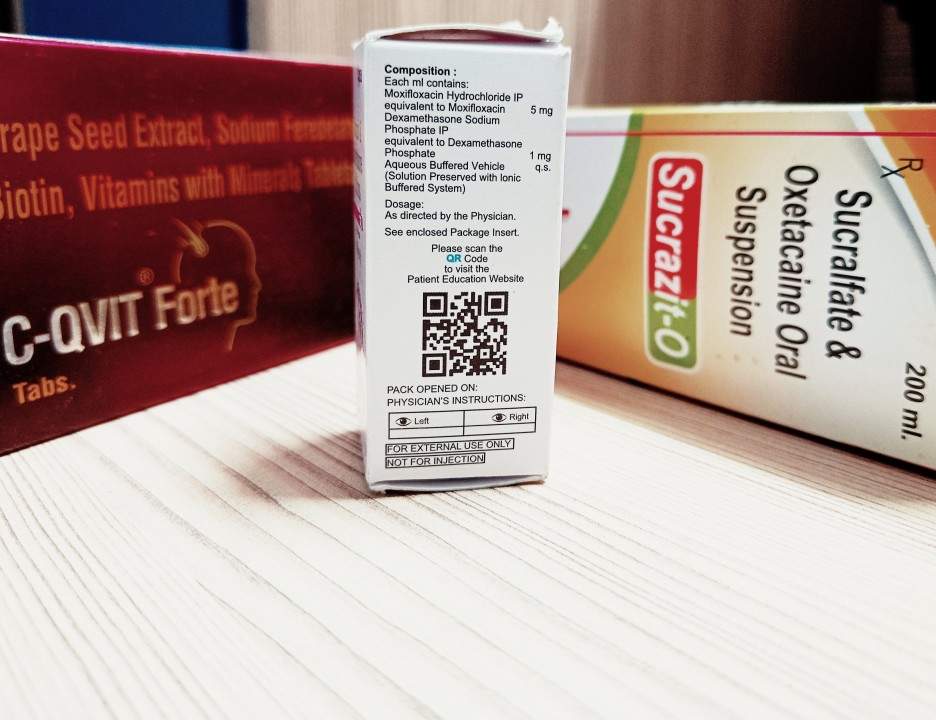
China has administered QR Codes that verify a drug's composition before consumption. For structured data like batch numbers or expiry dates, look for a platform that supports GS1-standardized QR Code encoding built for pharmaceutical supply-chain compliance, not a generic URL redirect.
Serialized QR Codes can also integrate with regulatory databases like the FDA to instantly verify batch recall status, enabling rapid quarantine of defective lots and minimizing patient risk.
7. Medical equipment information
Hospitals depend entirely on the equipment they use, and correct functioning is vital for effective care. QR Codes attached to equipment open a landing page with manuals, operating instructions, and setup videos, so staff can scan instead of hunting through a printed manual.
If the manual is a PDF, link a QR Code to that PDF and embed it on the packaging. When the manual updates, swap the file in the dashboard, and every code already printed on the equipment points at the current version, no relabeling required. The same codes can alert staff to malfunctions or replacement needs.
8. Clinical accuracy and care coordination
Over 400,000 people die from medical errors every year. And the lack of accurate information is the main reason.
QR Codes for cross-checking patient records are convenient and time-saving. In fact, 38% of smartphone users in the USA say mobile devices are essential for accessing health information.
QR Codes are the right tool for pulling up a patient's medical history quickly. Medical bracelets, tags, and folders with embedded QR Codes give caregivers instant, convenient access to that history when it matters most.
9. Asset tracking
Medical institutes and hospitals handle plenty of assets: tools, medical samples, tests, and equipment. Mismanagement can have grave consequences, and medical instruments are expensive and hard to retrieve once lost.
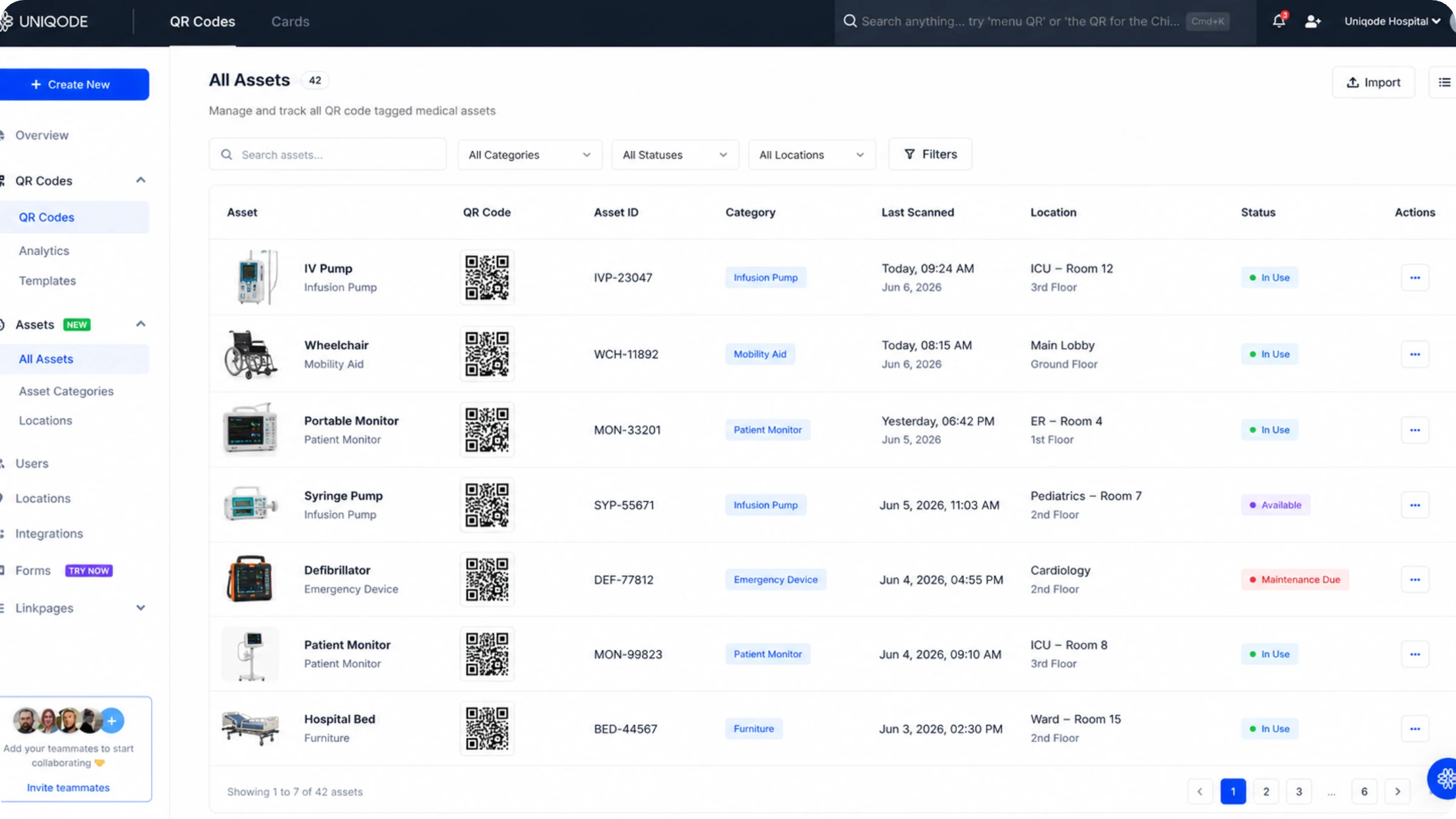
QR Codes for asset tracking solve this: codes on equipment let teams track items in real time, update counts, alert operators to emergencies, and send feedback, all from one dashboard. Hospitals can save capital by skipping expensive scanning devices. Facilities with frequent supply deliveries can pair this with mailroom management tools that organize logistics and cut down on lost items.
10. Procedure information for patients
Dynamic QR Codes allows information update instantly and print in 100 languages, so multilingual patients get the same access.
PatientPoint, a healthcare advertiser network, reached 208,000 unique users with QR Code-driven patient education content, proof this works at scale rather than as a leaflet afterthought.
QR Codes in waiting areas
Lobby codes connect patients to their doctor and condition-specific information. Since doctors spend more than half their time on EMR documentation, a code communicating wait times doesn't pull staff away from care. WiFi QR Codes in the waiting room help patients get online while they wait.
11. Patient check-in and intake
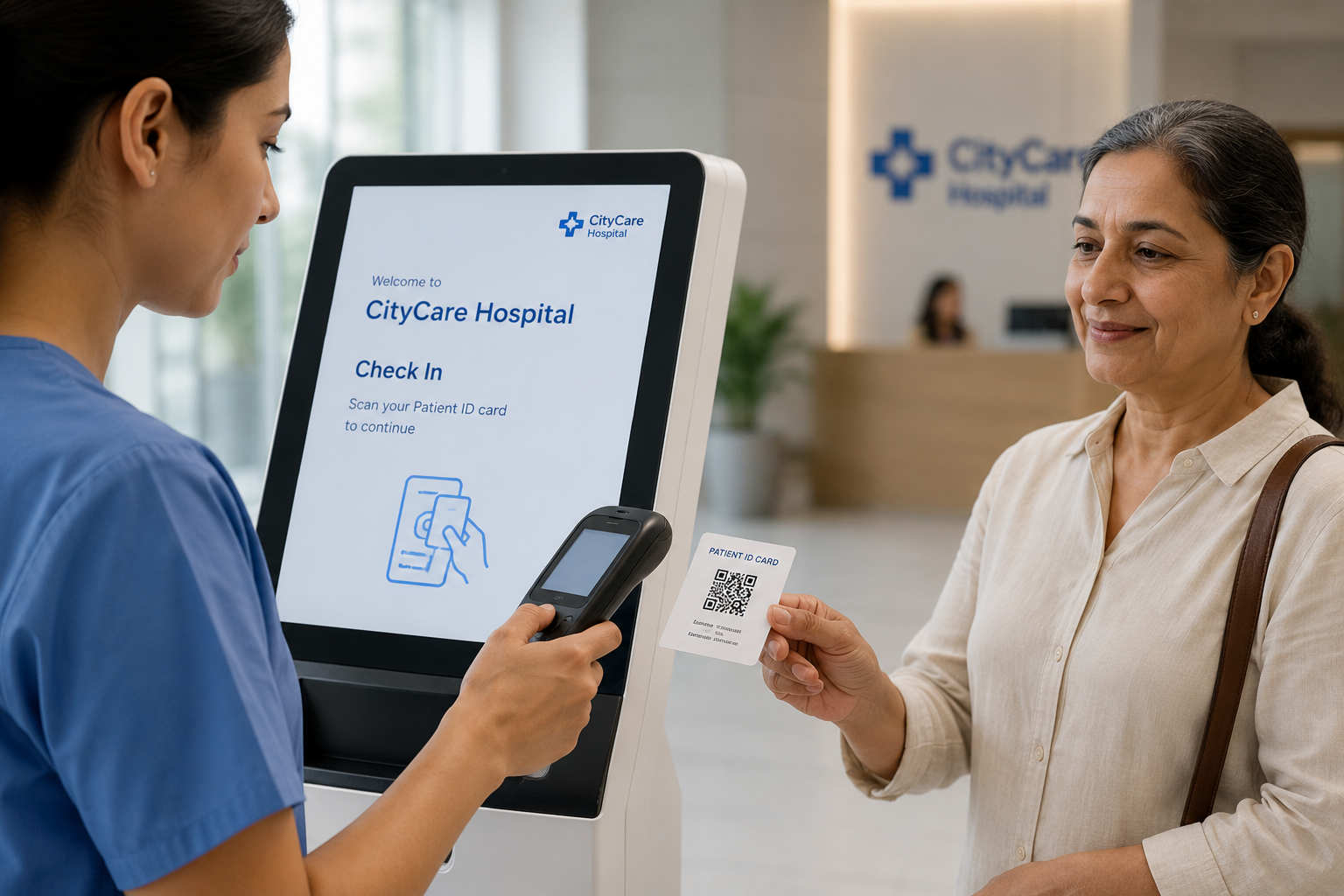
Front-desk check-in is often the first bottleneck a patient hits. A QR Code at the kiosk can route to a check-in form that auto-fills known patient details and flags a staff member only when something needs a human. Because the code is dynamic, the destination form can change as intake requirements change, without reprinting a single sign or wristband.
This doesn't replace clinical judgment. It removes the paperwork step in front of it, so front-desk staff spend less time re-entering the same information twice.
12. Wayfinding and facility navigation
Large hospital campuses are genuinely hard to navigate, and a confused visitor asking for directions pulls a staff member away from actual patient care. A QR Code at the entrance or on a directory sign can link straight to an interactive map or specific department directions, skipping the front-desk detour entirely.
Because the code's destination can be edited after printing, a wing renovation or a department relocation doesn't mean reprinting every sign in the building, just updating where the code points.
13. Visitor and staff sign-in
Front-desk sign-in sheets are a compliance gap hiding in plain sight: anyone can read the name above theirs on a paper log. A QR Code at the entrance can route visitors and staff to a digital sign-in form instead, capturing who's on-site without an open logbook everyone can see.
For departments that need it, that same sign-in flow can double as basic visitor tracking for compliance audits, without adding a second system for staff to check.
Are QR Codes HIPAA compliant?
A QR Code itself is neither HIPAA compliant nor non-compliant. It's a pattern of black and white squares with no data-handling behavior of its own. Compliance is a property of the QR Code generator and the destination it points to.

That distinction is where most "is this safe" questions actually live. A QR Code becomes a HIPAA concern the moment it links to something that touches protected health information: a patient portal, a prescription record, an intake form. The platform behind that link needs a signed Business Associate Agreement, encrypted storage, and access controls. A QR Code linking to a public-facing brochure doesn't carry the same requirement, since no PHI is involved.
Security matters here too. Dynamic QR Codes from an authenticated, HIPAA-compliant platform route through a destination the issuing organization controls and can monitor, which closes off "quishing," the practice of pasting a malicious code over a legitimate one. A static code printed on signage is just ink: anyone can paste a replacement over it, and there's no way to know until someone reports it.
Which QR Code platform is right for healthcare?
HIPAA compliance is more common among QR Code platforms than a single-vendor pitch would suggest, so verify it directly rather than assume any one vendor has it locked up.
Uniqode holds SOC 2 Type II, HIPAA, and GDPR certifications, making it a strong option for compliance-sensitive pharmaceutical deployments. Flowcode and QRCodeChimp both publicly claim HIPAA compliance alongside SOC 2 Type II and GDPR.
The table below reflects what each vendor states publicly as of this writing. Confirm current certification status directly with any vendor before a compliance-sensitive deployment, since these claims can change.
| Feature | Uniqode | Flowcode | QR Chimp | ME-QR |
|---|---|---|---|---|
| HIPAA compliant | Yes | Yes | No | Yes |
| SOC 2 Type II | Yes | Yes | Yes | Yes |
| GDPR compliant | Yes | Yes | Yes | Yes |
| Dynamic QR Code editing | Yes | Yes | Yes | Yes |
| Conditional routing (Smart Rules or equivalent) | Yes | Yes | No | No |
| Scan analytics | Yes | Yes | Yes | Yes |
Given the overlap on paper, the deciding factor comes down to what a vendor can actually document and support during procurement, not which box is checked on a feature page.
To get a detailed comparison of the security features each tool offers, check out this guide on safe QR Code generators.
What to check before deploying healthcare QR Codes
Choosing the right QR Code platform for healthcare goes beyond features and pricing. Before committing to any vendor, verify these three things:
- Business Associate Agreement (BAA): Confirm whether the vendor signs a BAA and on which pricing tier. On Uniqode, BAA support starts at Business Plus and above, not the entry level.
- Written compliance documentation: Ask for documentation, not a verbal confirmation. A vendor's data-compliance posture should be something a legal team can review, covering both pharma and data compliance requirements.
- Analytics controls: Verify what scan data is collected by default and whether it can be restricted. For healthcare deployments, location tracking should be a setting you control, not a fixed behavior discovered after codes are printed.
A platform built for patient data responsibility from the start is always a safer bet than one that scrambles to comply after problems arise. Get these answers before codes are printed, not after.
How to set up a HIPAA-safe QR Code for patient check-in
Keep protected health information out of the code itself. The QR Code should only ever route to a secure destination, never encode PHI directly.
- Create a dynamic QR Code so the destination can be edited after printing, without reprinting wristbands or signage.
- Point it to an authenticated check-in portal rather than a public form. No patient data should live in the code's payload.
- Add password protection and a custom domain for deployments handling sensitive intake steps.
- Track scans and check-in activity through the analytics dashboard to spot bottlenecks without adding a second system.
The compliance question comes first, everything else follows
QR Codes in healthcare cover a wide range of real workflows, from patient identification to wayfinding, but none of that matters until the compliance question gets answered: will the vendor sign a Business Associate Agreement. Verify HIPAA and SOC 2 Type II certification directly, since more platforms carry them than expected. Once that's settled, dynamic QR Codes give hospitals, pharmaceutical teams, and healthcare marketers a way to update information without reprinting, track what's actually being scanned, and close the security gaps static codes leave open.
Uniqode is built for healthcare deployments from the ground up, holding SOC 2 Type II, HIPAA, and GDPR certifications with BAA support available for enterprise teams. From serialized pharmaceutical packaging to hospital wayfinding, Uniqode's dynamic QR Codes give healthcare organizations the compliance foundation and operational flexibility to deploy with confidence.
See how Uniqode works for your healthcare use case. Book a demo.
Frequently Asked Questions
- 1. What are the main use cases for QR Codes in healthcare?
QR Codes in healthcare are primarily used for three critical applications: patient identification and tracking, healthcare marketing, and drug safety verification. Hospitals deploy QR Codes to access thousands of research papers, hospital records, medicines, and medical procedures instantly. Pharmaceutical companies also implement QR Codes on medicines to instill trust and ensure product authenticity among patients.
- 2. How can hospitals use QR Codes for marketing purposes?
Healthcare providers can place QR Codes on leaflets, brochures, bills, emails, newsletters, billboards, and medical journals to promote their services. When scanned, these codes redirect patients and visitors to landing pages showcasing hospital infrastructure, cleanliness standards, success stories, and treatment methods. This marketing approach is increasingly important as private equity deals in healthcare continue to set new records each year.
- 3. Does a QR Code platform need to be HIPAA compliant to use in a hospital?
Only if the QR Code or its destination touches protected health information. A code linking to a patient portal, prescription details, or records access requires a HIPAA-compliant platform willing to sign a Business Associate Agreement. A code on a marketing brochure or public-facing informational leaflet usually doesn't carry that requirement, since no PHI is involved.
- 4. Can a QR Code be hacked or used for phishing in a healthcare setting?
A QR Code itself can't be hacked, but it can be physically replaced with a malicious one, a tactic known as quishing. Dynamic QR Codes from an authenticated platform reduce this risk because the destination is controlled and monitored by the issuing organization, unlike a static code that anyone can tamper with once it's printed.
About the Author
Ektha is a QR code expert with years of research and analysis into the evolution of QR codes. Having written over 70 in-depth articles on QR technology, she has developed a comprehensive understanding of how QR codes are transforming industries. Her insights, including The State of QR Report, have been featured in leading publications. With a passion for simplifying complex topics and providing actionable strategies, Ektha helps businesses leverage QR codes to enhance their 'phygital' connections.