What the FDA’s New Traceability Requirements Mean for CPG Brands

Retailers are enforcing traceability now, even though the FDA extended FSMA 204 to 2028. CPG brands must meet lot-level requirements today, and QR Codes can help make compliance scalable and audit-ready.
Traceability isn’t optional anymore.
Even though the U.S. Food and Drug Administration (FDA) extended the FSMA 204 compliance deadline to July 2028, major retailers aren’t waiting. Retailers such as Walmart, Kroger, and Albertsons are moving aggressively with their own deadlines (many already in effect), pushing CPG brands to prove and not just document their traceability capabilities.
CPG brands now face two conflicting compliance timelines. The federal timeline allows preparation until 2028. The retailer timeline demands compliance now, with consequences for non-compliance.
TL;DR:
Do CPG brands really have until 2028 to comply with FSMA 204?
The federal compliance deadline is July 20, 2028. However, retailers such as Walmart, Kroger, and Albertsons have already enforced their own traceability timelines. Brands selling through major retailers face immediate compliance pressure regardless of the federal extension.
What does FSMA 204 actually require?
FSMA 204 requires detailed, lot-level traceability records. Brands must assign traceability lot codes, capture data at Critical Tracking Events (CTEs), and produce organized electronic records within 24 hours if requested by the FDA.
Why are retailers moving faster than the FDA?
Retailers want faster recalls, lower risk exposure, and better supply chain visibility. Many require traceability for all food products, not just items on the FDA’s Food Traceability List.
How can QR Codes help with traceability?
QR Codes connect physical products to digital records, capture supply chain events through scans, and make traceability data searchable and exportable without replacing existing ERP or WMS systems.
What are the FDA’s new traceability requirements?
The FDA’s Food Traceability Rule, formally Section 204(d) of the Food Safety Modernization Act (FSMA), requires companies handling higher-risk foods to maintain detailed records at every critical point in the supply chain. The practical test is straightforward: when the FDA requests traceability data for a specific product, the company must identify the exact lot, the production origin, and every recipient in the chain and deliver those records electronically within 24 hours.
Who it applies to
FSMA 204 applies to companies that manufacture, process, pack, or hold foods on the FDA’s Food Traceability List (FTL). The FTL includes higher-risk foods such as fresh-cut fruits and vegetables, leafy greens, shell eggs, certain cheeses, nut butters, and specific seafood products.
Core expectations
- Lot-level traceability: Companies must track products at the batch or lot level (a single production run or group of units), not just by product type.
- Capture at key moments: Companies must record specific data at Critical Tracking Events (CTEs) such as harvesting, packing, shipping, and receiving.
- Fast access to records: Companies must retrieve and share those records (usually in an electronic, usable format) within 24 hours.
Put simply, FSMA 204 does not tell companies which software to buy. It sets an outcome: when called upon, you must answer “Which exact lot, produced when and where, went to whom?” and show the supporting documents quickly.
The Food Traceability Rule was finalized in November 2022. The original compliance deadline was January 20, 2026. However, in August 2025, the FDA proposed a 30-month extension, moving the federal deadline to July 20, 2028.
Why FSMA 204 matters now for CPG brands
While the FDA gave the industry more time, major retailers did not.
Traceability is no longer just a future regulatory checkbox. Despite the federal extension to 2028, retailers are already enforcing their own traceability requirements, and their commercial demands are significantly ahead of the new federal timeline.
The FDA extension does not change retailer expectations. Retailers have publicly stated they expect suppliers to maintain their original compliance timelines.
Walmart, for example, established traceability expectations that extend beyond federal deadlines. The retail giant now requires food suppliers to include detailed, lot-level traceability data and update labeling standards, pushing suppliers to comply as early as August 1, 2025.
The company has said
“While the FDA has recently proposed a 30-month extension to the compliance date for the Food Traceability Rule, we strongly encourage all suppliers to maintain momentum in their compliance efforts.”
Walmart added that it expects suppliers to meet the original compliance timelines it outlined.
Walmart, Albertsons, Sam’s Club, KeHE, Kroger, and Target are among the companies requiring traceability for all food products, not just those in the FDA’s FTL.
CPG brands now face two parallel compliance regimes. The federal regime provides until July 2028. The retailer regime is already active. Losing shelf space at Walmart or Kroger because of a traceability gap is a more immediate business risk than an FDA enforcement action years from now.
The operational realities blocking end-to-end traceability
Meeting FSMA 204 and retailer traceability requirements is less about policy and more about day-to-day operations. Common failure points include:
- Disconnected lot code storage: Production or labeling teams may assign lot codes, but those codes live in isolated spreadsheets or local systems that downstream teams cannot reliably access.
- Missed scanning at handoff points: Transfer points (warehouse receiving, third-party logistics) often rely on manual checks instead of consistent scanning. Missing scans prevent Critical Tracking Events from being recorded when custody changes.
- Broken links between labels and records: Barcodes or pallet labels do not always match the electronic shipment data, so a physical scan does not yield the needed documentation.
Operational gaps do not just raise the risk of regulatory penalties. They slow operations and make recalls more expensive and less precise. With retailers enforcing traceability requirements now and not in 2028, brands do not have the luxury of waiting.
How QR Codes can be the solution for traceability problems
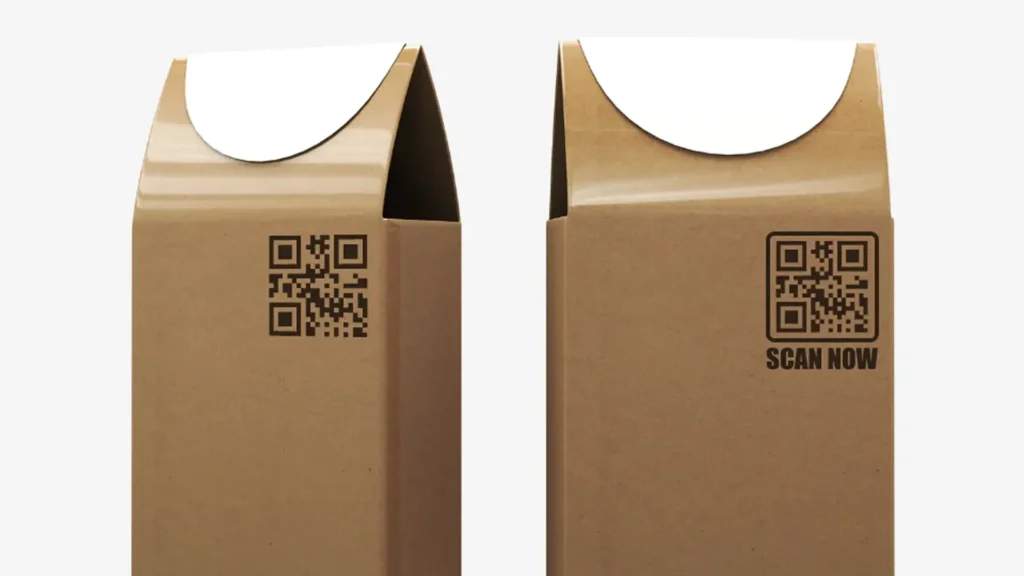
The three failure points above share a common root. Physical products move through the supply chain without a persistent, machine-readable digital identity attached to them. QR Codes provide that identity.
A single scan, instant context
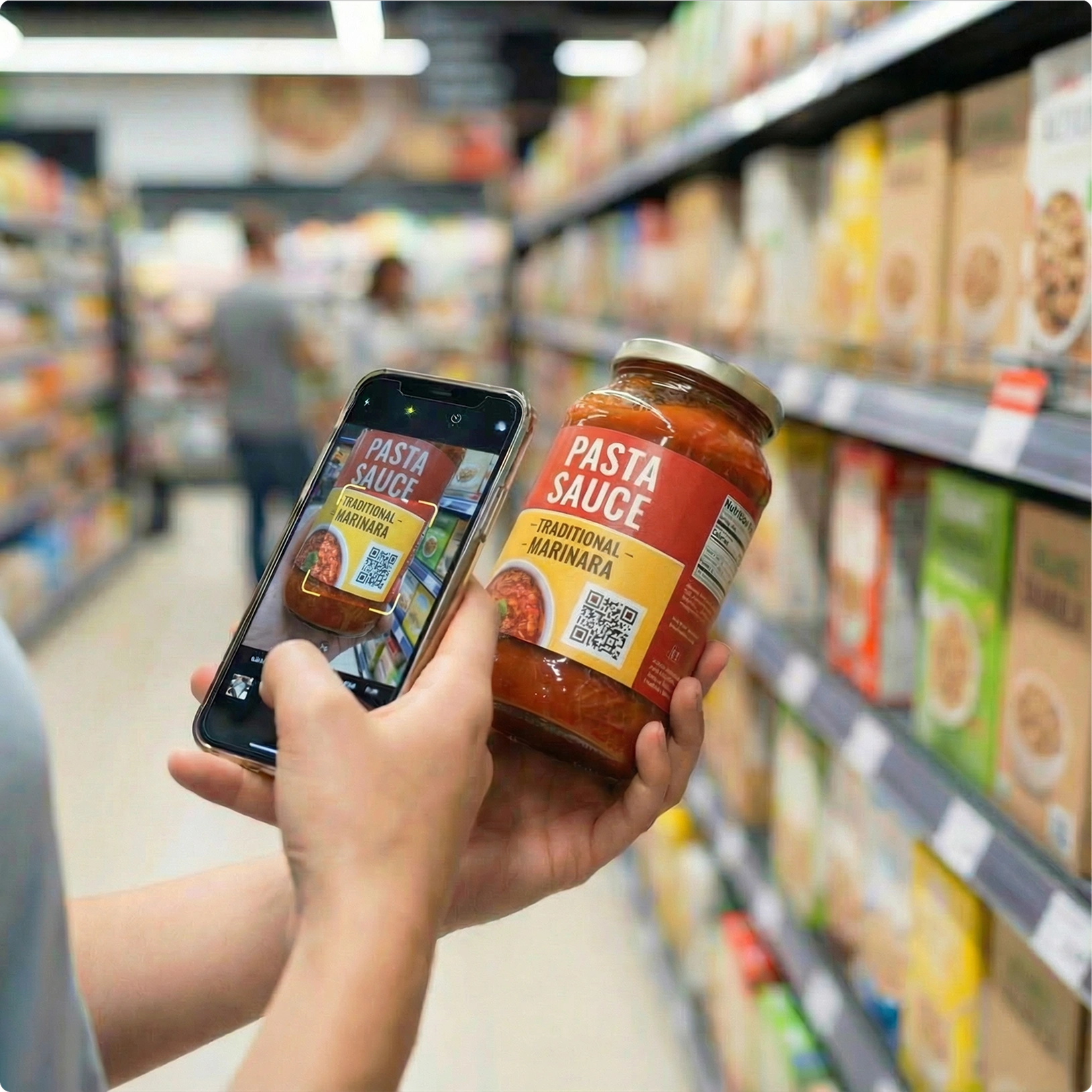
A stable QR Code or barcode tied to a lot or pallet can resolve to a digital record that contains shipment metadata, certificates, packing lists, and traceability lot codes. A dock worker or auditor can access the full context in seconds.
Event capture along the flow
QR Codes turn passive handoffs into recorded supply chain events. A scan at warehouse receiving captures a timestamp, a location, and device details. A scan at a third-party logistics checkpoint captures another. A scan at the retail dock captures a third. Each scan builds the chain of custody that both FSMA 204 and retailer programs require without relying on manual data entry.
Bridging systems without replacing them
QR Code-based links act as an execution layer that sits above ERPs and WMSs. The source systems remain authoritative, but the QR Code becomes the practical interface that surfaces and aggregates the needed data.
Reducing human error
Machine-readable labels reduce manual transcription errors and mismatches, improving the completeness and reliability of tracebacks.
Future-proofing for dual timelines
A QR Code system that meets retailer requirements today will also satisfy the FDA’s 2028 requirements, giving you one solution for both timelines.
Bulk generation connects QR Codes directly to production systems. API-driven QR generation connects to existing ERP, WMS, or production systems, so a new lot number automatically triggers a new QR Code at scale.
In short, QR Codes make lot-level traceability usable at scale.
How Uniqode helps CPG brands get audit-ready
Uniqode is a QR Code platform that connects physical products to traceability records at the lot, batch, or pallet level. Each Uniqode QR Code links to a Linkpage, a digital page that serves as the single access point for all compliance documents, shipment metadata, and traceability records tied to that lot.
One scan, one record, every touchpoint
Every scan of a Uniqode QR Code at receiving, packaging, or shipping ties back to the same Linkpage, building the traceability record as events happen across the supply chain rather than retroactively during an audit. QA and compliance teams retrieve complete lot-level records from one system when a retailer or the FDA requests traceability data.
Scan analytics as audit evidence
Every Uniqode scan automatically records a timestamp, GPS location, and device details. QA teams gain visibility into whether traceability handoffs occur at distribution centers, logistics checkpoints, and retail receiving gates. Scan analytics data serves as independent audit evidence that events were captured at the point of transfer.
Enterprise governance and integrations
Uniqode manages all QR Codes and traceability workflows from a single dashboard with role-based access controls and GDPR and SOC 2 Type 2 compliance for data handling.
Uniqode integrates with Google Analytics, Zapier, Salesforce, Slack, and other platforms. Traceability data flows into existing reporting and compliance workflows without requiring new system adoption.
Uniqode enables QA teams to produce complete lot-level traceability records from one system within 24 hours of a request, covering both timelines with a single implementation.
Don’t wait for 2028 — your retailers aren’t
The federal extension offers time, but most CPG brands cannot use it. If you sell to major retailers, your deadline is already here. QR Codes provide a machine-readable bridge between physical products and digital records that captures events as they happen.
Uniqode helps food safety teams stop scrambling during audits and start keeping traceability data ready whenever it is needed. Build once to meet retailer requirements today, and you will be positioned for FDA compliance in 2028.
Ready to see how Uniqode can help your team get audit-ready for both timelines? Book a call with us.
Frequently Asked Questions
- What is the difference between FDA and retailer traceability requirements?
While the FDA's FSMA 204 deadline extends to July 20, 2028, major retailers are enforcing immediate compliance with deadlines already in effect. Retailers like Walmart, Albertsons, and Kroger require traceability for all food products (not just those on the FDA's Food Traceability List), creating two parallel compliance regimes that CPG brands must navigate simultaneously.
- What are Critical Tracking Events (CTEs) in food traceability?
Critical Tracking Events (CTEs) are specific moments in the supply chain where FSMA 204 requires companies to record traceability data, including harvesting, packing, shipping, and receiving. Companies must capture lot-level information at each CTE to demonstrate exactly which batch or production run moved through each stage and maintain these records for rapid 24-hour retrieval.
Related Posts
How CPG Brands Use QR Codes on Packaging
Louisiana SB 14 Requires QR Codes on Food Packaging
What Expo West 2026 Taught Us About the Future of CPG (And Why Your Packaging Is at the Center of It)
Reduce Customer Support Calls with Product QR Codes: A Complete Guide for Brands
How to Drive App Downloads from Product Packaging Using QR Codes