QR Code Printing: Sizes, File Formats, and Materials (2026)
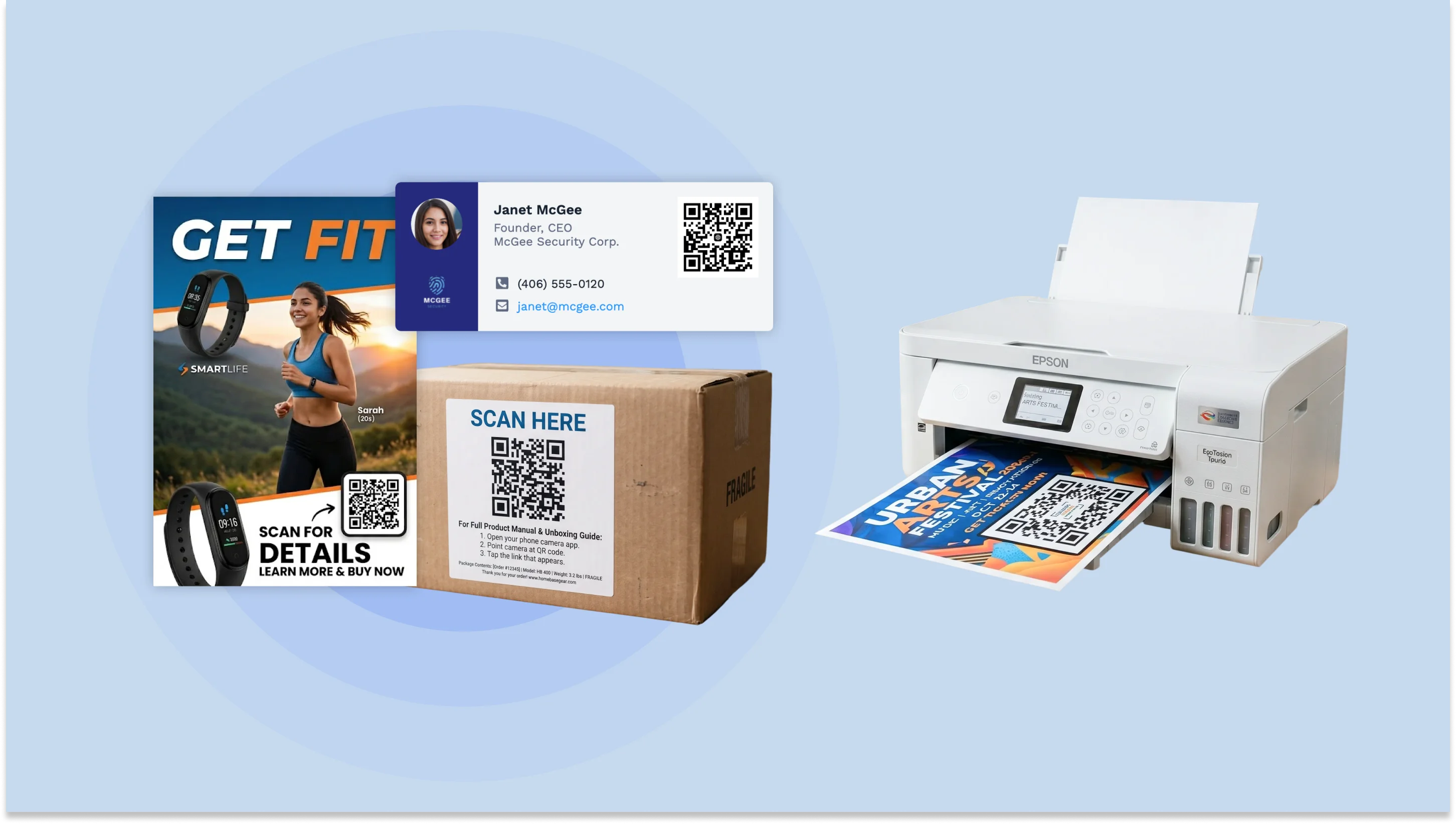
Trace the complete journey of QR Code high-resolution printing, right from creation, and design, to printing and implementation. Learn more about the multiple use cases of high-resolution printing.
TL;DR:
- Export QR Codes as vector files (SVG or EPS), set error correction to M or higher, and maintain at least a 4:1 contrast ratio.
- Size using the 10:1 rule: divide scanning distance in inches by 10. Add 20-30% for real-world conditions.
- Use dynamic QR Codes for any print material with a shelf life beyond a single campaign. They scan better at small sizes and let you update the destination without reprinting.
QR Codes show up on everything from business cards to billboards. But printing a code that actually scans requires more than hitting the right size. The file format, error correction level, color contrast, and quiet zone all play a role.
This guide walks through the full print workflow for QR Codes. You will learn the five requirements for a scannable code, the right size for every format, which materials need special treatment, and what to do when a printed code stops working.
How to print a QR Code correctly (step-by-step)
Creating a printable QR Code starts with choosing the right generator. You need one that lets you export vector files, set error correction levels, and edit the destination URL after printing. Uniqode's QR Code generator supports all three. Below are five steps to create a print-ready QR Code.
Step 1: Choose a QR Code type
Choose a dynamic QR Code if the material will have a shelf life beyond a single event. If you are printing more than a handful of codes, choose the Bulk Create option. Enter where your QR Code will point to.
Step 2: Customize your QR Code
Customize your QR Code by adding brand colors and logo or adjusting the shape. You can also use the existing templates.
Step 3: Export as SVG or EPS
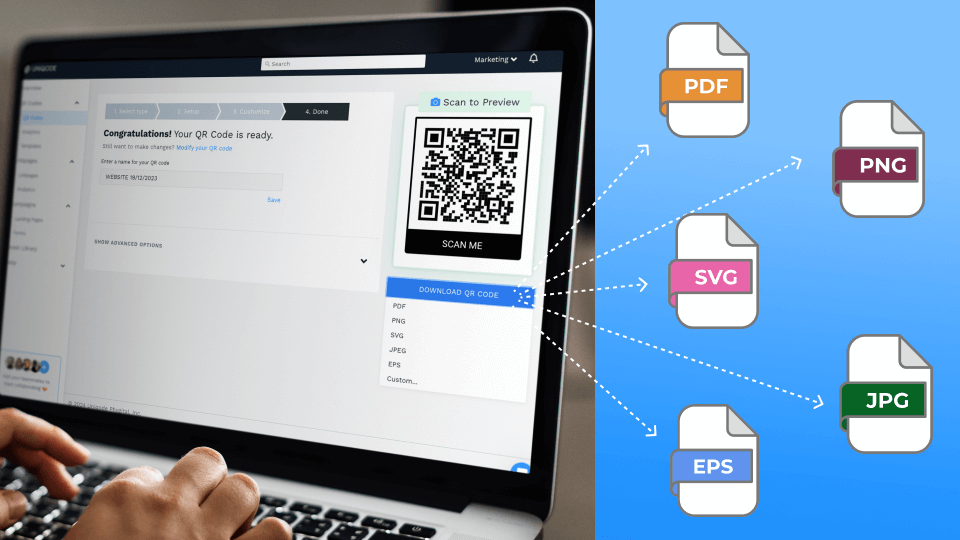
Download the QR Code as a vector file: SVG or EPS. Do not screenshot the code from a preview screen or copy-paste it from a browser window.
Step 4: Verify the color mode
If your design file is in RGB, convert to CMYK before sending to print. This will ensure better contrast and improve scannability. After conversion, check the contrast between the code's foreground and background. The minimum for reliable scanning is a 4:1 ratio.
Step 5: Size the code for scanning distance
Use the 10:1 formula: scanning distance (in inches) divided by 10 equals minimum code size. Check the reference table in the next section for your specific format. Add 20-30% to the minimum if the material will be in poor lighting, on a curved surface, or scanned by a wide range of devices.
Step 6: Test a physical proof before the full run
Scan the QR Code from a printed material, not just your screen. Use at least three devices: a current iPhone, a current Android phone, and an older model (2-3 years old). Scan at the distance the final audience will actually use. If any device fails, stop and diagnose before printing the full run.
Should you print a static or dynamic QR Code?
For most print use cases, dynamic QR Codes are the better choice. A static code encodes the full destination URL directly into the pattern. Once printed, it cannot be changed. If the URL breaks, the page moves, or the campaign ends, the only fix is a reprint. For a dynamic QR Code, you can update the destination URL without reprinting the material.
Here’s why printing dynamic QR Codes is the best choice:
- Longer shelf life. Print materials last months or years. A brochure, product label, or magazine ad might be scanned long after the campaign has ended. Dynamic codes keep these working because the destination stays current even as the material ages.
- Flexible timelines. Print deadlines often arrive before the landing page or campaign URL is finalized. With a dynamic code, teams can send materials to the printer with a placeholder URL and update the destination later.
- Fewer reprints. According to Uniqode's State of QR Codes 2026 report, 28% of marketers report a significant reduction in printed material waste after switching to dynamic codes. Another 45% report some reduction in reprints.
Static QR Codes work well for one-time use cases where the URL will never change and scan tracking is not needed. A Wi-Fi login code or a vCard QR Code are good examples.
For anything with a shelf life beyond a single event, go with a dynamic QR Code generator like Uniqode that lets you edit destinations, track scans, and export the QR Codes as vector files.
Printing QR Codes at scale: stickers, labels, and dedicated printers
Once your QR Codes are set up correctly, the next question is how to produce them. The right method depends on the volume, the use case, and how often the materials change.
- Custom QR Code stickers are the fastest option for events, product packaging, and short-run promotions. Order them from a print vendor in bulk with your QR Code design already applied. They work well on surfaces where direct printing is not practical, like glass, existing packaging, or merchandise. Make sure the vendor prints from your vector file (SVG or EPS) and not from a screenshot.
- Standard commercial printers (digital or offset) are the best fit for marketing collateral like brochures, flyers, posters, and direct mail. Most print shops handle QR Codes without issues as long as you supply a vector file in CMYK and follow the size and contrast guidelines in this article.
- Dedicated QR Code or label printers make sense for high-volume, repetitive use cases like warehouse labels, inventory tags, shipping labels, and asset tracking. Thermal label printers are the most common option here. Look for models that support 300 DPI or higher and can print from high-resolution files.
Whichever path you choose, the QR Code itself is the starting point. A platform like Uniqode lets you generate print-ready codes in SVG format, set the right error correction level, and update destinations after printing. Get the code right first. Then pick the production method that fits your workflow.
QR Code size recommendations for various print formats
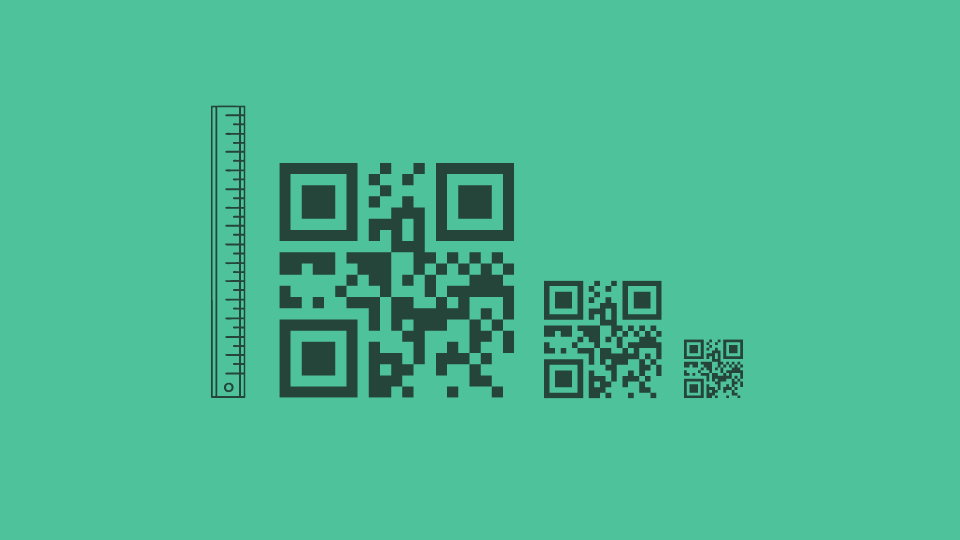
The recommended size of a QR Code is 2 x 2 cm (approximately 0.8 x 0.8 inches). That is the threshold for reliable scanning at arm's length with a modern smartphone. Below that, scanning gets unreliable.
The 10:1 scanning distance rule
The universal formula for QR Code print size is:
QR Code size (in inches) = scanning distance (in inches) / 10
If the code will be scanned from 10 feet away (120 inches), the code needs to be at least 12 inches across. If it will be scanned from arm's length (about 20 inches), it needs to be at least 2 inches. Real-world conditions (poor lighting, textured surfaces, older phone cameras) mean you should add 20-30% to the calculated minimum.
Size reference table by print format
| Print format | Typical scanning distance | Minimum size | Recommended size |
|---|---|---|---|
| Business card | 6-10 inches | 0.6 x 0.6 in (1.5 cm) | 0.8 x 0.8 in (2 cm) |
| Flyer or brochure | 10-14 inches | 1 x 1 in (2.5 cm) | 1.2 x 1.2 in (3 cm) |
| Product label | 8-12 inches | 0.8 x 0.8 in (2 cm) | 1 x 1 in (2.5 cm) |
| Magazine ad | 12-18 inches | 1.2 x 1.2 in (3 cm) | 1.5 x 1.5 in (4 cm) |
| Poster (A2/A1) | 3-6 feet | 3 x 3 in (8 cm) | 4 x 4 in (10 cm) |
| Banner or trade show display | 4-8 feet | 5 x 5 in (13 cm) | 6 x 6 in (15 cm) |
| Billboard or banner | 15-30+ feet | 18 x 18 in (46 cm) | 24 x 24 in (61 cm) |
QR Code printing materials: what works on paper, vinyl, metal, fabric, and glass
The surface you print on affects whether your QR Code scans reliably. Here is what to know for each material.
- Printing QR Codes on paper and cardboard work best with matte or uncoated stock. Glossy finishes cause glare, so increase code size by 15-20% if glossy is required. On corrugated cardboard, go 25% larger and use error correction Q or H. For magazines and catalogs, always use dynamic codes since the printed code will likely outlive its original URL.
- Vinyl and plastic need matte lamination, UV-resistant ink, and error correction H for outdoor use. Plan to replace or re-laminate every 12-18 months, depending on sun exposure.
- Metal and aluminum require laser etching, anodized printing, or vinyl overlay. Laser-etched codes have lower contrast, so increase size by 30-40% and use error correction H. Always test on the actual surface finish.
- Fabric and textiles need a minimum code size of 2 inches (5 cm). The weave texture breaks up fine modules, so use dynamic codes with fewer modules and error correction H. Test on the actual fabric before the production run.
- Glass and acrylic lose contrast when the background behind them changes. Add an opaque backing or vinyl overlay to stabilize it. For frosted glass, test under both backlit and front-lit conditions.
When printed QR Codes don't scan: diagnosis and fixes
If a printed QR Code isn’t working, check out these four ways to troubleshoot it.
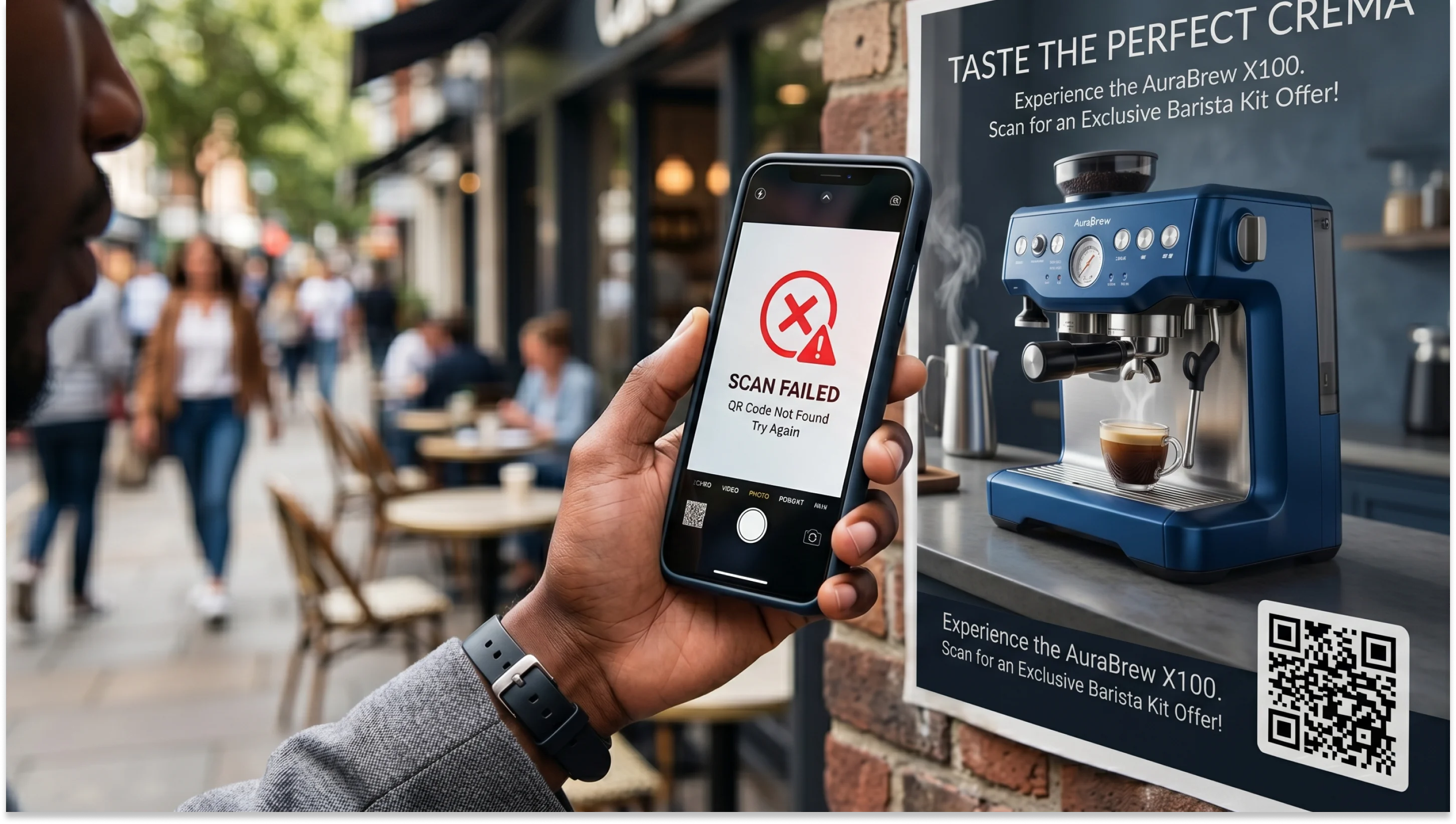
- The code does not scan at all. If your phone camera doesn’t scan a QR Code, the reason is a broken file format (a raster file enlarged past its resolution or a screenshot used instead of the original), or design elements invading the quiet zone. Re-export the code as SVG from the original generator and replace it with proper spacing. If the code looks pixelated, see the guide on blurry QR Codes for detailed diagnosis.
- The code scans but loads a dead or wrong page. This is the most expensive failure because it happens after the print run is distributed. The cause is almost always a static QR Code whose destination URL has changed after printing. The fix is switching to dynamic codes so the QR Code destination can be updated without reprinting.
- The code scans slowly or intermittently. The QR Code is too small for the scanning distance, the data density is too high, or the error correction level is too low for the surface. Reprint larger, switch to a dynamic QR Code with a shorter URL, or increase error correction to H.
- The code works on screen but fails on print. This means the export chain broke. Someone screenshotted the code, pasted it into Canva or PowerPoint, and exported to PDF. Each step re-rasterizes the image and degrades the edges. Always place the original vector file directly into the print-ready design file.
Where should QR Codes be placed on printed materials for the best scanning results?
QR Codes should be placed at eye level (approximately 5 to 6 feet high for standing adults) on printed materials to achieve optimal scan rates, with studies showing this placement increases engagement by up to 80%.
On product packaging and marketing collateral, position the QR Code in the lower right or center area where it's naturally visible without requiring the material to be rotated. Businesses that create custom signs for retail stores, trade shows, events, and wayfinding applications should also consider viewing distance, sign placement, and surrounding design elements to ensure QR Codes remain accessible and scannable. Always include at least 4 times the QR Code's width as white space (quiet zone) around all edges. For a 2-inch QR Code, this means a minimum 0.5-inch border, to prevent scanning failures.
Pre-print checklist for QR Codes
Run through the five checks below before every print job.
- File format: Is the QR Code saved as SVG or EPS? If you only have a PNG, re-export from the original generator.
- Color mode: Is the design file in CMYK? After converting from RGB, does the code's foreground-to-background contrast still meet the 4:1 minimum?
- Size: Does the code size pass the 10:1 formula for the intended scanning distance? Have you added 20-30% margin for real-world conditions?
- Error correction: Is the error correction level set to M or higher? If the code will be on a textured surface or outdoors, is it set to H?
- Physical proof: Have you scanned the printed proof with at least three devices, in at least two lighting conditions, at the actual intended scanning distance?
Print QR Codes that last
Dynamic QR Codes give you the flexibility to update destinations, track scans, and avoid reprints when campaigns change. The print workflow and the digital workflow do not need to run on the same timeline.
Uniqode lets you create print-ready QR Codes in SVG format, set error correction levels, customize with brand colors, and manage destinations after printing.
Frequently Asked Questions
- 1. What is the minimum size for printing a QR Code?
The minimum recommended size is 2 x 2 cm (approximately 0.8 x 0.8 inches) for reliable scanning at arm's length. For longer scanning distances, use the 10:1 rule: divide the scanning distance in inches by 10 to get the minimum code size in inches. A code scanned from 10 feet away needs to be at least 12 inches across. Always add 20-30% to the calculated minimum for real-world conditions.
- 2. What file format is best for printing QR Codes?
SVG or EPS. Both are vector formats that scale to any size without losing clarity. A vector QR Code exported at 72 DPI prints as crisply on a billboard as it does on a business card, because vector files store the code as paths rather than pixels. PNG and JPG are acceptable only for small-format prints (business cards, stickers) where the source resolution is high enough that no enlargement is needed.
- 3. Should I use a dynamic or static QR Code for printing?
Dynamic for anything with a shelf life beyond a single event or campaign. Dynamic codes encode a short redirect URL, which makes the code pattern less dense and easier to scan at small sizes. The destination URL can change after printing without reprinting. Most dynamic QR Code plans include this capability, which eliminates the most expensive print failure: a code that scans but leads to a dead page. Static codes are fine for one-time uses where the URL will never change and scan tracking is not needed.
- 4. What contrast ratio do I need for a scannable QR Code?
A minimum of 4:1 between the foreground (the code modules) and the background. The code should always be darker than the background. Black on white provides approximately 21:1 contrast and scans under virtually any condition. When using brand colors, check the contrast ratio after CMYK conversion, not just in the RGB design file. Online contrast checkers (designed for web accessibility) work for this purpose.
- 5. Where should QR Codes be placed on printed materials?
At eye level (approximately 5-6 feet) on posters and signage. On product packaging, place the code where it is visible without rotating the package. On printed collateral (brochures, flyers), place it on the front cover or the most prominent interior page. Leave a quiet zone of at least 4 modules (about 10-15% of the code's width) on all sides. Do not place the code near the fold of a booklet or overlap any other design element.
- 6. Can I update a QR Code after it has been printed?
Yes, if it is a dynamic QR Code. Dynamic codes point to a short redirect URL, and the destination behind that redirect can be changed an unlimited number of times without altering the printed code. This is the primary reason print-heavy teams use dynamic codes: the QR Code and the content it links to do not need to be finalized at the same time. If the code is static (encodes the full destination URL directly), it cannot be changed after printing.
- 7. What happens when I run out of dynamic QR Codes on my plan?
You do not need to delete codes to make room. Set up custom error pages so that deactivated codes redirect to something useful rather than showing a 404. Use time-based rules to auto-expire event codes after the event date passes. Review active codes quarterly and repurpose old codes by pointing them to current campaigns. Most teams find they have more active codes than they realize, and a quarterly audit frees up capacity without losing scan data.
Related Posts
QR Code Formats: File Types, Structural Formats, and What Each One Actually Means
Blurry QR Code: Why It Happens and How to Fix It

Where to Place QR Codes for Maximum Engagement
QR Code Minimum Size Guidelines: How Small Can a QR Code Be?