
Hotel Sustainability and Revenue: What a 2026 Industry Report Found

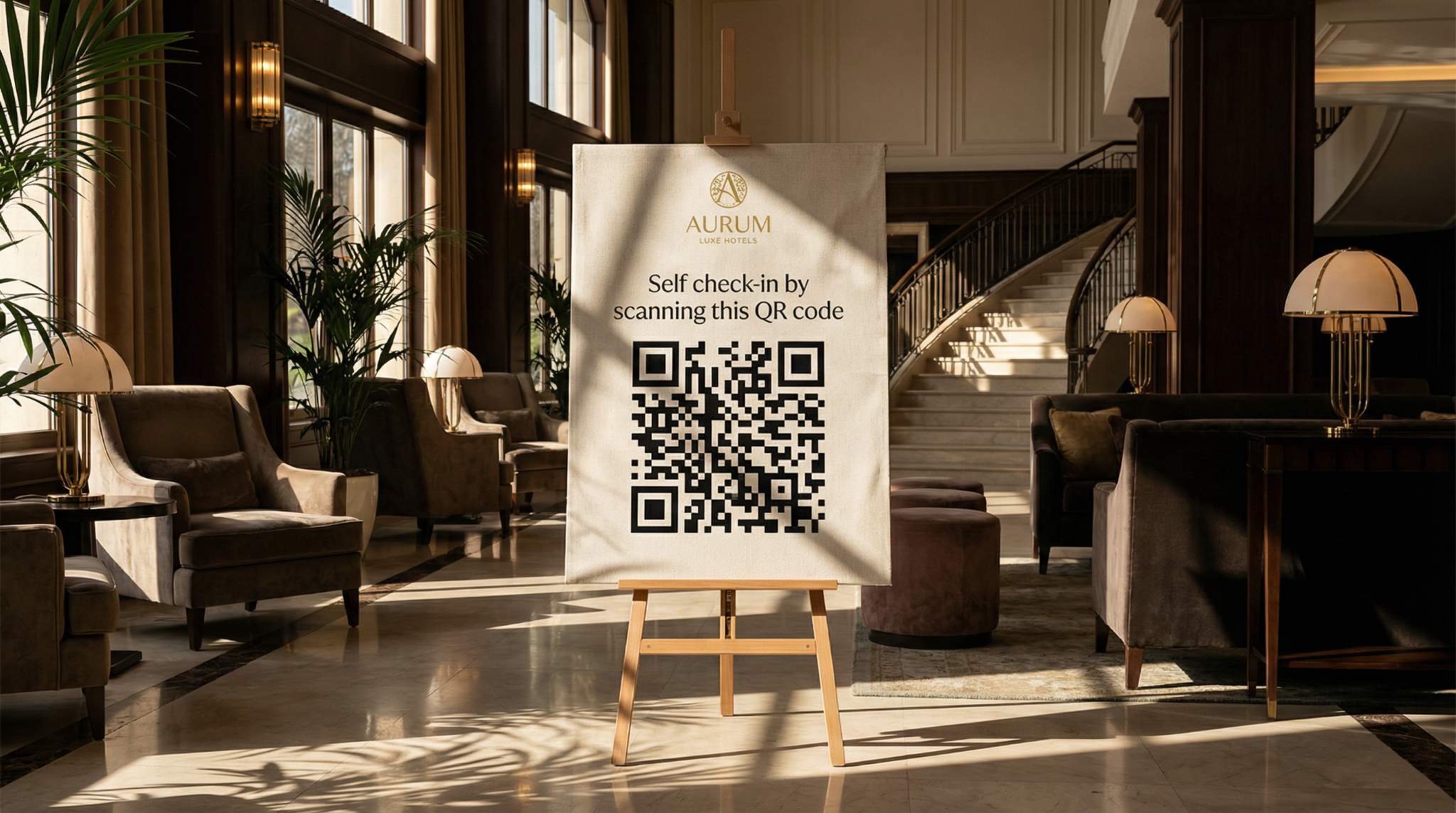
Greenwashing in hospitality is rarely deliberate, it's a documentation gap between what a property claims and what it can prove. Case in point — Booking.com's "Travel Sustainable" program got pulled after Dutch regulators ruled the label unsubstantiated. The Hotel Sustainability Playbook from Uniqode provides a three-tier framework fix for sustainability. Read more in this blog
Sustainability stopped being a hotel's side project the moment it became a booking filter. Eco-certified properties now see up to 24.5% higher booking share than uncertified competitors, and travelers say they'll pay a premium to stay somewhere with credible environmental credentials.
Uniqode's 2026 report, Sustainability in Hospitality: The Operational Playbook for Hotels, digs into what's driving that shift, where hotels lose guest trust by overclaiming, and how going paperless is one of the rare sustainability investments that pays for itself through reduced operating costs and first-party guest data. The gap between what properties are doing and what they communicate is where revenue quietly leaks to competitors. This report addresses that gap directly.
Key takeaways
- Eco-certified hotels see up to 24.5% higher booking share and travelers report willingness to pay a 5% premium for eco-certified stays, but the report's real warning is about the gap between what properties do and what they say.
- 67% of travelers say they've encountered misleading environmental claims during a hotel stay. Greenwashing risk usually comes from a documentation gap between what was claimed and what can be verified.
- A three-tier framework (quick wins, operational investments, structural commitments) gives any property, regardless of ESG budget, a place to start and a way to build credibility in sequence.
- Specific, dated, measurable claims outperform vague ones. "We eliminated 40,000 single-use plastic items" converts better at the booking stage than "we're committed to sustainability."
- Going paperless is the report's most measurable recommendation: the Marriott Aruba case study alone produced 150,000 QR Code scans, 80,000 unique guests reached, and roughly $150,000 in printing costs saved from one property.
- Sustainability claims need to show up at three separate moments in the guest journey (pre-stay, in-stay, post-stay).
Why sustainability now moves RevPAR, not just reputation
The numbers the report leads with are specific: eco-certified hotels see a 24.5% increase in booking share compared to uncertified properties, and travelers report willingness to pay a 5% premium for eco-conscious accommodation. Sustainable properties reportedly achieve 12% higher ADR and 23% better occupancy.
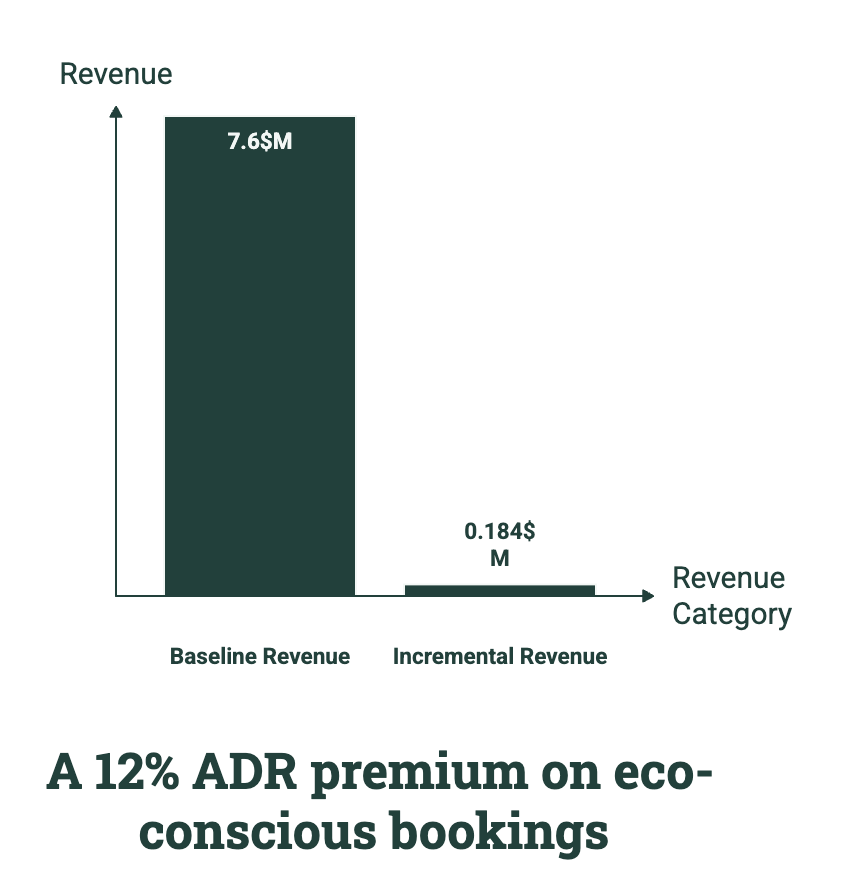
Consider a 150-room property operating at 70% occupancy with a $200 ADR. Annual room revenue is roughly $7.6 million. For the estimated 20% of bookings from eco-conscious guests, a 12% ADR premium adds approximately $184,000 in additional annual room revenue.
Demand spans every generation. Millennials represent an estimated $200 billion in spending power and 82% say they want vacations with minimal environmental impact, while Gen Z travelers show even stronger preferences for sustainable, experience-driven stays. Baby boomers, meanwhile, are more likely to translate sustainability values into daily behaviors like reducing waste and shopping locally. The opportunity spans the entire guest base.
Pro tip: Any sustainability investment needs a measurable connection to RevPAR to survive a conversation with a CFO. Every initiative in this report is framed around a measurable business outcome for exactly that reason.
The greenwashing trap (and why honest hotels fall into it anyway)
The report's second chapter is a warning most sustainability content skips: greenwashing in hospitality is rarely deliberate. It's usually a documentation gap between a well-meaning claim and the evidence needed to defend it. A marketing team describes a pilot program as if it were company-wide, or promotes an aspirational goal as a current achievement.
That gap is expensive. According to the report, 67% of travelers have encountered misleading environmental claims during a hotel stay, and when a claim doesn't hold up, guests start questioning the brand. That shows up in OTA reviews, loyalty enrollment, and repeat bookings.
In March 2024, the Netherlands Authority for Consumers and Markets ruled that Booking.com's "Travel Sustainable" program was a possibly misleading claim, since the underlying label wasn't sufficiently substantiated. Booking.com discontinued the program and shifted toward third-party certifications instead. The lesson is that sustainability claims now require evidence that holds up under regulatory and consumer scrutiny. If one of the largest OTAs in the world couldn't defend a self-assessed sustainability label, individual properties cannot afford to rely on ones they cannot independently verify.
The three-tier framework for real sustainability
The report organizes sustainability into three tiers, ordered by complexity and the trust each one builds.
| Tier | Actions | Guest signal | Marketability |
|---|---|---|---|
| Tier 1: Quick wins | Paper straws, refillable dispensers, linen reuse opt-in, digital receipts via QR Codes | Immediately visible; signals intent at check-in | Tangible, easy to communicate, visible on OTA listing |
| Tier 2: Operational investments | QR Code digital menus, in-room directories, contactless check-in, local sourcing, zero-waste kitchen, energy-efficient room controls | Reduces friction, improves guest experience | Generates measurable data for sustainability reporting |
| Tier 3: Structural commitments | LEED, Green Key, EarthCheck certification; GHG Protocol carbon reporting; wastewater infrastructure | Builds deep, long-term trust | Third-party verified and recognizable to travelers, OTAs, corporate buyers |
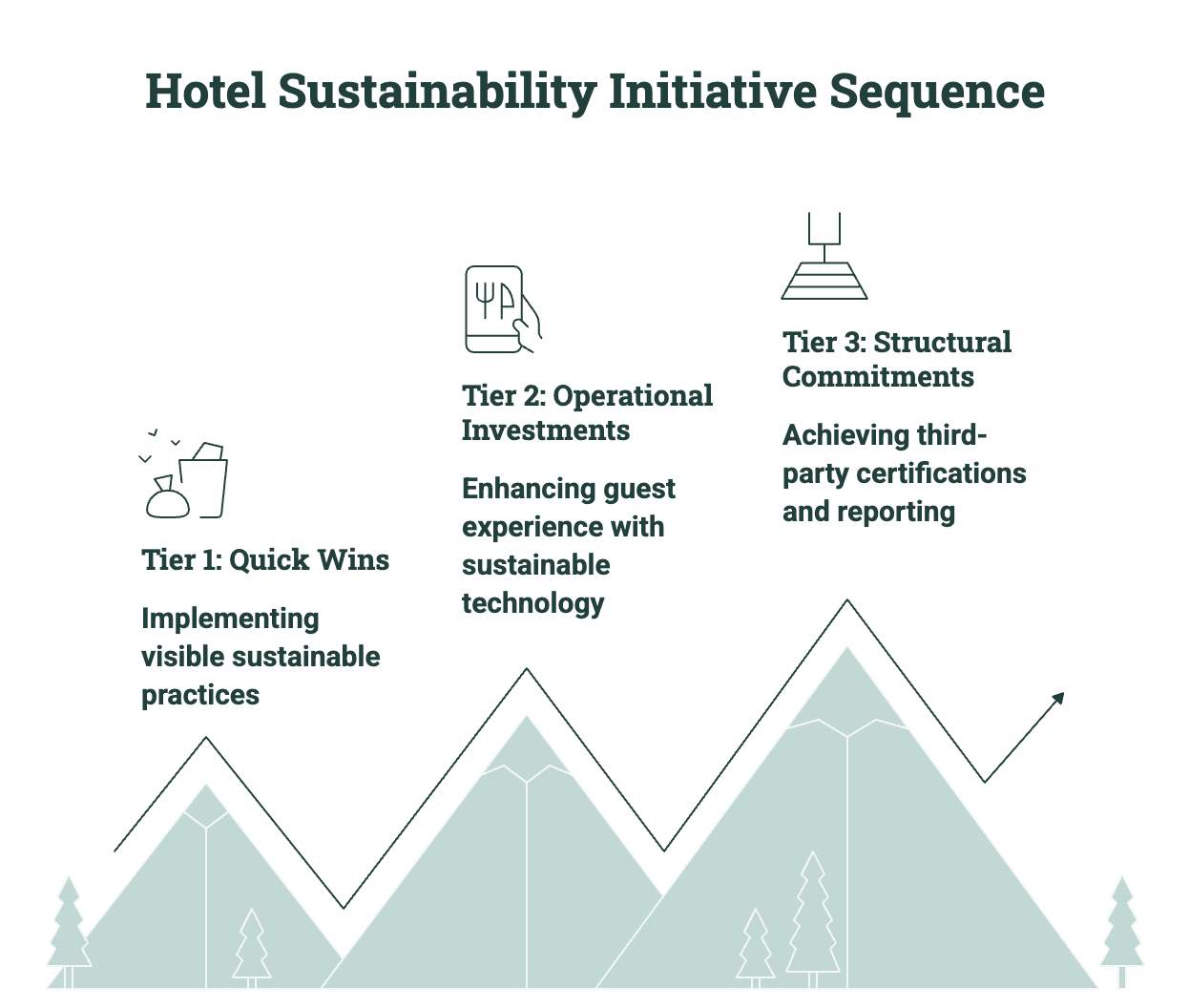
The goal is to start where the property is today and build momentum over time. The properties that succeed convert sustainability initiatives into measurable outcomes and evidence guests can see and verify, regardless of ESG budget size.
Green Key comes up repeatedly as the most accessible certification entry point, recognized by the Global Sustainable Tourism Council without the cost and complexity of larger certification programs like LEED.
Measuring and reporting: the six metrics that matter
The report's fourth chapter treats measurement as a competitive advantage most properties leave unused. Six metrics anchor the scorecard:
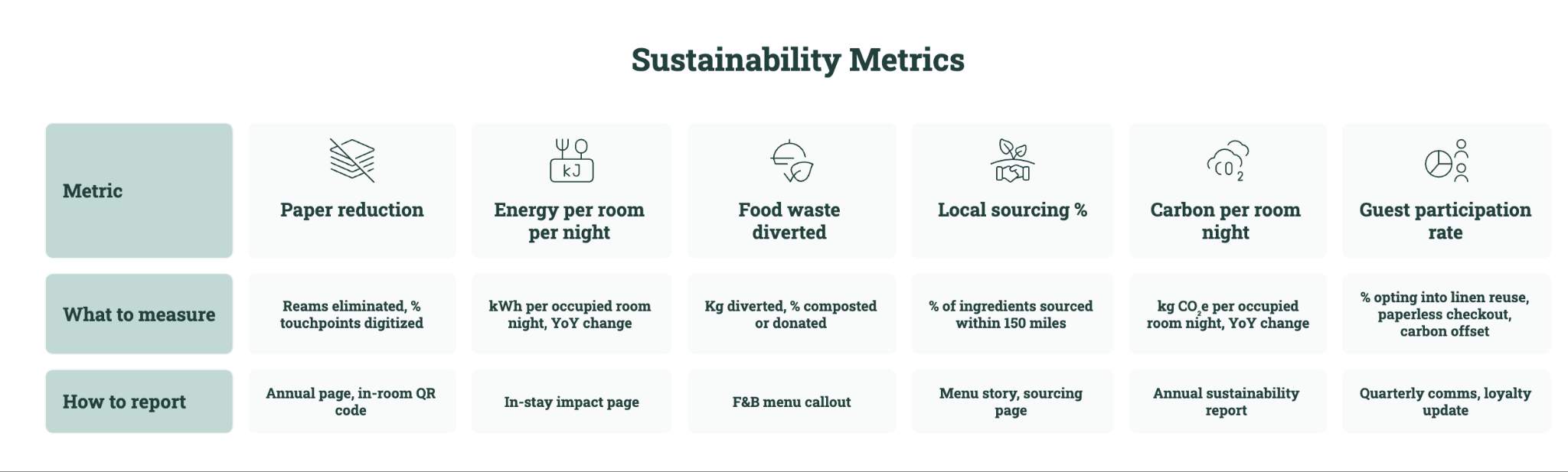
The report recommends anchoring carbon measurement to the Hotel Carbon Measurement Initiative (HCMI), water to the Hotel Water Measurement Initiative (HWMI), and waste to the Hotel Waste Measurement Methodology (HWMM). All three are industry-standard methodologies that make a property's numbers comparable rather than self-defined.
It also breaks reporting into three moments in the guest journey: pre-stay (certification badges on OTA listings, booking-confirmation callouts) to influence the decision; in-stay (QR Code impact pages, menu sourcing callouts) to reinforce the experience; and post-stay (impact summaries, loyalty communications) to extend the story past checkout.
How to talk about it without sounding like a press release
Four principles run through the report's communication chapter, and each comes down to the same point: specificity beats sentiment.
- Numbers beat adjectives. "We eliminated 40,000 single-use plastic items last year" outperforms "we're committed to reducing our environmental footprint". The difference matters every time.
- Translate operations into guest impact. "We reduced water consumption by 18%" is a fact. "Your towel reuse saves 18 liters of water per stay" is a story the guest is part of.
- The physical space outperforms the website footer. A QR Code on a dining table linking to a sourcing story is more credible than a paragraph buried in a website footer, because it meets the guest at the moment they're receptive.
- Third-party signals beat self-reported claims. Certification logos displayed at the booking stage are the strongest trust signal most properties already have and the most consistently underused.
| Don't say this | Say this instead |
|---|---|
| We are committed to protecting the environment. | We eliminated 40,000 single-use plastic items across 18 properties in 2026. |
| Our hotel is eco-friendly. | We hold Green Key certification, verified by independent auditors. Scan here to see our full impact report. |
| We care about sustainability. | We reduced food waste by 31% last year — the equivalent of 18,000 meals. Here's how. |
Uniqode's State of QR Codes 2026 report covers 188 million scans across 796,000 QR Codes, including hospitality-specific benchmarks by placement and season.
The paperless property: the report's most measurable win
The report's final chapter makes the case that going paperless is the single most measurable sustainability initiative available to hotels, because it cuts costs, generates first-party guest data, and produces a guest-facing story in one motion. A 150-room property generates paper across menus, in-room directories, event programs, receipts, loyalty forms, and feedback cards. Every one of those carries both a printing cost and a reprinting cost every time something changes.
Uniqode's QR Codes guide for hotels maps the same shift touchpoint by touchpoint. Printed menus can become QR Code digital menus, in-room compendiums become a single QR Code in-room hub, and printed loyalty cards become scan-to-join enrollment with a captured opt-in. Digital menus capture item-level engagement data, while in-room hubs can cover information ranging from Wi-Fi and service requests to local guides. Wi-Fi passwords typed at the front desk become a single Wi-Fi QR Code guests scan without asking staff for the password.
Aruba Marriott Resort deployed Uniqode QR Codes across eight on-property restaurants and multiple guest touchpoints: towel huts, gym schedules, resort maps, and loyalty enrollment. Over one year: 150,000 total scans, 80,000 unique guests reached, and an estimated $150,000 in printing costs saved, most of it from eliminating disposable menu reprints running $0.20–$0.50 per copy across eight restaurants. Dynamic menus updated automatically by mealtime, removing the reprint cycle entirely.
“With Uniqode, we love that we're able to turn away from so many paper flyers, booklets, and signage. We now have everything in one place.” — Noemi Tromp, Marketing Executive, Marriott Aruba
First-party data matters beyond the paper savings. As third-party cookies and OTA data-sharing both tighten, every QR Code touchpoint a property owns, including menus, in-room hubs, and checkout receipts, becomes a proprietary data channel. Uniqode's own research found 83% of consumers are willing to share information after scanning a QR Code when data collection is transparent, and QR Codes generated nearly 27 million scans in hospitality in 2025 alone.
See the sustainability paperwork savings before you commit to anything.
Every step in this playbook feeds the next one. Start with a paper touchpoint audit, display the certifications you've already earned wherever booking decisions happen, and replace one touchpoint with a digital alternative. Measure the outcome, communicate it honestly, and repeat the process.
Frequently Asked Questions
- 1. Does sustainability actually affect hotel revenue, or is it just a reputation play?
The report ties it directly to RevPAR: eco-certified hotels see up to 24.5% higher booking share, a reported 12% higher ADR, and 23% better occupancy versus uncertified properties. For a 150-room hotel, that can translate to roughly $184,000 in additional annual room revenue from eco-conscious guests alone.
- 2. What is greenwashing, and how do most hotels fall into it accidentally?
Greenwashing is making an environmental claim that can't be substantiated. Most greenwashing in hospitality stems from a documentation gap: the distance between what a property claims and what it can verify.
- 3. What's the fastest, lowest-cost sustainability win for a hotel to start with?
Replacing paper touchpoints (menus, directories, receipts, feedback cards) with QR Codes. It cuts printing costs immediately, requires no capital project, and generates first-party guest data as a byproduct.
- 4. How should a hotel report sustainability progress without sounding promotional?
Use specific, dated, quantified claims rather than adjectives: 'we eliminated 40,000 single-use plastic items' is more credible than 'we're committed to sustainability.' Communicate across all three points in the guest journey: pre-stay, in-stay, and post-stay.
About the Author
Tanmayee is a Lead Content Marketer at Uniqode, where she covers the intersection of QR Code technology, first-party data, and marketing strategy for industries including CPG and Hospitality. She specialises in turning complex ideas — how brands capture and activate guest data, how a packaging scan becomes a customer relationship — into content that is clear, grounded, and useful for marketers making real decisions. Her work includes contributions to The State of QR Codes 2026, Uniqode's annual report combining insights from over 524 marketers, 1,000 consumers, and 188+ million scans. Outside of work, Tanmayee is most likely reading a book in a park or singing at a venue.