
GS1 Sunrise 2027 Guide for CPG Brands
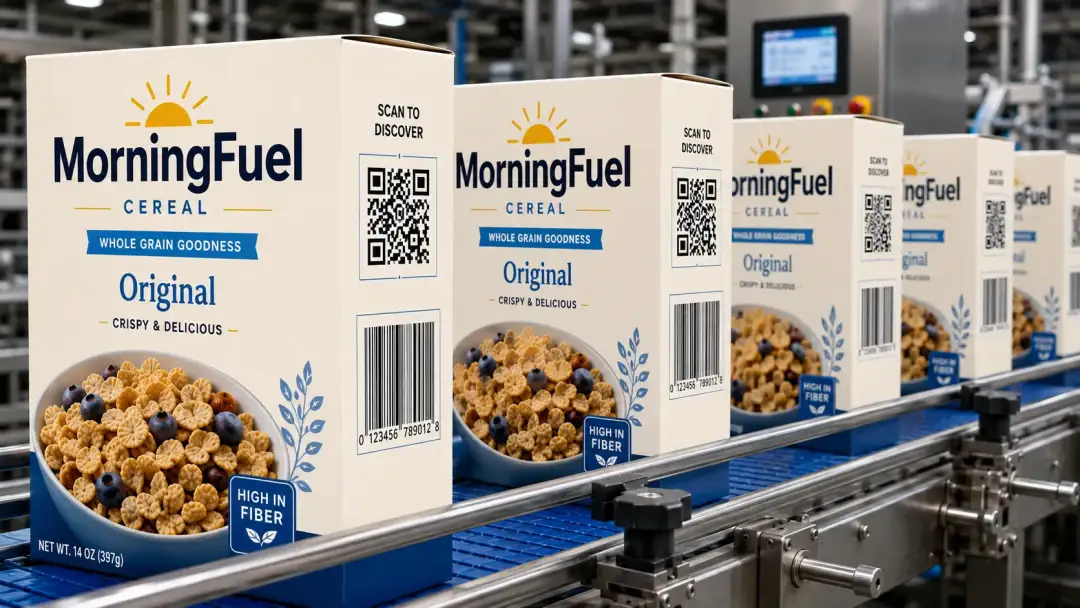
What has to change in your product data, packaging, and retail readiness before retailers switch on 2D scanning.
Read the GS1 Sunrise 2027 eBook
GS1 Sunrise 2027: Why your next print run is the real deadline
A retailer is going to ask about your 2D barcode readiness before Sunrise 2027 rolls around. There's no fine for missing it, but your next packaging print run is the real deadline.
Get your GTIN and QR Code right on that run, and you get an owned growth channel on your packaging. Get it wrong, and you're printing a code a scanner can't read, on a print run you can't undo until the next one.
This guide covers exactly what to lock in before that print run, and what to do with the code once it's compliant.
Key Insights
No fines exist for missing the 2027 deadline. But retailers can set their own timelines.
Inside a GS1 Digital Link URI, your GTIN must be 14 digits. Getting this wrong is what breaks the most implementations.
The 2D code must sit within 50mm of your linear barcode's center to hit retail scan-speed targets. A hard constraint, not a design preference.
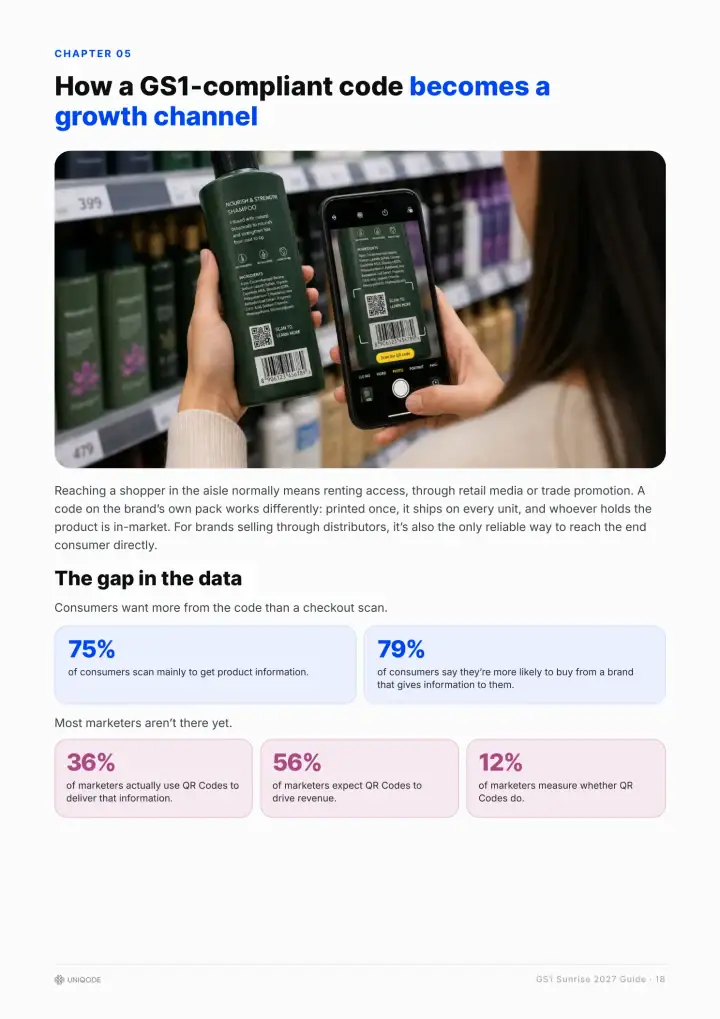
75% of consumers scan QR Codes mainly to get more product information. Only 36% of marketers use QR Codes to deliver it.
No fines exist for missing the 2027 deadline. But retailers can set their own timelines.
Inside a GS1 Digital Link URI, your GTIN must be 14 digits. Getting this wrong is what breaks the most implementations.
The 2D code must sit within 50mm of your linear barcode's center to hit retail scan-speed targets. A hard constraint, not a design preference.
75% of consumers scan QR Codes mainly to get more product information. Only 36% of marketers use QR Codes to deliver it.
Preview what's inside the guide
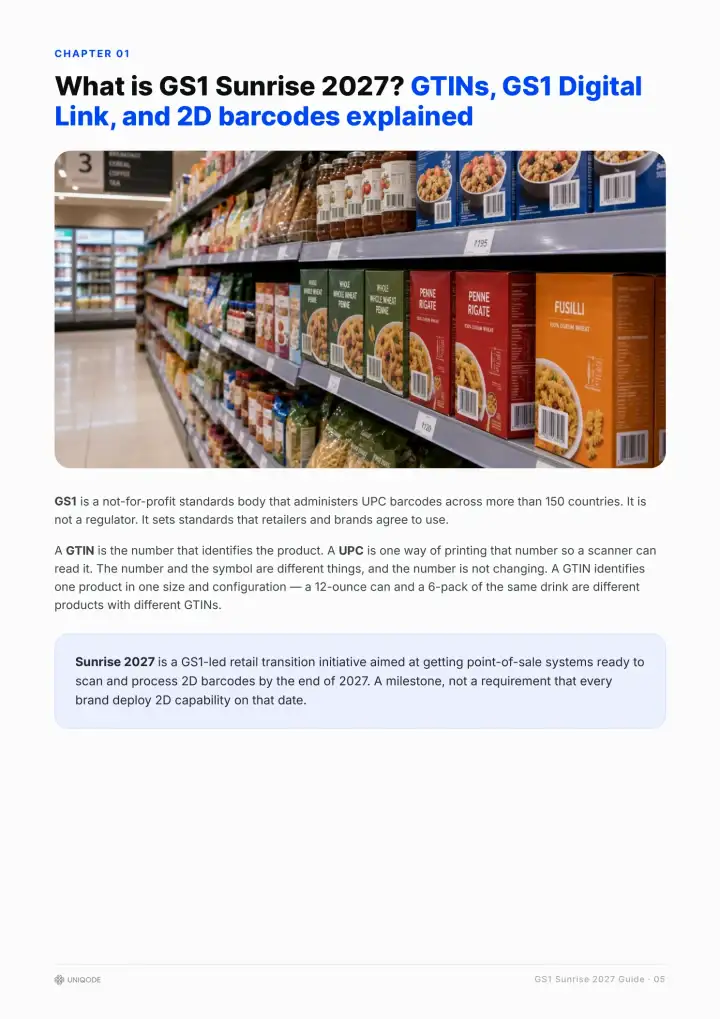
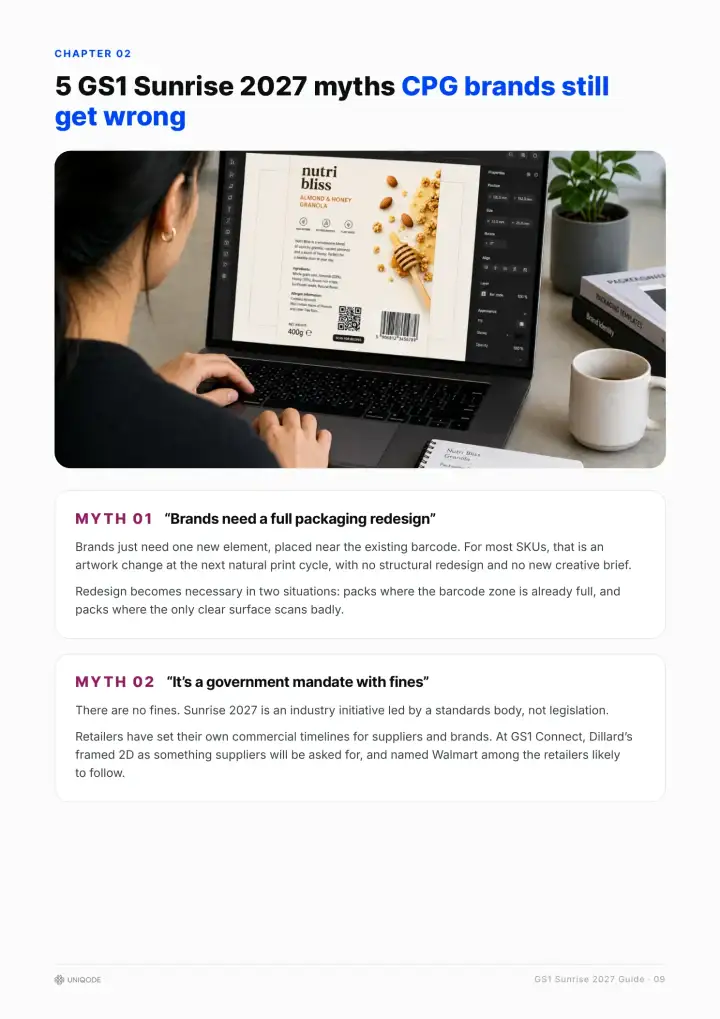
GS1 Sunrise 2027 is the industry milestone for retailers to scan 2D barcodes like the GS1 QR Code alongside your GTIN.
Frequently Asked Questions
A GS1-led industry initiative to get retail point-of-sale systems ready to scan and process 2D barcodes, including QR Codes powered by GS1, by the end of 2027.
GS1 Sunrise is an industry initiative. There is no law and no fine. Individual retailers may still make 2D readiness a supplier requirement on their own timeline.
No. GS1 recommends dual-marking through the transition, with both codes carrying the same GTIN. Retiring the linear barcode depends on scanner readiness across your retail footprint, not on the 2027 date.
A regular QR Code carries a web address. A QR Code powered by GS1 carries your GTIN in GS1 Digital Link syntax, which is what lets a point-of-sale system recognize it as product identity.
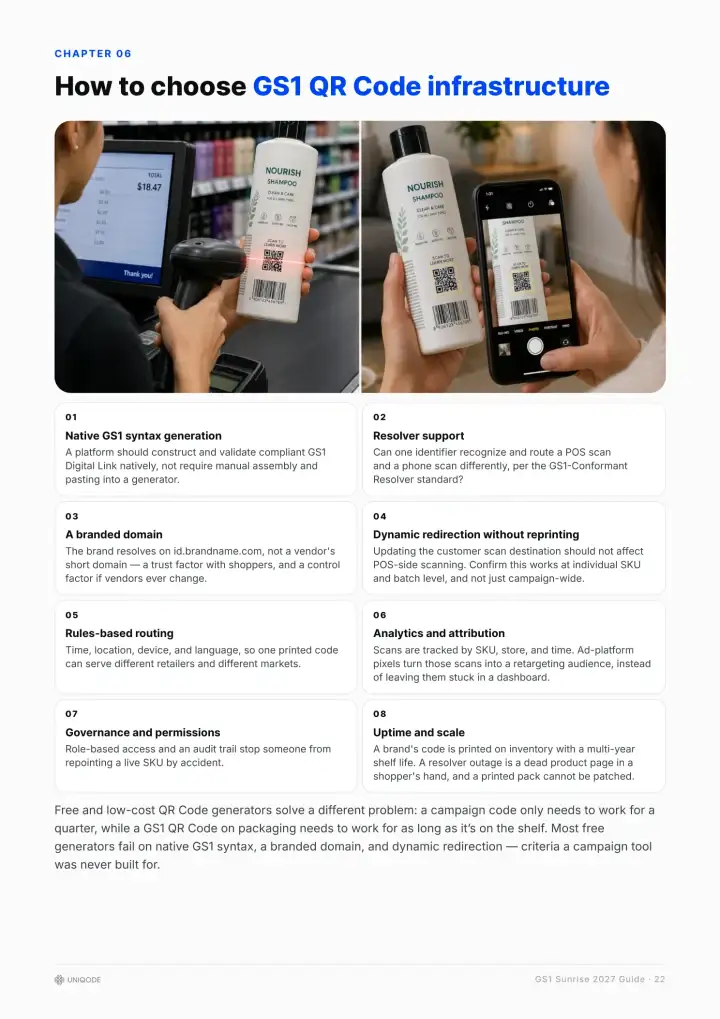
Both scan at POS. Only a GS1 QR Code reliably opens on a shopper's phone camera. For consumer packaged goods, QR Codes are the way to go.
Confirm your GTIN is valid and 14 digits, build a GS1 Digital Link on your own subdomain, generate the QR Code from that URI, place it within 50 mm of your linear barcode, and run barcode verification with graded equipment before print.
You need a GTIN issued through GS1, either as a single number or from a licensed Company Prefix. Barcodes bought from resellers trace back to another company and are widely rejected.
Both a linear and a 2D barcode on pack, encoding the same GTIN, is called dual-marking. Plan on keeping both until scanner readiness across the retailers you sell to makes 2D-only safe.
Batch or lot, serial number, and expiry date are the common additions. All are optional under Sunrise 2027, which requires only that retailers can extract the GTIN.
Not if it was printed as a static code, because the destination is fixed inside the symbol. Existing dynamic codes can be repointed, but the GS1 syntax still has to be encoded in the printed symbol, so a GS1-compliant code means a new print run.
Different origins and obligations. Sunrise is a GS1 initiative with no penalty. The Digital Product Passport is an EU regulation that applies category by category as delegated acts come into force, and it does not yet reach most food, beverage, and household CPG. FSMA 204 is a US FDA recordkeeping rule for listed foods. All three depend on accurate, structured product data, which is why one infrastructure decision can serve them.
Verify with ISO-graded equipment rather than a phone, print a proof on the actual substrate at actual line speed, and test for double scans in a POS environment. GS1's Barcode Capabilities Test Kit is the reference retailers use for their side.
Yes, technically. QR Codes carry built-in error correction, so a centered logo is compensated for by the code's redundancy. The tradeoff is less room to recover from print defects or a scratched pack, so use the highest error correction level available and never let the logo touch the quiet zone. Test on an actual retail scanner before print, not just a phone.
Pick one hero SKU and start there
Generate a compliant QR Code powered by GS1 and learn what shoppers do with it.