QR Code with Custom Domain: What It Is and How to Set One Up
Improve branding and generate more business with the help of Uniqode’s custom QR Code domains. Want to know how? Check out this article to learn more about our custom domain feature.
Key takeaways
- A custom domain QR Code replaces the generic redirect URL, such as qrcodes.pro, with a domain you own, using one DNS CNAME record. No code or server changes are required.
- Changing or removing a custom domain after QR Codes are printed regenerates the QR image and breaks every already-distributed code. Decide the domain and the plan tier before you print anything.
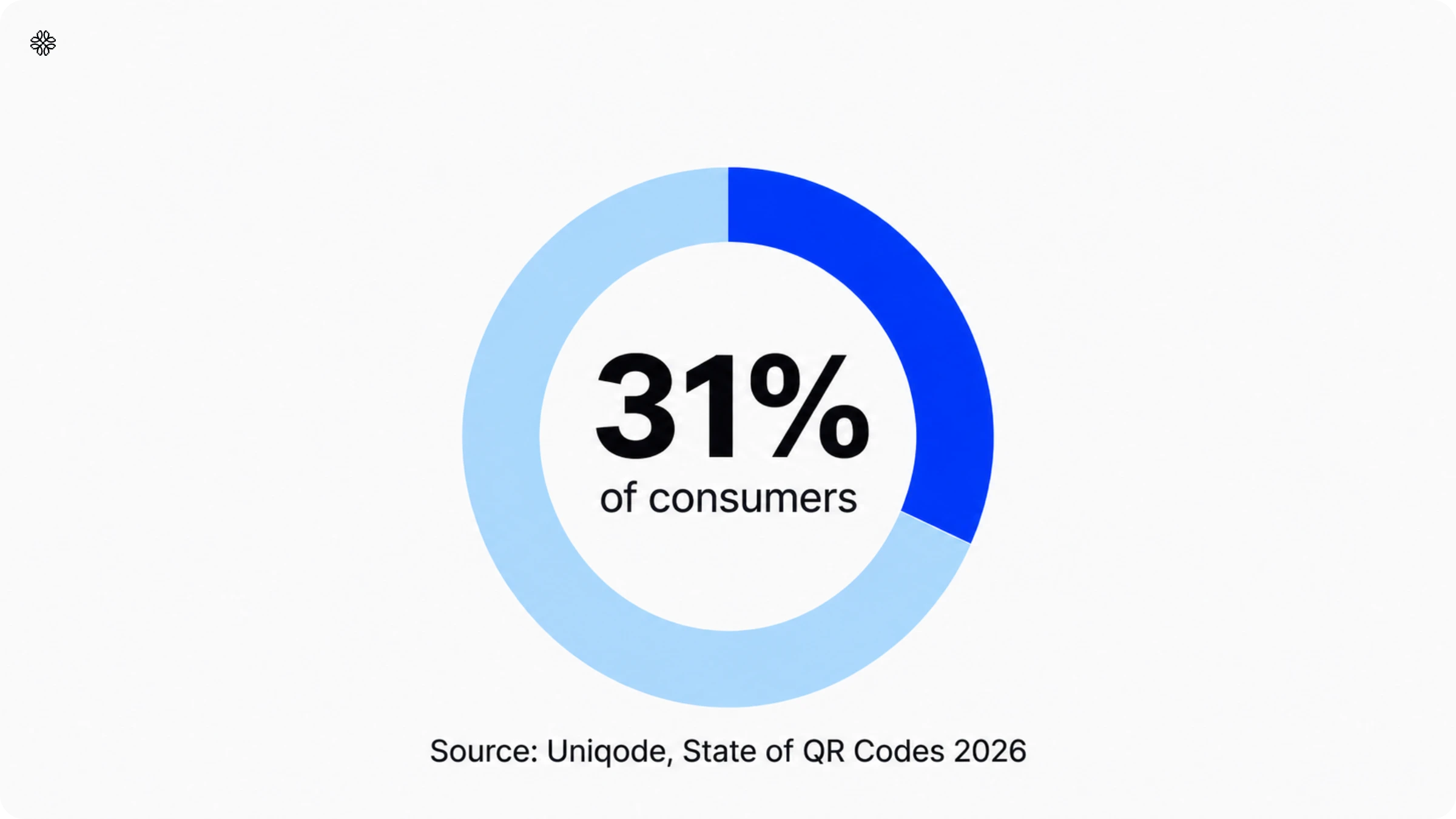
- 31% of consumers say visible branding or a logo is what encourages them to scan a QR Code, according to Uniqode's State of QR Codes 2026 report.
A QR Code with a custom domain is a dynamic QR Code that uses a domain you own, think qr.yourbrand.com, instead of the platform’s default short domain. While most platforms redirect through shared domains like qrcodes.pro or bit.ly, this approach is only suitable for a one-off flyer. The moment that same code appears on packaging, a storefront window, or a patient discharge sheet, trust becomes a concern.
In this article, we will discuss how Uniqode’s custom domain feature helps enterprises scale up, manage campaigns, and improve conversion.
What is a QR Code with a custom domain?
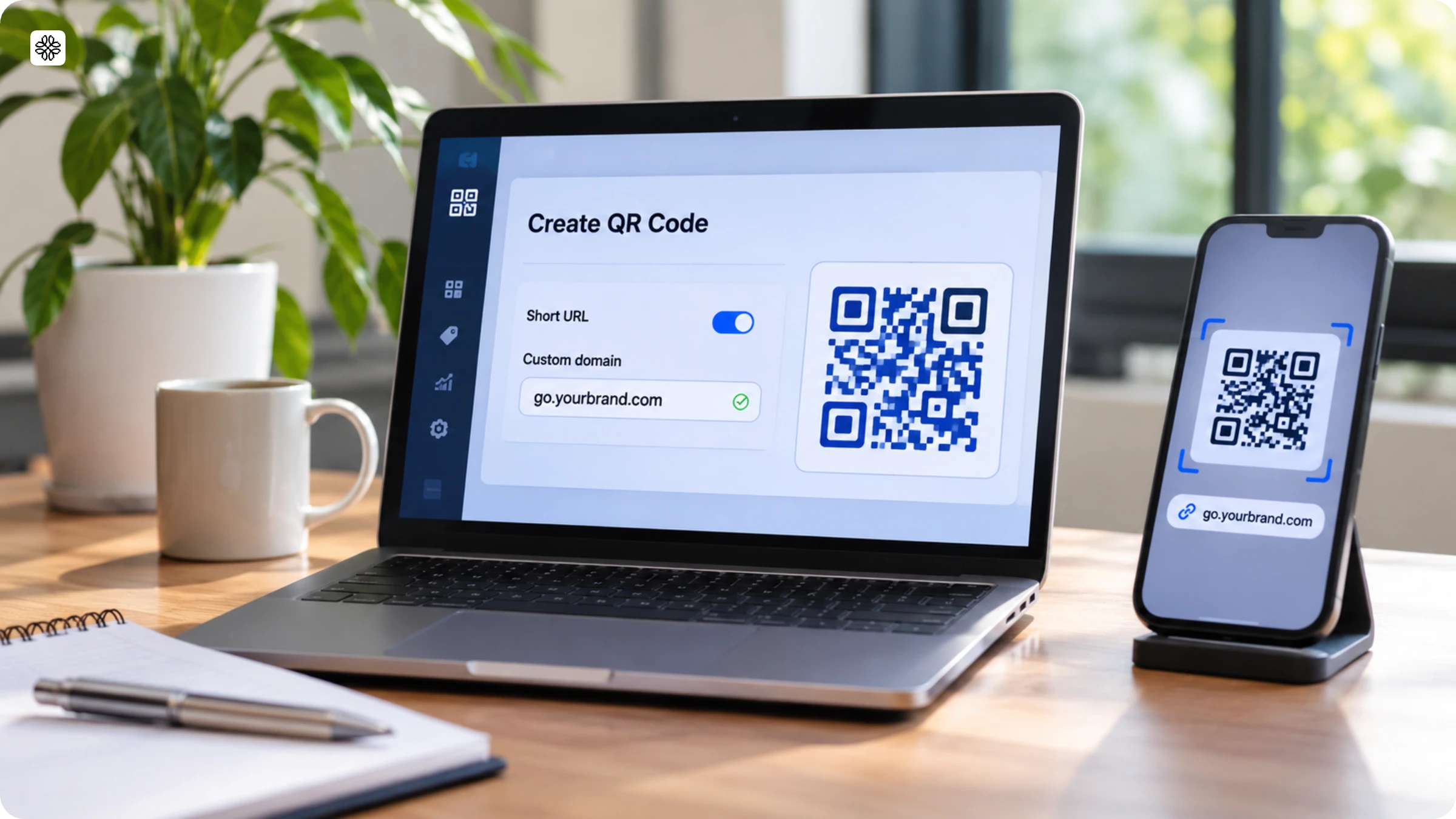
A QR Code with a custom domain is a dynamic QR Code that uses your own domain for its redirect link, rather than the platform’s standard short domain. Instead of a generic prefix like qrcodes.pro, you get to showcase your brand with something like qr.yourbrand.com. This way, every scan reinforces your brand identity, not the platform’s.
It’s important to note that the destination page remains unchanged. Your QR Code will still direct visitors to the same landing page, product page, or form as before. The only change is the domain displayed during the scan-to-redirect process, which shifts from a shared default to one you own. This distinction is key: a custom domain QR Code adds a layer of branding and ownership to your existing redirect, rather than creating a new link or page. In the industry, this is often referred to as ‘white labeling,’ a term that can also include dashboard branding.
Are custom domain QR Codes short links?
Think of a custom domain QR Code as your own branded short link. It uses the same redirect mechanism as any URL shortener, but instead of sending people through a generic, shared domain, it points to one you control. Every dynamic QR Code already acts as a short link in the background, instantly expanding to the real destination when scanned. The difference is, with a custom domain, that short link carries your brand, not the platform’s. That’s also why you might find custom domain options tucked away under a ‘short URL’ settings menu, rather than with the QR Code tools.
Branding your redirect works the same way, whether you’re sharing a link in an email or printing a QR Code on your packaging. And when someone scans your branded code, those visits appear just like any other in your QR Code tracking in Google Analytics.
Why use a custom domain QR Code?
A custom domain QR Code gives you four things a generic redirect domain doesn’t. You gain stronger brand trust, complete control over your redirects, the ability to track campaigns by domain, and the freedom to use as many branded domains as your teams or brands require.
Let’s talk about brand trust. According to Uniqode’s State of QR Codes 2026 report, which surveyed 1,000 U.S. consumers and analyzed over 188 million scans, 31% of people are more likely to scan a QR Code when they see visible branding or a logo. In much the same way, a familiar domain name reassures your customers that the code is safe and legitimate, even before they scan it.
Full control. A custom domain means your business, not the QR vendor, owns the DNS layer the redirect runs through. In addition, once you hold the domain, switching tools or renegotiating a contract doesn’t put every printed code at risk.
Campaign tracking by domain. Separate domains let you segment analytics by brand, region, or campaign without building a separate dashboard for each one.
No domain cap. You’re not limited to a single custom domain. Business+ lets you configure as many domains as your organization needs, and Plus supports additional domains at $500 per year each. Teams running the same QR program across several product lines often prefer one domain per brand rather than forcing everything through a single URL.
How do custom domain QR Codes work?
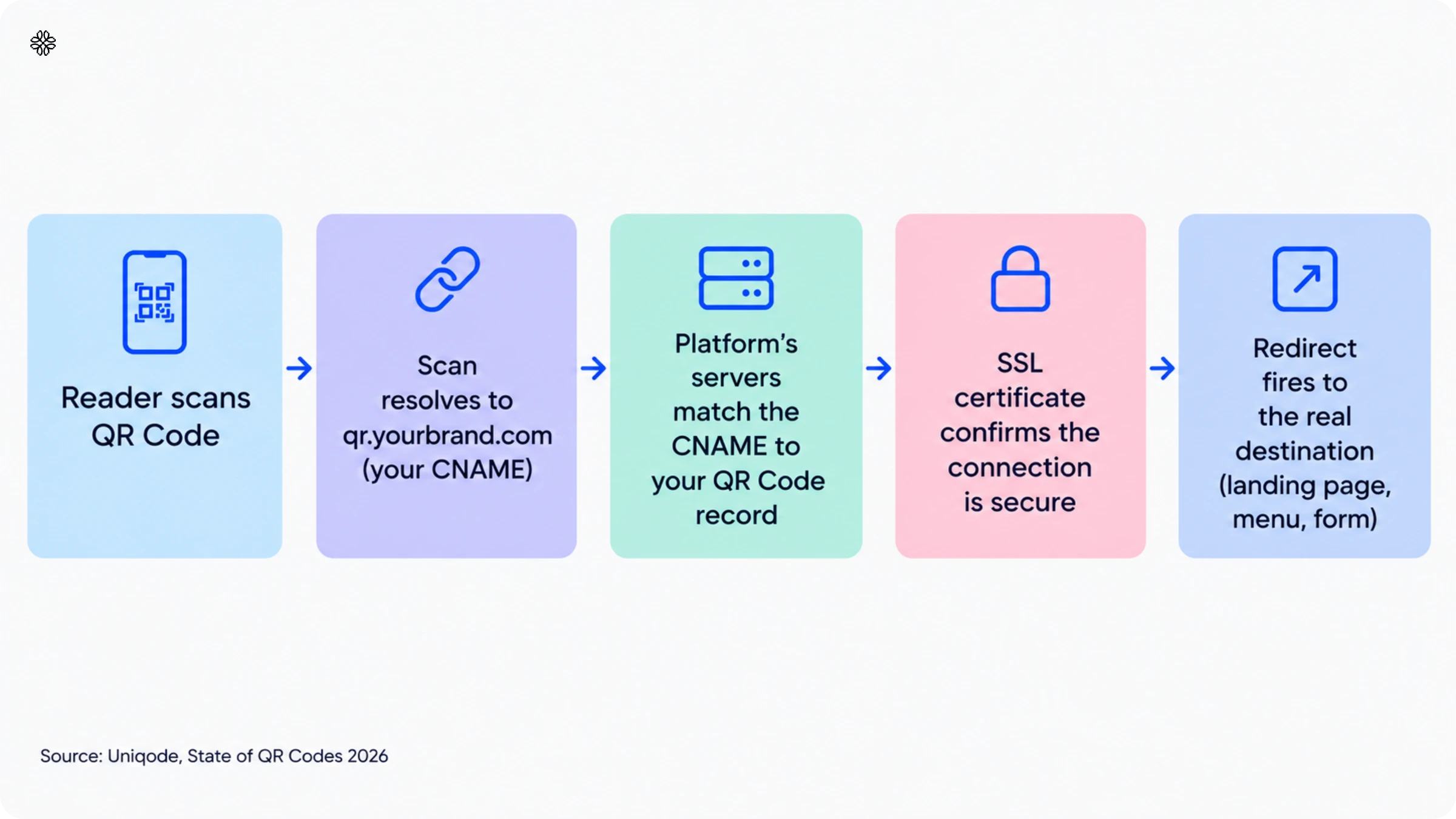
Setting up a custom domain QR Code is simpler than it sounds. Your QR platform provides a CNAME value, which you just need to add to your domain’s DNS settings. Once that’s done, every scan of your QR Code will pass through your own domain before seamlessly redirecting to the final destination.
There are three key pieces at play here, each with its own role. First, you pick a subdomain or hostname that will appear in your QR Code links. Next, the CNAME record comes into play, connecting your chosen subdomain to the platform’s servers behind the scenes. Finally, an SSL certificate ensures that every scan loads securely, so visitors see your branded domain without any browser warnings.
How to set up a custom domain for a QR Code
Setting up a custom domain for a QR Code takes four steps on almost any platform: choose a subdomain, add a CNAME record, verify it in your QR platform, and wait for the change to take effect.
- Choose a subdomain, such as qr.yourbrand.com. Pick something short enough to type and recognizable enough that a scanner trusts it on sight.
- Add a CNAME record in your domain's DNS settings, pointing that subdomain to the value your QR platform provides.
- Enter the subdomain in your QR platform's custom domain setting and verify it.
- Wait for DNS propagation and SSL activation. DNS changes can take minutes; SSL activation can take up to 48 hours.
This sequence holds across the category. It's consistent enough that one telecom customer rolling out custom domains across several country markets still had one question before starting:
"Is it a DNS record, a CNAME record, or is it something just that is straightforward from Uniqode's end?"
— IT lead, multi-market telecom operator, enterprise
It’s a CNAME record specifically, and adding one does not require you to migrate servers or rewrite any code. The person who manages your domain’s DNS handles this step, not the person who manages your QR Codes. In every case we’ve seen, the customer’s IT team adds the record, since DNS access and QR dashboard access use separate logins.
Why is a custom QR Code domain important?
When a user scans your QR Code, they are redirected to a website, custom landing page, digital form, or even a digital business card. All these campaigns have one common factor – a URL.
A URL is the front and center of all your online campaigns. One of the important aspects of your campaign URL is its domain name.
A custom domain is a unique identifier, and it helps the audience recognize your brand from the URL. Potential customers are more likely to click on a link that appears familiar and boost conversion.
Uniqode’s custom domain feature is powerful, with several unique benefits:
#1 Boost branding
Data shows that consistent presentation of a brand increases revenue by 33%. (Source: Oberlo)
Users scanning your QR Code expect the URL to match or closely resemble your company’s name. When you add a custom domain to your QR Code, it shows consistency with your brand identity.
When they see your logo design or your domain name in a URL, customers can easily identify and relate to your organization.
Also read: Maintain consistent branding using QR Code templates.
#2 Improve credibility
69% of people fear that most websites are fake and spread misinformation. Only 1 in 3 people trust a brand enough to interact with and purchase from. (Source: Edelman Report)
A custom domain can play a crucial role in improving your credibility in the eyes of a user. Every time a customer scans a QR Code, your website’s branded URL will appear legitimate to visitors.
#3 Better campaign management
Organized marketers are 674% more likely to succeed in their initiatives, owing to optimal planning and excellent campaign management. (Source: Coschedule)
With Uniqode, you can manage multiple clients, each having their own custom domain. Role-based access and automated workflows make it convenient for all the stakeholders to collaborate with each other.
Additionally, each sub-account owner can create their QR Codes, track them, and share reports seamlessly.
#4 Unlimited custom domains
There is no limit on the number of custom domains you can create on the Uniqode dashboard. Before adding them, a quick domain name search helps you confirm all your preferred names are available and locked in before you start building your campaigns. Whether yours is a small or large enterprise, we understand that different teams have varying needs.
For instance, a PR agency with various clients would need to manage different QR Code campaigns. Each client may represent a different brand. You can add a custom domain for each client and manage everything from a single dashboard.
#5 Easy-to-track analytics
A survey from Deloitte notes that over 49% of marketers believe analytics helps them make better decisions.
You can create a custom QR Code tracker and measure the success of your campaign with Uniqode’s in-house analytics feature. Get insight into data such as number of scans, date and time of the scan, device type, location, and much more.
How can you create a custom QR Code domain?
Uniqode lets you add multiple users under the same organization. The owner and administrator of an enterprise account have access to create and add custom domains.
You can create a custom QR Code domain in 6 easy steps.
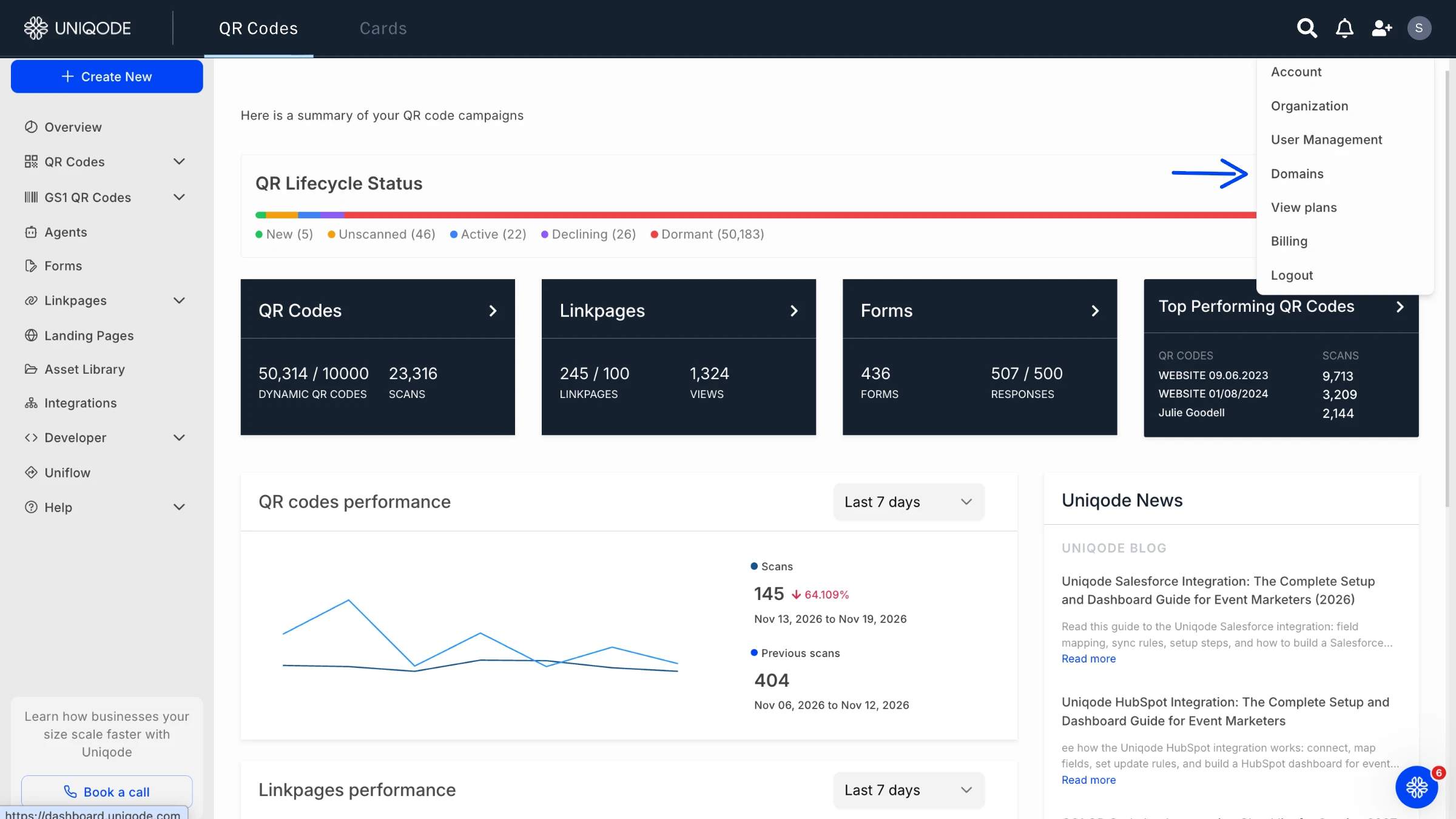
#1 Log in to the Uniqode dashboard and click on your username at the top-right corner
Click on ‘Domains’ from the drop-down menu.
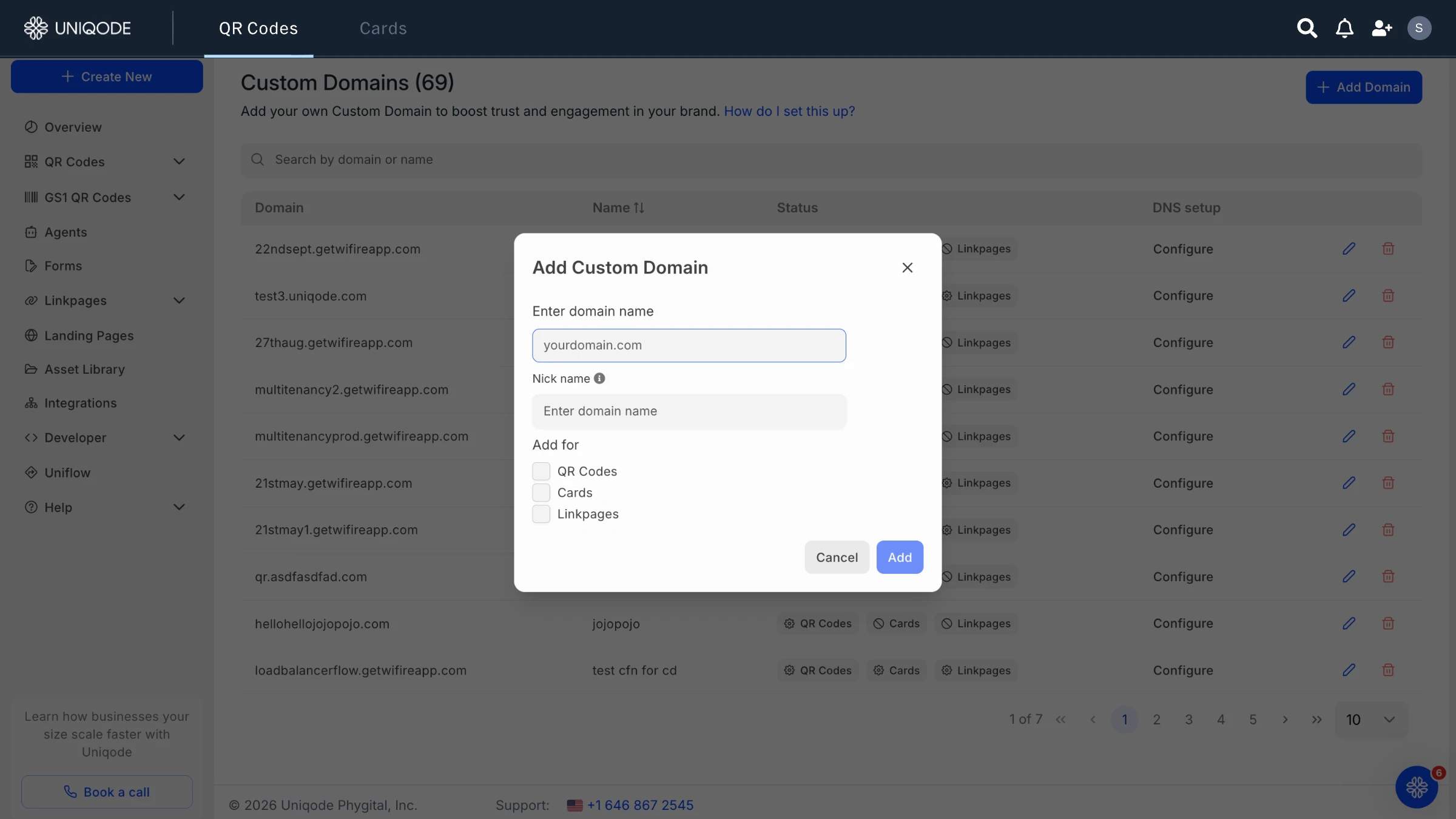
#2 Click on ‘+Add Domain’ and enter the domain details
Enter your domain name and URL. Next, click on ‘Add’.
#3 Complete the verification process
Verify the CNAME by adding it to your DNS configuration. If your domain is managed through a website offering domain services, you can access the DNS settings there to add the required records. Once the records are added, you will see the ‘verified’ status. Next, request SSL verification.
Next, request SSL verification.
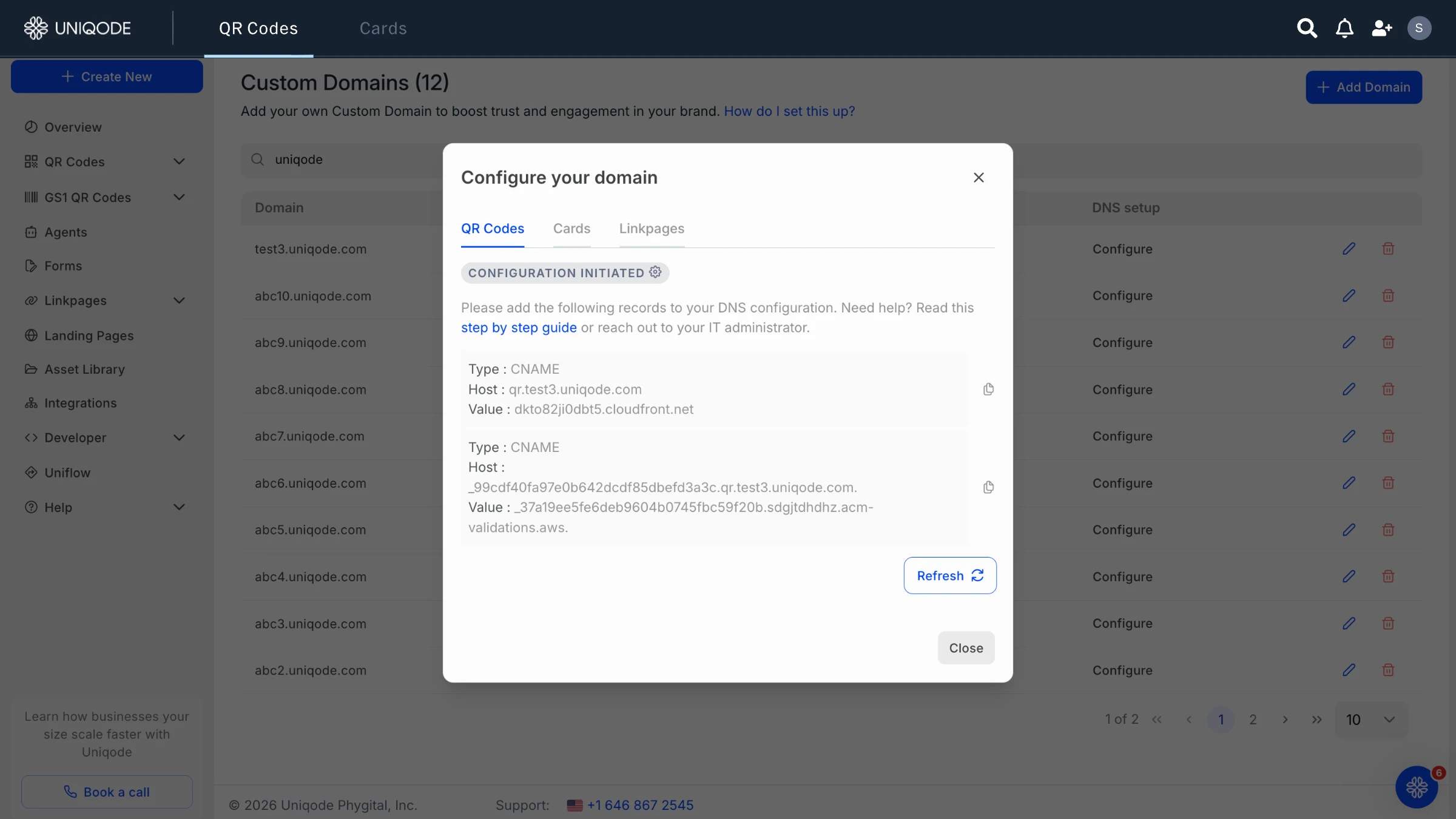
#4 Complete SSL verification and your domain will be added to the dashboard.
Now that you’ve created a custom domain, add your CNAME records to the DNS configuration one more time. This is to complete the SSL verification of your domain for security purposes.
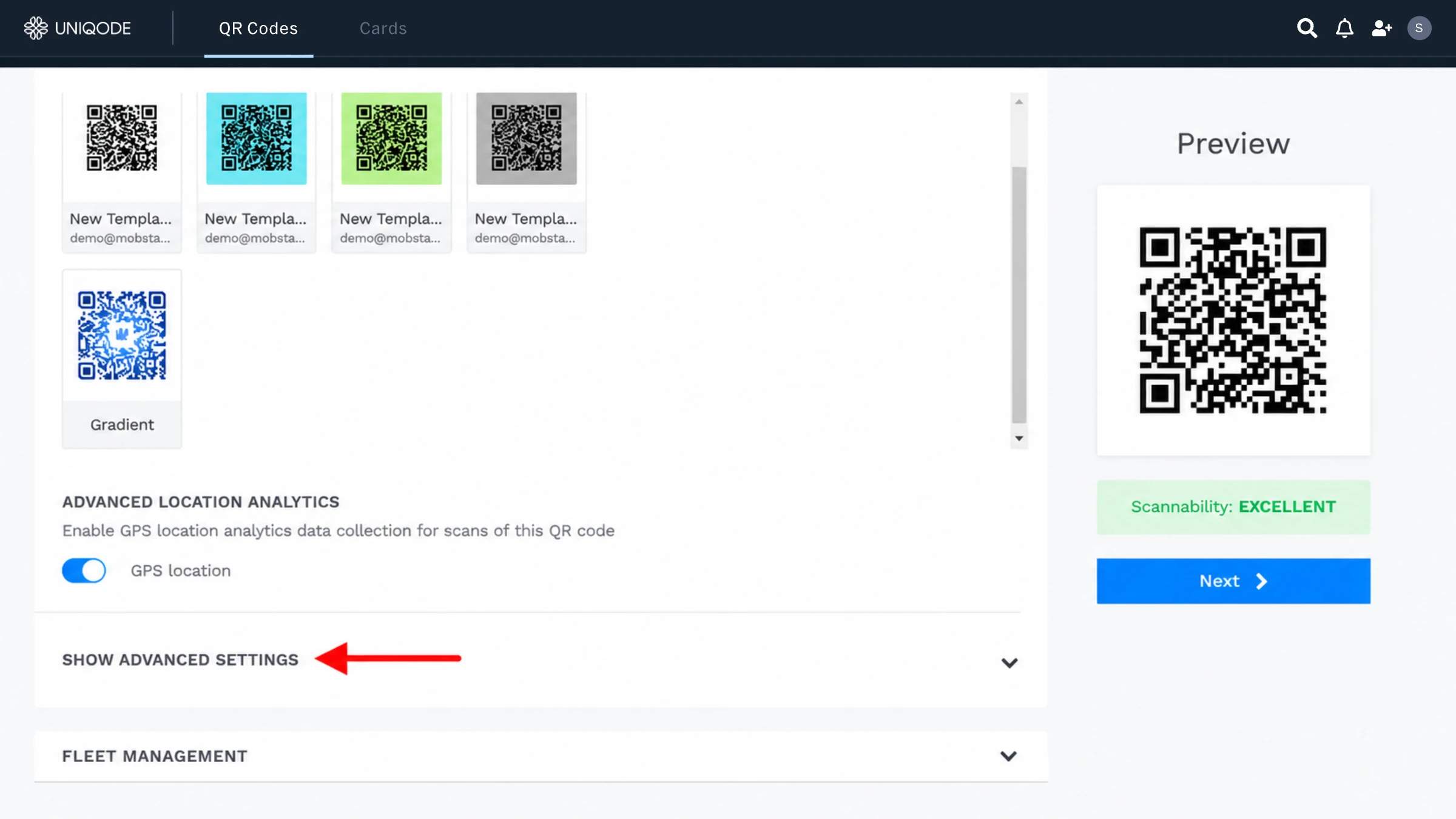
#5 Create a new QR Code or edit an existing one with the newly added domain
Generate your QR Code and customize it as per your brand design. Scroll down and click on ‘Show Advanced Settings’.
#6 Under advanced settings, you’ll find ‘URL DOMAIN’
Click on the drop-down menu and select the newly created domain. Finish customizing your QR Code.
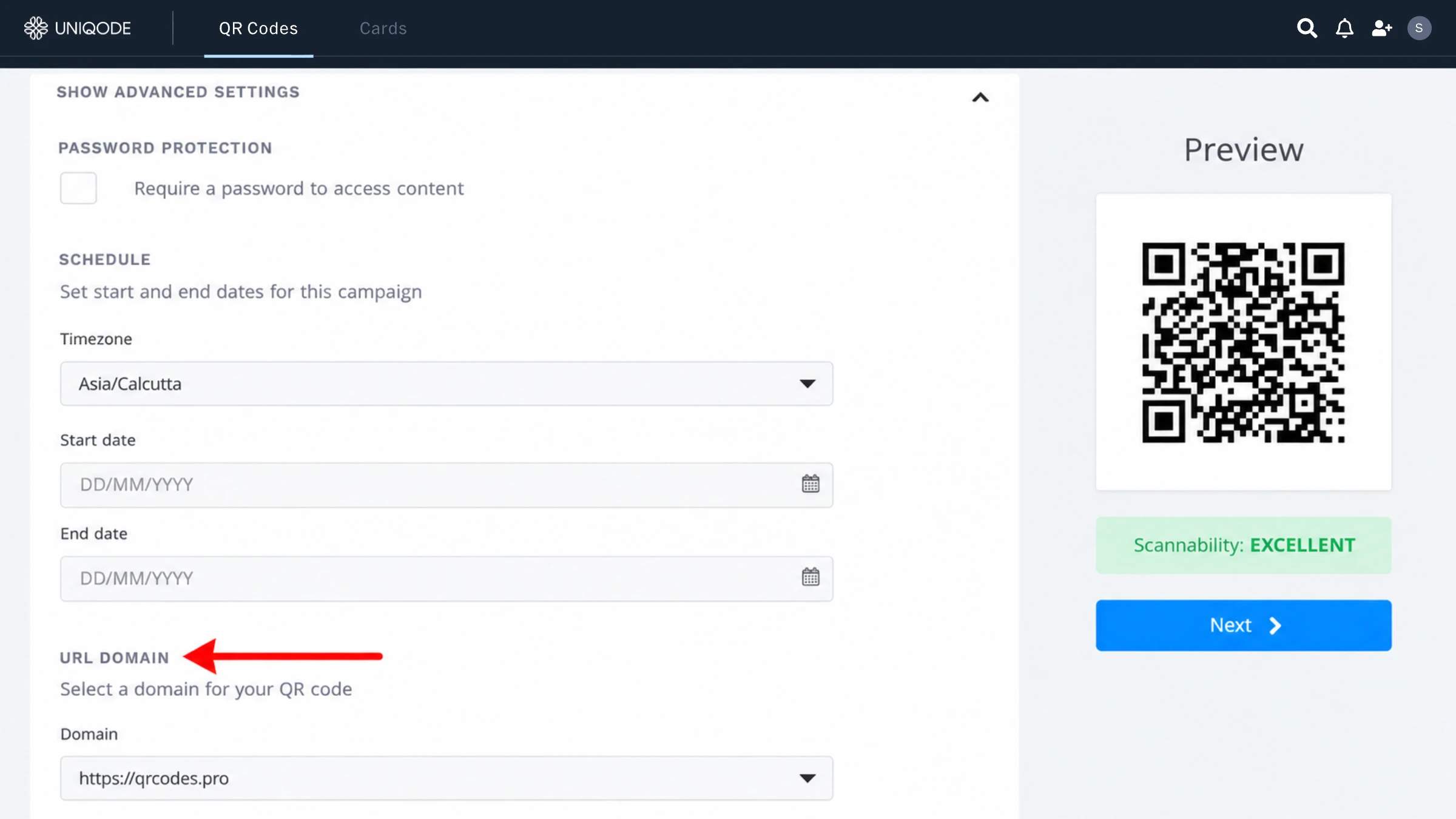
Your custom QR Code domain is ready to be deployed.
Note: The custom domain feature is available for Enterprise customers only. Check out the complete list of our QR Code generator pricing plans.
Who can benefit from managing QR Codes for different brand domains?
#1 Agencies and consultants
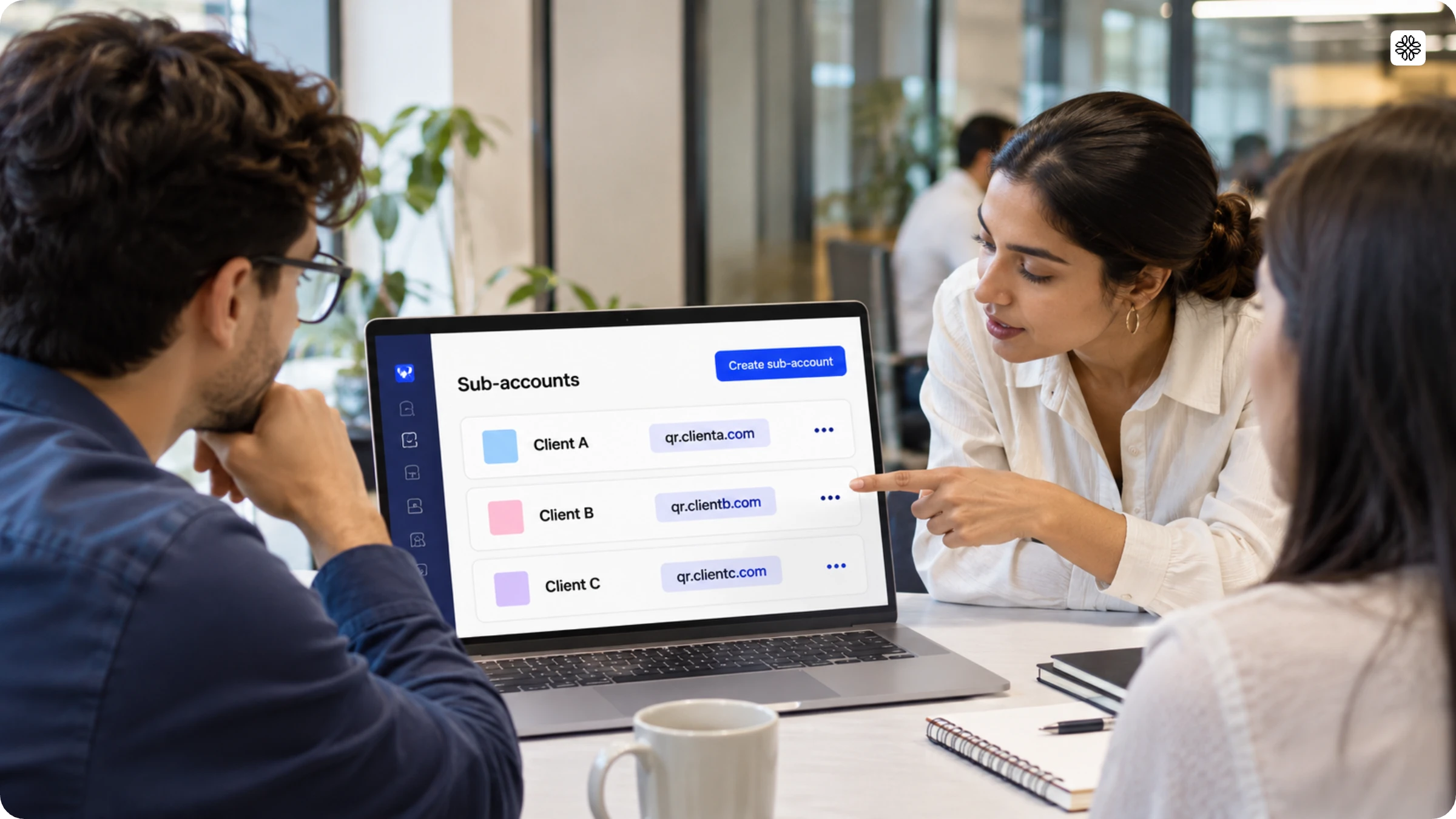
According to a survey, over 50% of agencies cited workflow efficiency as their top priority for FY’22.
Traditionally, agencies handle multiple clients and often deal with unique requirements for every brand they represent.
This is where Uniqode’s custom domain and multi-user access management features come in handy.
Marketing agencies can create separate sub-accounts for each client and assign a custom domain per the requirement.
For instance, once you assign a sub-account, the marketing executive or brand manager for that particular client can create, manage, and track QR Code campaigns with ease.
If one of your clients wants a custom domain linked to their QR Code, you can create and assign it to them in a few easy steps.
#2 Real estate
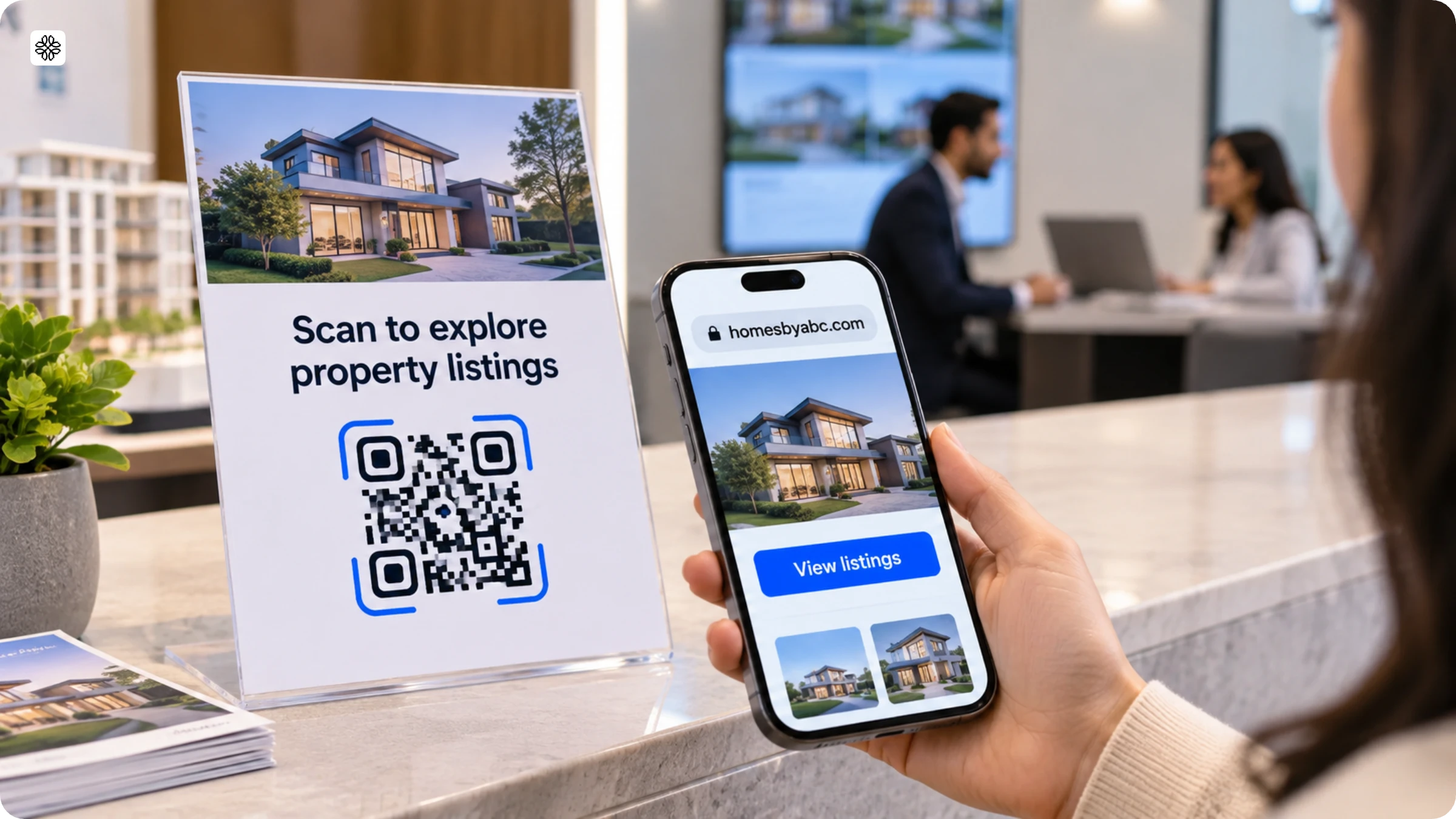
In 2021, 97% of buyers used the internet to search for a home. To capture this massive audience, real estate agencies need to have optimized websites and landing pages that can quickly convert customers.
Add custom domains to the mix, and you have a powerful website in hand.
With Uniqode’s custom domain feature, you can personalize your QR Code domain as per the agency/consultancy name.
When potential clients come across your QR Code, they might scan and click on the link since it looks familiar.
That’s not all.
Real estate agencies employ several realtors, who in turn, handle multiple clients in a day.
With our multi-user feature, each agent can have their own sub-account with a custom domain. They can run separate QR Code campaigns for the properties they manage and sell.
#3 CPG brands
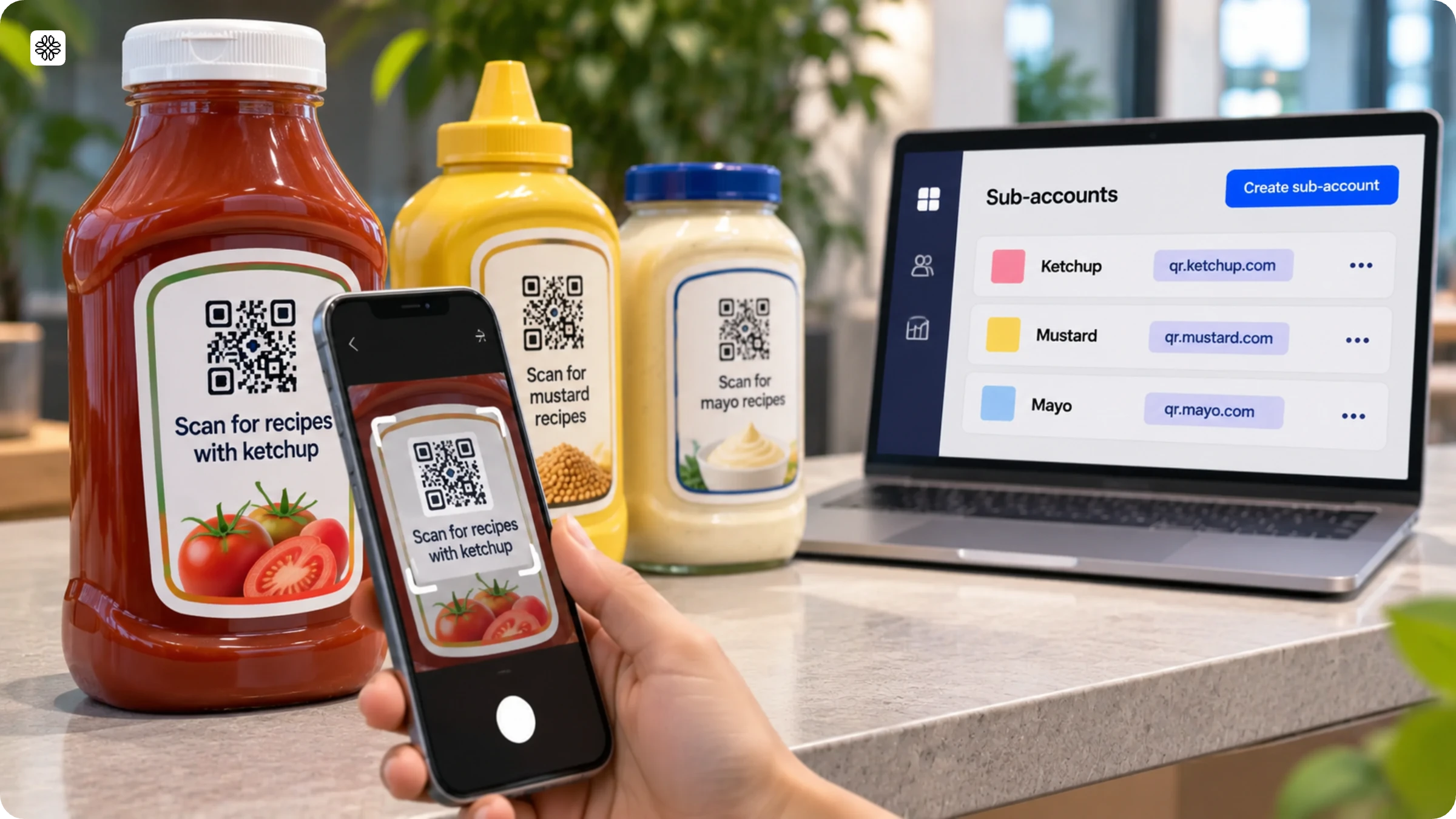
Data shows that over 92% of CPG brands are using QR Codes in their product packaging as of 2022.
For CPG brands with multiple products, the custom domain feature can help better manage and promote individual products.
For instance, companies such as Heinz have other products besides ketchup. For each of their other condiments, separate custom QR Code domains can be created.
Additionally, you can assign a sub-account to each team member handling different products. They can create QR Codes, manage campaigns, and track performance on their own.
With a custom QR Code domain, you can improve the user experience and generate ROI.
Best practices for custom domain QR Codes
The costliest misstep you can make with custom domain QR Codes is to change or remove the domain after your codes have already been printed. Doing so regenerates the QR image, leaving every distributed copy unusable and offering no way to redirect those old codes to your new domain.
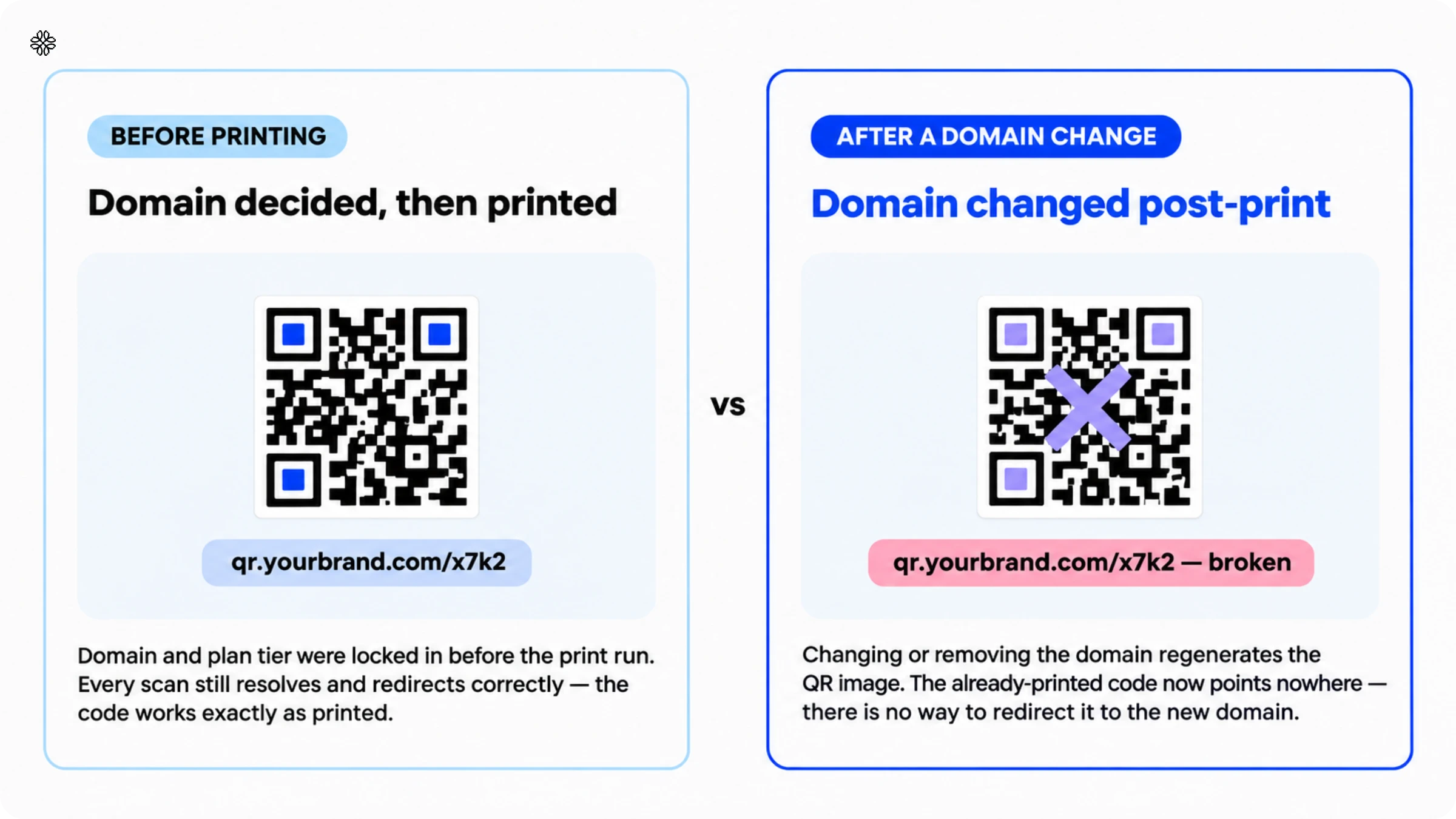
- Lock in your domain before you print. One enterprise medical device company confirmed this risk directly during its own implementation: existing QR Codes can't be retroactively updated with a new custom domain, and new codes must be generated instead.
- Lock in your plan tier at the same time. Downgrading off a plan that includes a custom domain breaks those same already-printed codes just as permanently, because the domain is tied to the plan tier that supports it.
- Verify SSL activation before printing. DNS can propagate in minutes, but SSL can take up to 48 hours, and a scan during that window can show a security warning instead of your branded redirect.
- Use one domain per brand or market if you manage more than one. Forcing every brand through a single shared domain makes analytics and governance harder to untangle later.
- Pair your custom domain with security settings you'd apply to a sensitive page anyway. Uniqode pairs custom domains with password protection, automatic malware and phishing scanning, and a full QR Code history audit trail. The same SOC 2 Type II, GDPR, HIPAA, and ISO 27001 certifications that cover Uniqode's security practices apply across all of it, including the redirect domain itself.
Custom domain QR Code examples
Real teams often use custom domain QR Codes in three main ways. They bring different product lines together under one branded domain, direct users to regional sites based on location, and make customer materials safer by using a familiar domain.
- Unify multiple product lines under one branded domain. A global consumer health company set up a single custom domain across three related oral-care product lines, replacing three separate generic redirect URLs with one branded domain.
- Route one domain to different regional sites by location. The same company paired its custom domain with geolocation, so a scan on packaging in one country sends the visitor to that country's local site while the URL preview stays consistent across every market. The combination (one custom domain, geolocation, and multi-lingual destinations) covers international packaging without needing a different QR Code per country. Businesses selling into multiple markets through QR Codes on consumer packaging run into this same requirement regularly.
- Protect customer-facing materials with a recognizable domain. A multi-location healthcare network used a branded domain in QR redirect URLs specifically to make the link recognizable and legitimate to patients scanning it across many facility locations. For a franchise or multi-location business, a domain patients already trust at one location carries that same trust to every other location using the same code.
Uniqode’s custom domain feature is built for your enterprise needs
Uniqode’s custom domain feature can help enterprises reinforce branding and convert prospects into regular customers.
Designed for enterprise needs, Uniqode’s robust QR Code platform has been consistently rated as the best QR Code generator.
With unique features such as SSO login, custom domain, retargeting, multi-user access management, and white labeling, enterprise customers can leverage our product to execute successful QR Code campaigns.
When it comes to enterprises, we understand that security and data protection is of utmost importance. That’s why we adhere to the highest security standards.
Along with GDPR compliance, we are also the world’s first QR Code generator that is SOC 2® Type 1 & Type 2compliant.
With a stellar rating of 4.9/5 on G2, we are a company dedicated to providing for your enterprise needs.
Frequently Asked Questions
- How do custom domain QR codes improve conversion rates?
Custom domain QR codes can increase click-through rates by 25-35% compared to generic short links because they establish brand credibility and trust at first glance. When users see a familiar brand domain in the QR code URL preview, they're 3x more likely to complete the desired action after scanning. Additionally, custom domains allow for better tracking and A/B testing, enabling businesses to optimize campaigns based on real performance data.
- How much does a custom domain QR code solution cost for businesses?
Custom domain QR code solutions typically range from $50 to $500+ per month depending on scan volume, number of codes, and team features. Enterprise solutions like Uniqode offer white-label custom domains starting at professional tier pricing, with unlimited code generation and advanced analytics included. Most platforms require businesses to own their custom domain separately, which costs approximately $10-15 per year through standard domain registrars.
- How do I change the domain on a QR Code?
You can change the QR Code domain in 4 easy steps:
- Log in to the Uniqode dashboard and click on your user name at the top-right corner.
- Select ‘+Add Domain’ and enter your domain name and URL.
- Complete your CNAMe and SSL verification process.
- Once this is done, your domain name will be verified and ready to use.
- How do I create a QR Code for my domain?
Creating a QR Code for your domain follows the same four-step process covered above: choose a subdomain, add a CNAME record pointing it at your QR platform, verify the subdomain inside that platform, then wait for DNS and SSL to activate before printing or distributing the code.
- Can you make any URL into a QR Code?
Yes, you can make any URL into a QR Code. Any URL can become a QR Code, because a QR Code is simply a visual encoding of a link. A custom domain doesn't change what a QR Code can point to; it changes which domain shows in the link preview during the scan-to-redirect step.
- Is a custom domain QR Code the same as a short link?
A custom domain QR Code is a branded version of a short link. Both use the same redirect mechanism: a brief, trackable URL that expands into a full destination address on click or scan. A custom domain is what makes that short link display your own brand instead of a shared one.
About the Author
Somreeta is a Senior Content Marketer at Uniqode, where she writes about QR Code technology and how teams put it to work in the real world. She brings 8+ years of marketing experience to every piece, with a focus on turning product depth into content people actually use.