
What Is a 2D Barcode? Types, Uses, and GS1 Formats
A 2D barcode stores data horizontally and vertically. Learn the main types, where each is used, and the three symbols GS1 accepts for retail.
What is a 2D barcode?
A 2D barcode is a machine-readable symbol that stores data in two dimensions: horizontally and vertically. A Universal Product Code (UPC), the traditional linear barcode, encodes only one product number in a row of bars. A 2D barcode holds more information in a compact space, such as the product identifier plus batch data, expiration dates, serial numbers, and web links.
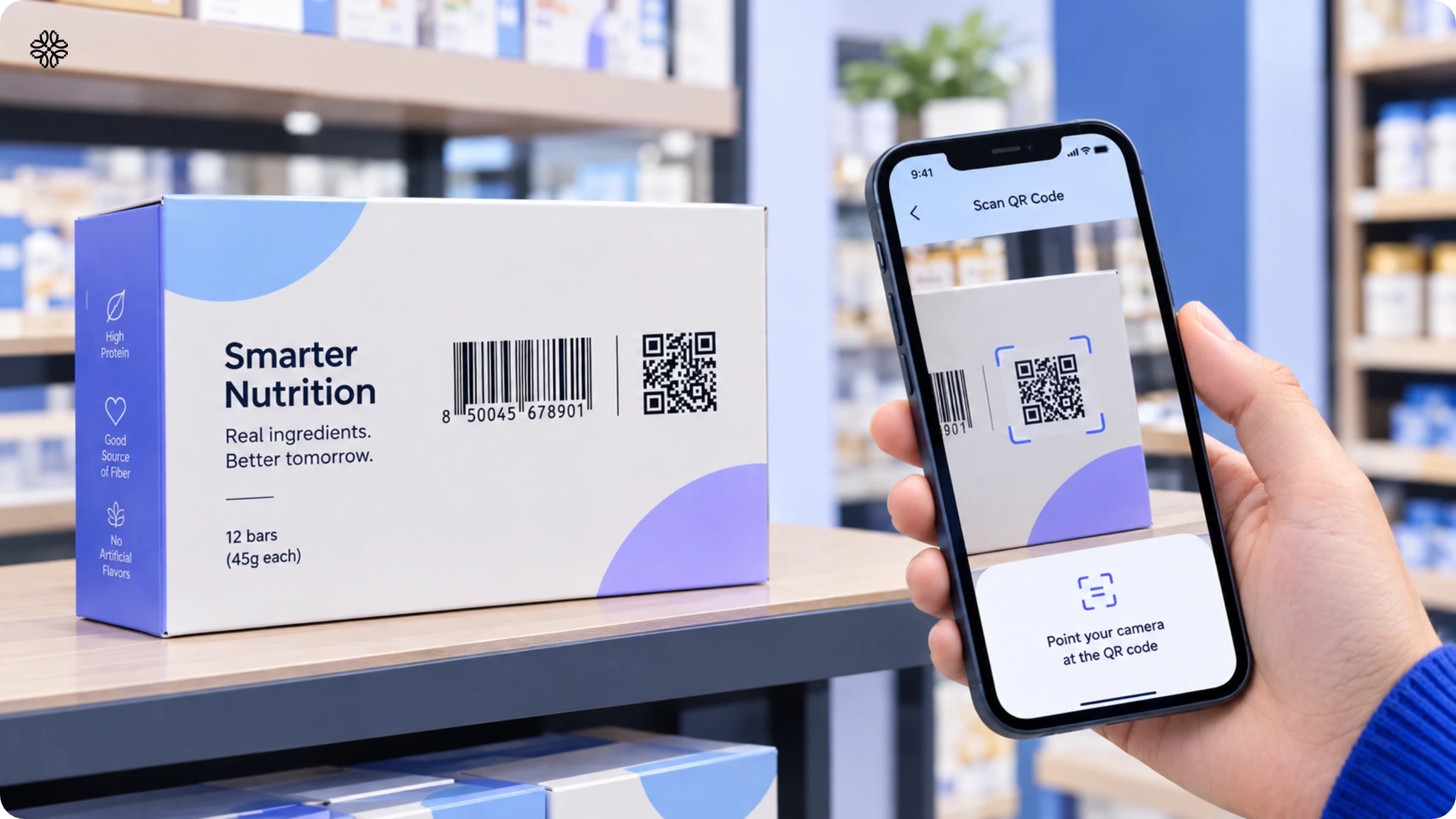
The extra information is useful in different ways. A retailer uses batch or expiration data to support inventory checks and recall workflows. A manufacturer can identify individual parts. A shopper can scan a QR Code on a product pack to open ingredients, instructions, or recycling information.
GS1 Sunrise 2027 is the industry goal for retail checkouts to read 2D barcodes by the end of 2027. Brands preparing for it should consider two things: the barcode symbol printed on the pack and the data syntax encoded in it. The symbol determines how the data is represented visually. The data syntax determines how compatible systems interpret it.
Key takeaways
- A 2D barcode stores data horizontally and vertically, so it carries more information than a traditional linear barcode (UPC) in less space.
- The four most common 2D barcode types are QR Code, Data Matrix, PDF417, and Aztec Code.
- A camera-based scanner reads a 2D barcode from any angle, and error correction rebuilds data from a damaged symbol.
- Retail, healthcare, logistics, manufacturing, and transport use 2D barcodes, each with the symbol that fits its surfaces and scanners.
- GS1 accepts three 2D symbols for retail packaging, combining a QR Code or Data Matrix with a GS1 data syntax.
How does a 2D barcode work?
A 2D barcode stores information in a pattern of black and white shapes. A scanner reads this pattern and turns it into information a computer can understand, such as a product number, expiration date, or web address.
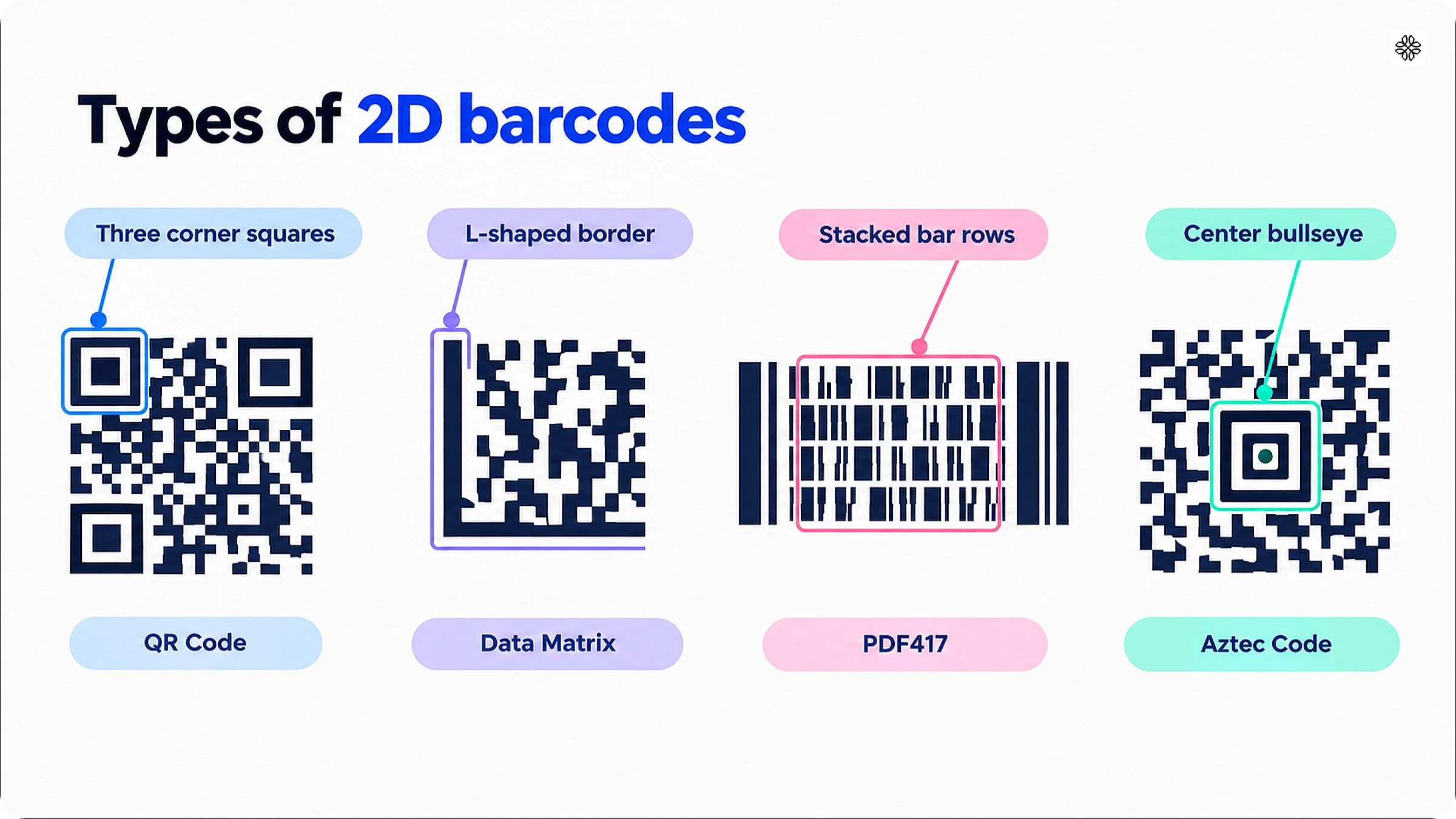
Different types of 2D barcodes have different patterns. A QR Code has three large squares near its corners. A Data Matrix has an L-shaped border, while an Aztec Code has a square bullseye in the center. PDF417 looks like several rows of traditional barcodes stacked on top of one another.
Many 2D barcodes also use error correction, which helps a scanner read the barcode even if part of it is scratched or damaged. However, a badly printed or heavily damaged barcode may still fail to scan.
Types of 2D barcodes
The four most common types of 2D barcodes are QR Code, Data Matrix, PDF417, and Aztec Code. They differ in how they look, how much space they need, and where they're used. QR Codes are common on consumer packaging, Data Matrix works well on small items, PDF417 appears on ID cards, and Aztec Code is used on mobile boarding passes.
QR Code
A QR Code is a square 2D barcode that stores information such as text, web address, or other data in a pattern of black and white squares. Most smartphone cameras can scan a QR Code using the camera app.
Common uses: Product packaging, menus, posters, payment screens, and links to online info.
Did you know? According to GS1, a QR Code holds up to 7,089 numeric or 4,296 alphanumeric characters.
Data Matrix
A Data Matrix is a compact 2D barcode with a solid L-shaped border in a square or rectangular shape. It can store product and tracking information in a small space, making it useful when a large barcode won't fit. Reading it with a phone may require a compatible app; not all smartphone cameras scan it directly.
Common uses: Medical devices, pharmaceutical packaging, electronics, and small manufactured parts.
PDF417
A PDF417 is a rectangular 2D barcode made up of rows of stacked bars. The name stands for Portable Data File, and each pattern in a row has four bars within 17 units of width. It reads like several linear barcodes stacked in one rectangle. It can hold substantial amounts of information, which makes it useful for documents that need to carry more than a simple identification number.
Common uses: Driver's licenses, ID cards, and printed boarding passes.
Aztec Code
An Aztec Code is a square 2D barcode with a distinctive bullseye at its center. The bullseye marks the symbol’s position and orientation.
Common uses: Mobile boarding passes and transport tickets
| Symbol | How to recognize it | Typical use |
|---|---|---|
| QR Code | Three large squares in three corners | Packaging, menus, payments, posters |
| Data Matrix | Solid L-shaped border | Electronics, medical devices, small parts |
| PDF417 | Rows of stacked bars in a rectangle | Driver’s licenses, ID cards, paper boarding passes |
| Aztec Code | Bullseye at the center | Mobile boarding passes, transport tickets |
Where are 2D barcodes used?
Retail, healthcare, logistics, manufacturing, and transport are the main industries that use 2D barcodes. Across these industries, 2D barcodes help businesses identify products, capture additional data, and connect physical items to digital information.
Retail and consumer goods
Retail and consumer goods brands use 2D barcodes to give retailers product details, expiration dates, and batch traces. Shoppers scan the same QR Code for ingredients, allergen information, usage instructions, recipes, or recycling guidance.
For example, Louisiana’s SB 14 requires food with certain additives to carry a QR Code on its packaging from January 1, 2028.
A 2D barcode also frees pack space. One symbol replaces the separate barcodes that carry marketing links and batch information. However, during the transition to 2D barcodes at retail, brands print both 2D barcodes and the existing UPC or EAN barcode on the same package. This is called dual-marking. Keep both until your retail partner confirms its checkout systems can read and process the 2D barcode.
Healthcare and pharma
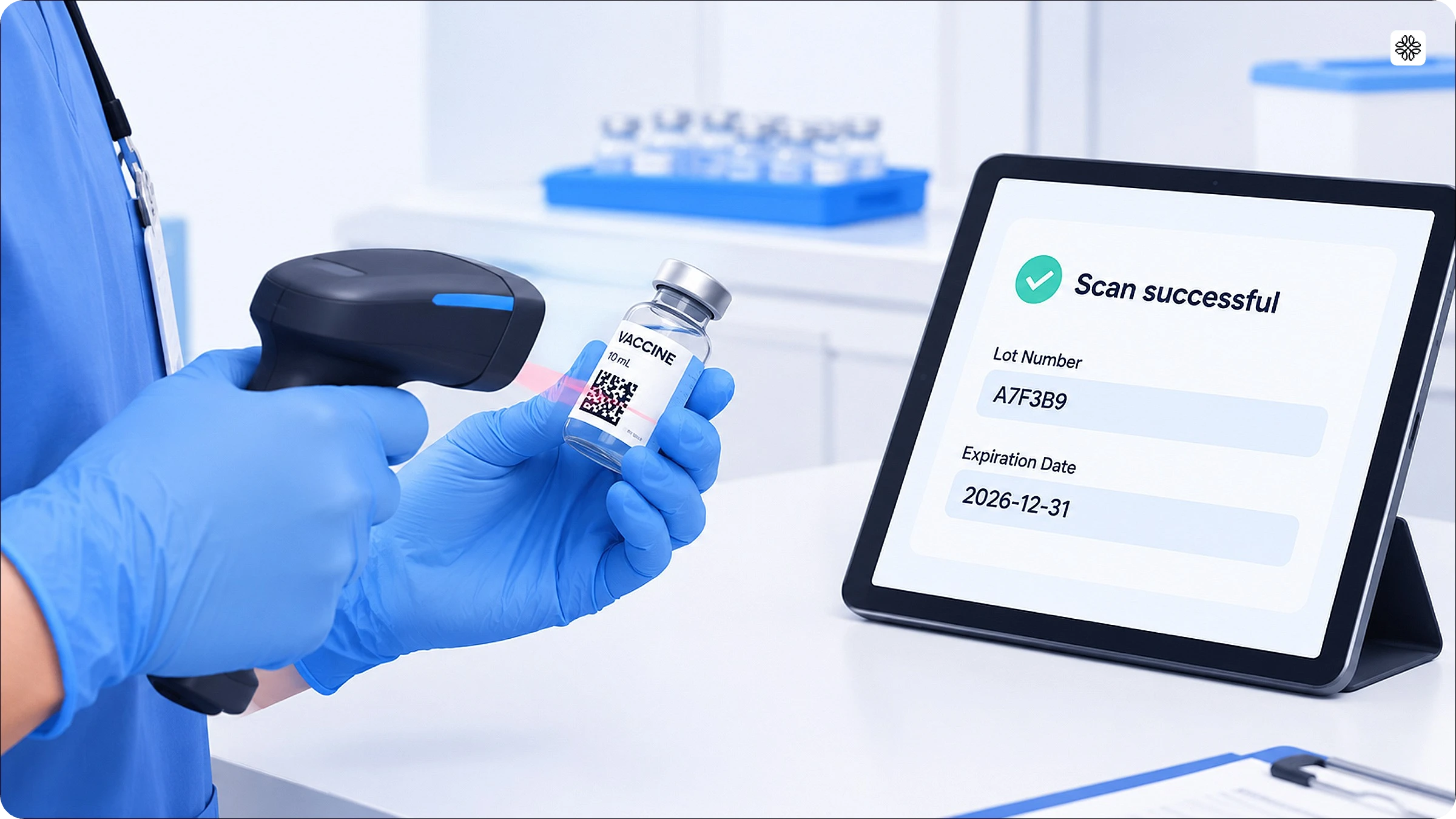
Healthcare teams use 2D barcodes to identify medicines and medical devices at the point of care. A vaccine’s 2D barcode encodes the product identification, lot number, and expiration date. Scanning that barcode replaces manual entry of those details, according to the CDC.
Vaccine 2D barcode scanning also improves data quality. A 2024 paper in Applied Clinical Informatics reported up to 99.999% accuracy across the data fields assessed. Data Matrix fits vials, syringes, and device labels because the symbol stays readable at very small sizes.
Shoppers scan 2D barcodes on medicine packs too. Brands print a QR Code on drug labels that links shoppers to the approved package leaflet on their phones. Argentina requires a QR Code or Data Matrix on the secondary packaging of every medicine. Manufacturers add the symbol to packs in phases as existing stock sells through. The symbol must link only to the approved, current leaflet. The rule covers prescription and over-the-counter medicines.
Logistics and manufacturing
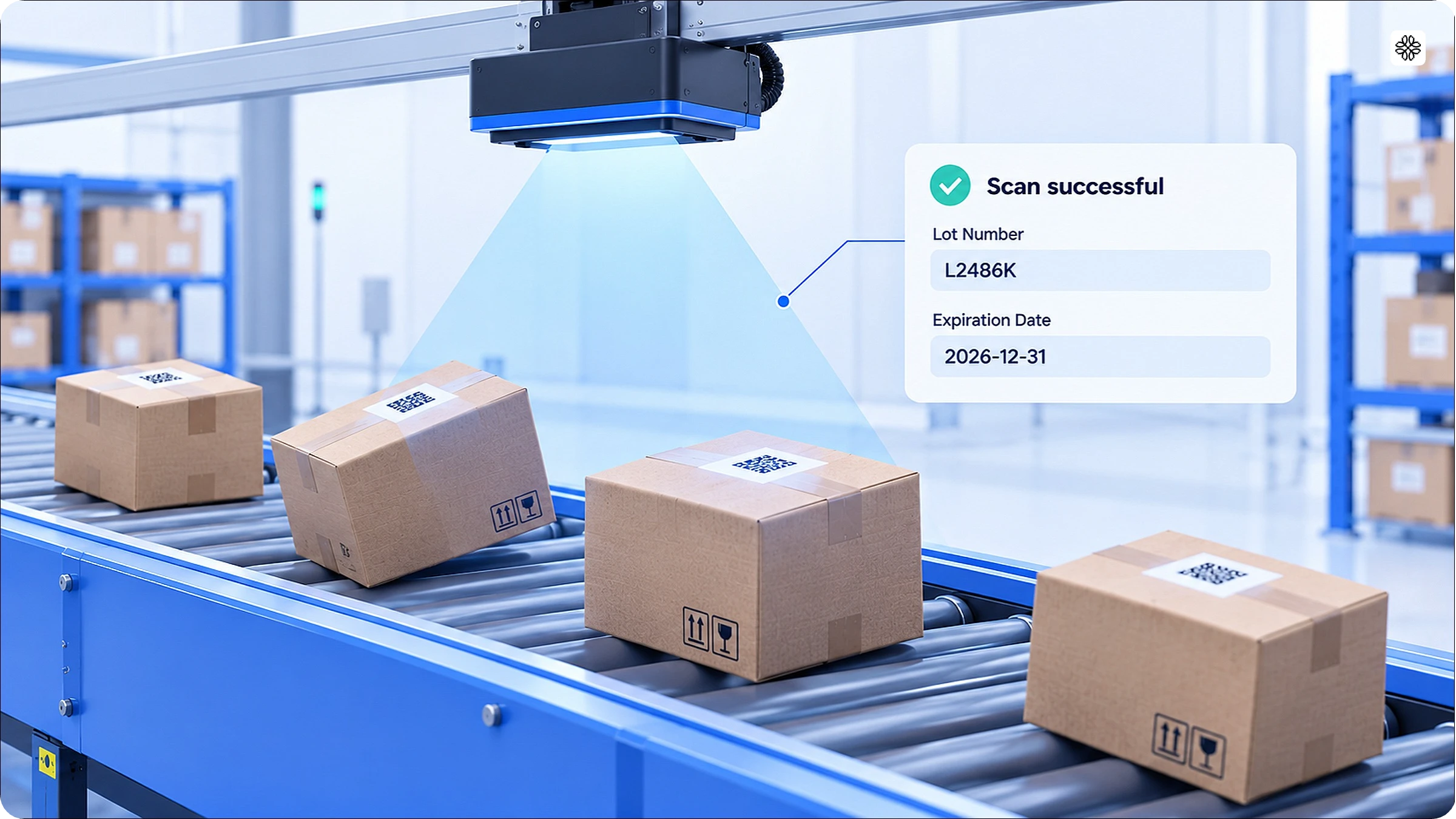
Distribution centers use 2D barcodes to log incoming shipments faster and with fewer scan errors. One scan records the product, its batch, and the shipment it arrived in. An imager reads each symbol at any angle as cartons ride a conveyor, so staff handle fewer items by hand.
Manufacturers use 2D barcodes to track individual items through production. A Data Matrix on a part gives that part its own identifier, and the symbol stays readable at small sizes. The U.S. Department of Defense requires a Data Matrix on items it designates for unique identification. The symbol must meet the ISO/IEC 16022 ECC200 specification.
Transport and ID
Airlines use 2D barcodes to carry ticket details inside the boarding pass. IATA’s standard for printed boarding passes uses a PDF417. Mobile boarding passes use an Aztec Code, a Data Matrix, or a QR Code, according to IATA.
Governments print a PDF417 on driver’s licenses and ID cards. The AAMVA standard requires a PDF417 on the back of every conforming card. The wide rectangle holds identity details in a compact space, and a scanner reads them straight from the card.
Benefits of 2D barcodes
- More data in less space. A 2D barcode carries the product number, batch, and expiration date in one symbol, so packs need fewer labels. Small items gain the most, because a compact 2D symbol fits where a long linear barcode cannot.
- Built-in error correction. A 2D barcode rebuilds its data when part of the symbol is damaged, so scuffed or creased labels still scan. Cartons pass through warehouses, trucks, and stores before a shopper sees them, so a symbol that survives handling saves rescans.
- Any-angle and on-screen scanning. A camera-based scanner reads a 2D barcode from any angle and from a phone screen. Staff and conveyors scan a symbol without lining it up. A mobile boarding pass is a 2D barcode that a gate scanner reads directly from the passenger’s phone. IATA projected that bar-coded boarding passes would save airlines over US$500 million a year.
- Current product information. A QR Code links to a web page, and that page updates after the pack is printed. A dynamic QR Code redirects to a new page without reprinting the pack. On a medicine pack, a QR Code opens the current approved leaflet, so outdated paper copies do not circulate.
What is a GS1 2D barcode?
A GS1 2D barcode is a 2D barcode that encodes data using a format defined by GS1 standards for identifying products. GS1 is the global, not-for-profit standards organization behind the UPC, GTIN, and other product barcodes.
Planning for Sunrise 2027? Our Sunrise 2027 playbook covers GS1 QR Codes for consumer goods brands.
Two important concepts help explain how GS1 2D barcodes work:
- Barcode symbol: The visual pattern printed on the package, such as a QR Code or Data Matrix.
- Data syntax: The rules for structuring information within the barcode so compatible systems can read and interpret it.
A QR Code is not automatically a GS1 QR Code just because it appears on product packaging. A GS1 QR Code uses GS1 Digital Link URI syntax to represent GS1 identifiers, such as a GTIN, in a web-compatible structure. A different GS1 format, GS1 DataMatrix, uses GS1 element string syntax instead.
Which GS1 2D barcode formats are used for retail packaging?
GS1’s retail point-of-sale transition covers three 2D barcode options: GS1 DataMatrix, QR Code with GS1 Digital Link URI syntax, and Data Matrix with GS1 Digital Link URI syntax, according to its scanner playbook.
GS1 DataMatrix is a Data Matrix that carries GS1 element strings. A QR Code with GS1 Digital Link URI syntax is commonly called a GS1 QR Code. It carries a web address with the product identifiers, so a retail scanner reads the GTIN from the same symbol. Data Matrix with GS1 Digital Link URI syntax carries the same kind of web address inside a Data Matrix.
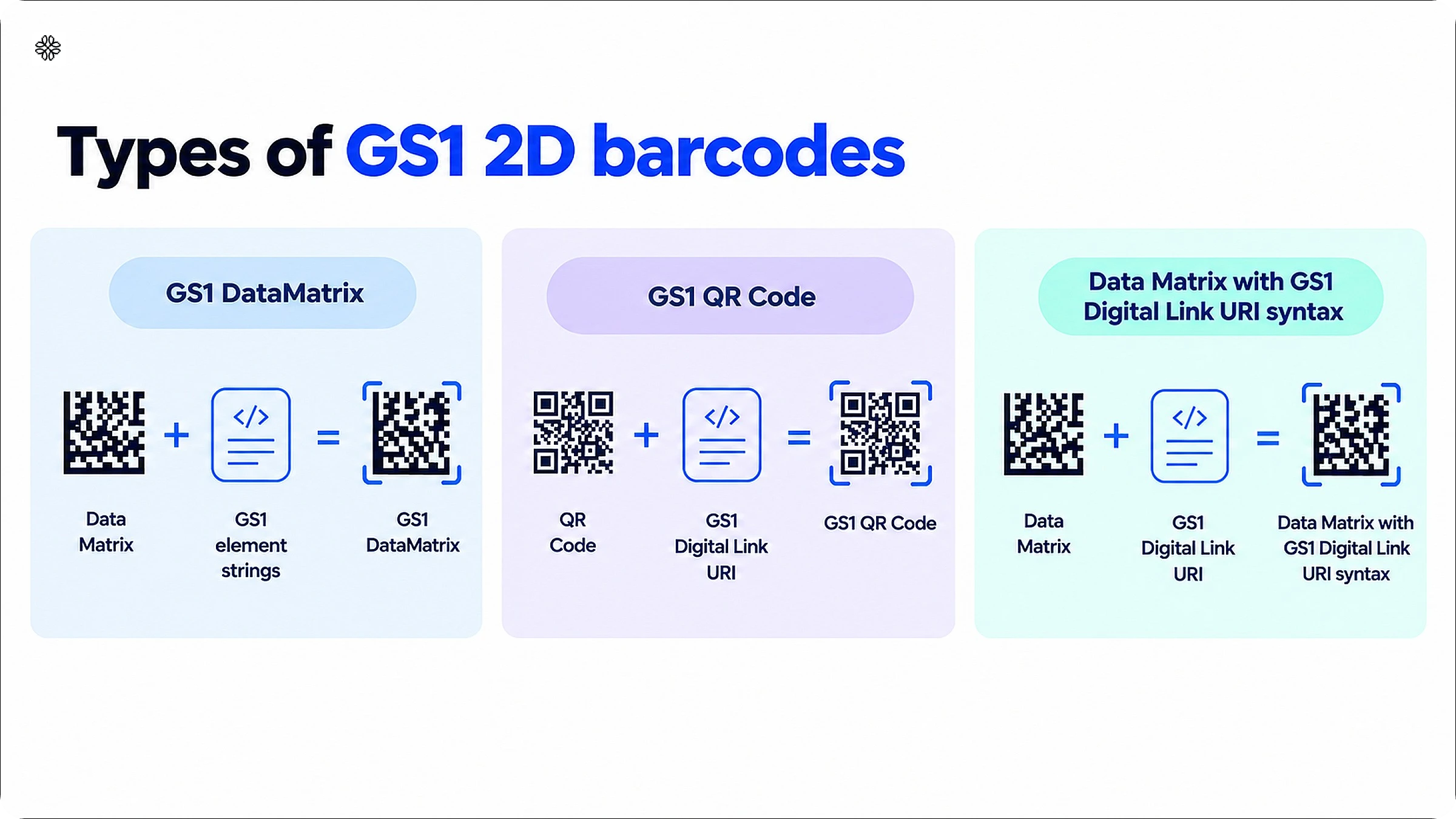
| GS1 2D barcode Format | Symbol | Data syntax | What it stores | Common uses |
|---|---|---|---|---|
| GS1 DataMatrix | Data Matrix | GS1 element strings | GTIN plus batch, expiration date, or serial number | Widely adopted in healthcare |
| QR Code with GS1 Digital Link URI syntax | QR Code | GS1 Digital Link URI | Product identifiers inside a web address | Consumer goods packaging that links shoppers to product information |
| Data Matrix with GS1 Digital Link URI syntax | Data Matrix | GS1 Digital Link URI | Product identifiers inside a web address | Retail packaging accepted for point-of-sale scanning |
How should a brand prepare for 2D barcodes?
Brands prepare for 2D barcodes by securing GTINs, choosing a format, planning dual-marking, confirming scanner support, and testing print quality.
- Secure a GTIN for every product. A GS1 2D barcode encodes a GTIN, which you receive through a GS1 Company Prefix.
- Choose the format. A QR Code with GS1 Digital Link URI syntax suits packs that send shoppers to a web page. GS1 DataMatrix suits small items and healthcare labels.
- Plan for dual-marking. Keep the UPC or EAN beside the 2D barcode. GS1’s retail guideline places the 2D barcode within 50 mm of the linear barcode’s center for point-of-sale scanning.
- Confirm scanner support with retail partners. Ask each retailer which 2D symbols its checkout and receiving systems read.
- Test print quality on the real pack. Print a sample on the final packaging material. Check it with a barcode verifier, a tool that grades the symbol’s print quality.
Get more from your 2D barcode with a GS1 QR Code
A GS1 QR Code gives your brand one QR Code for shoppers and for your supply chain. Shoppers scan it to reach recipes, usage instructions, or sustainability details, and you update that page after printing. Your team scans the same QR Code to read the product number plus an expiration date or serial number. That data supports tighter inventory control and faster recalls.
Uniqode gives enterprise teams one platform to create and manage GS1 QR Codes across every SKU. See how GS1 QR Codes fit your product lines.
Frequently Asked Questions
- Is a QR Code a 2D barcode?
A QR Code is a 2D barcode that stores data horizontally and vertically in a grid of squares. Data Matrix, PDF417, and Aztec Code are other 2D barcodes. A 2D barcode is the category, and a QR Code is one type within it.
- What is the difference between 1D and 2D barcodes?
A 1D barcode encodes data along one direction, usually as a series of vertical bars and spaces. A 2D barcode stores data across two dimensions: horizontally and vertically, which lets it store more information in a compact area. Traditional UPC and EAN barcodes remain widely used in retail; 2D barcodes can add information such as batch data, expiration dates, serial numbers, or web links.
- What is a 2D barcode called, and what is the most common type?
A 2D barcode is named for its type: QR Code, Data Matrix, PDF417, or Aztec Code. The QR Code is the most common type.
- Will 2D barcodes replace the UPC?
A 2D barcode sits alongside the UPC on a retail pack, and GS1 says linear barcodes will not go away. The 2D barcode carries more data, such as a batch number, an expiration date, or a web link. The UPC stays on the pack next to it.
- How much data can a 2D barcode hold?
A 2D barcode holds thousands of characters, depending on the symbol. According to GS1, a QR Code holds up to 7,089 numeric or 4,296 alphanumeric characters. A GS1 DataMatrix holds up to 3,116 numeric or 2,335 alphanumeric characters. That space carries numbers, text, web links, batch numbers, expiration dates, and serial numbers.
- How do I scan a 2D barcode?
Scan a 2D barcode by pointing a smartphone camera or a camera-based scanner at the symbol. On a phone, open the camera, frame the QR Code, and tap the link that appears. A camera-based 2D scanner reads QR Code, Data Matrix, PDF417, and Aztec Code from any angle.
- Can a 2D barcode scanner read a QR Code?
A 2D barcode scanner reads QR Codes because it captures the whole symbol as one image. This kind of scanner is also called an imager. The same scanner reads Data Matrix, PDF417, and Aztec Code. One device handles QR Codes on packaging and Data Matrix on labels.
- How do I create a 2D barcode?
Create a 2D barcode by choosing a symbol, entering the data to encode, and generating it with a 2D barcode generator. With Uniqode, you can generate QR Codes and GS1 QR Codes from one platform.
- What is the difference between a GS1 QR Code and a regular QR Code?
A GS1 QR Code encodes a GS1 Digital Link URI, while a regular QR Code encodes any web address or text. The GS1 URI includes product identifiers such as the GTIN. One GS1 QR Code then serves a shopper’s phone and the systems that read the product number.
- Which 2D barcode should my company use?
Use a QR Code for packs that send shoppers to a web page, and a Data Matrix for small items and healthcare labels. PDF417 and Aztec Code suit ID cards and boarding passes. GS1 accepts three symbols for retail packaging.
- Do I need a GTIN to make a GS1 2D barcode?
A GS1 2D barcode encodes a GTIN, so you need one for each product before you generate the 2D barcode. A GTIN is the Global Trade Item Number that identifies your product. You receive GTINs through a GS1 Company Prefix from your local GS1 member organization. A brand that already prints a UPC has a GTIN to encode.
About the Author
Architaa is a Content Marketer at Uniqode, where she explores how QR Codes, Digital Business Cards, and phygital experiences are reshaping the way brands connect with their audiences. She transforms complex marketing trends and technologies into clear, actionable insights that help businesses strengthen engagement and build lasting connections with their customers. Outside of work, Architaa is most likely lost in a novel, following every ball of a cricket match, or binging her favorite shows.