QR Codes on packaging can be a feature that actively works in your favor. Designed around whatever your food brand needs most, from transparency to customer engagement.
Seen as a source of innovation to connect the digital and physical worlds, QR Codes are a stellar way to connect with consumers and adapt to their ever-evolving needs. Let’s look at why QR Codes are so effective on packaging and learn from food brands that are doing it right.
Why use QR Codes on food packaging?
What if your packaging could do more than just look good? What if it could talk to your customers?
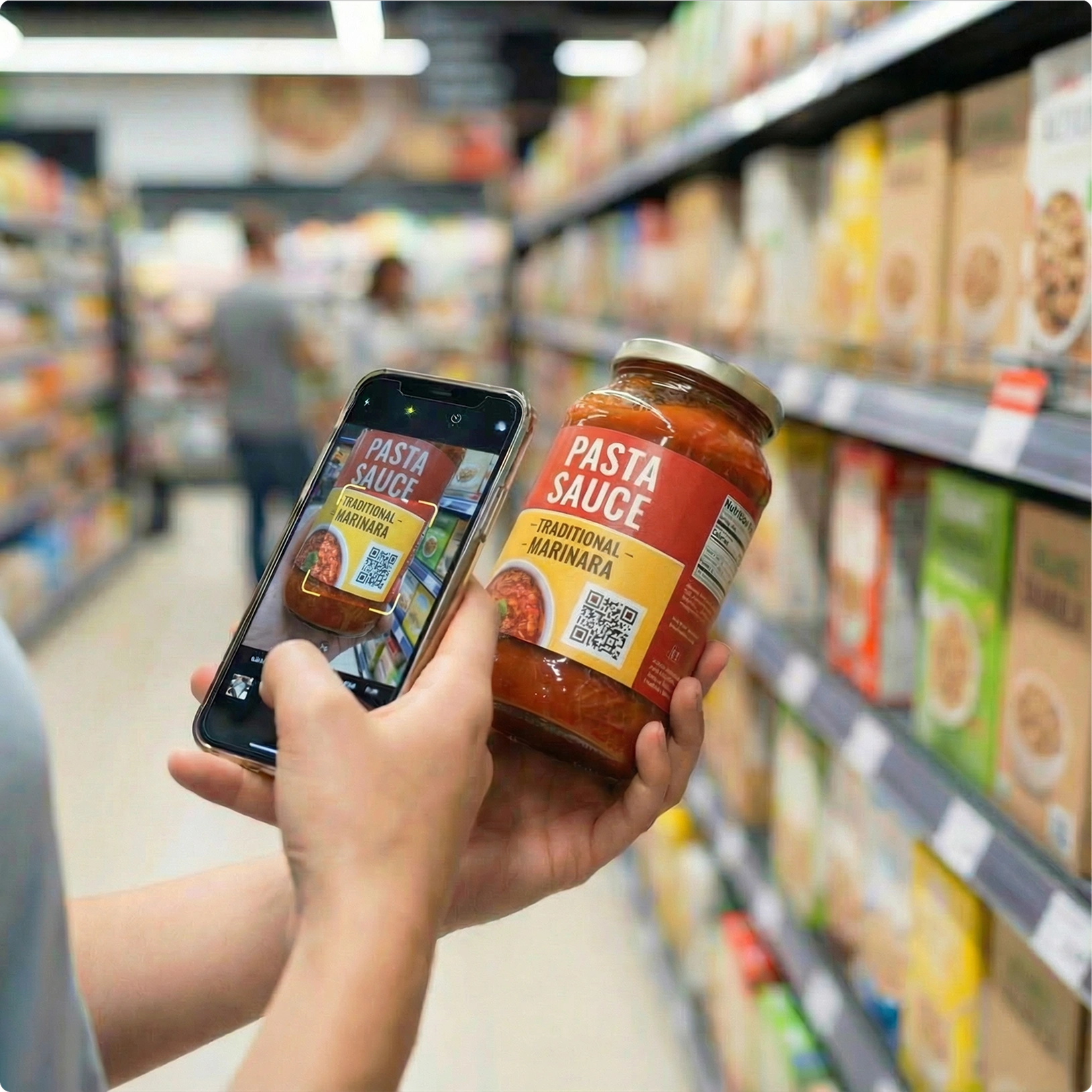
QR Codes make that possible by turning every label, box, or bottle into a digital touchpoint. With a quick scan, shoppers can view product details, tutorials, offers, or authenticity checks, while brands gain valuable insights into customer behavior. It’s a simple, cost-effective way to bridge the gap between physical packaging and digital engagement.
Here are the top benefits of using QR Codes in your food brand packaging:
Building trust through transparency

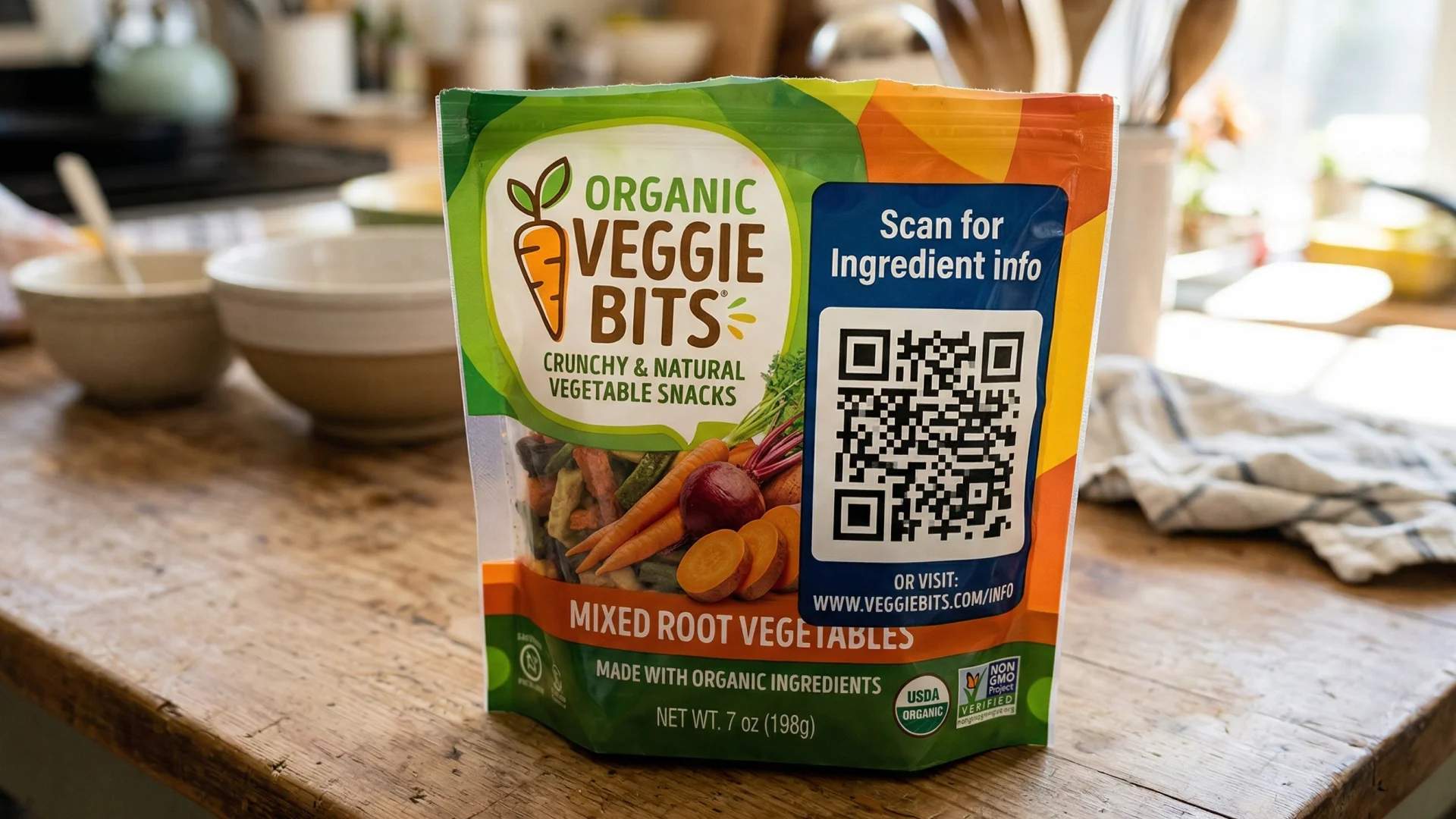
QR Codes on packaging can lead customers to vital information that won’t fit on the packaging. You can include details on sourcing, certifications, allergens, how the product is made, and the story behind it. This builds customer loyalty and trust. All with a single scan.
This strategy aligns with broader movements such as the clean label trend, where consumers look for simple, transparent, and trustworthy food branding.
Staying ahead of regulations
QR Codes help food manufacturers comply with evolving regulations from agencies such as the FDA that require improved transparency, food safety, and supply chain traceability.
The FDA is encouraging the use of QR Codes on food labels for easier certificate authentication, fair trade practices, and enhanced food traceability. They streamline verification processes, especially for export certificates, by enabling stakeholders to easily authenticate documents through scanning. This digital shift aims to expedite procedures that previously required more manual intervention
It’s wise to stay ahead of these regulations and become early adopters. Many leading food and beverage brands are already using QR Codes on their packaging.
Food safety
A major challenge for food brands is managing expired goods and tracing them regularly. This pertains to food safety concerns and is a significant cost contributor for FMCG brands.
With QR-enabled traceability, it’s easier to detect and address counterfeit or expired goods and provide real-time validation of authenticity.
Scanning a QR Code can instantly display expiry dates, manufacturing details, and recall status, enabling both consumers and retailers to verify whether the product is still safe for use.
Marketing and engagement
The benefits of QR Codes on food packaging extend beyond technical details and regulatory compliance.
If used correctly, QR Codes can help with branding and attract customers. They can bring connected, interactive experiences, collect real-time analytics on scan behavior, and support targeted offers. More on this later.
Read more on how to choose the best QR Code generator
How to use QR Codes for food packaging
Food brands, both big and small, are finding innovative ways to use QR Codes on packaging. Below are important use cases that show how a simple scan can enhance transparency, compliance, and brand building.
Providing additional information
Product packaging is limited and valuable real estate. QR Codes let you provide detailed information regarding products. As consumers become more conscious about what they buy and eat, this is shifting from a ‘nice to have’ to a must-have feature for brands.
You can have dedicated pages with ingredient origins, health benefits, allergen info, and nutritional data. Here’s an example from Sensei Farms, a Hawaiian fresh produce brand. They use QR Codes to provide detailed information and catalogs:

Shoppers on scanning are guided to the farm’s website to learn more about its range of products and view nutritional information and recipes.
Sonia Lo, CEO of Sensei Farms, states that the brand’s vision is to inspire wellness in the people of Hawaii.
“QR Codes are one of the simple, yet dynamic technologies that will pave the way for a smarter agriculture industry, helping consumers to better connect with their foods and Sensei Ag to better understand customer eating and purchasing preferences.”
Consumers can scan to learn about ethical sourcing, fair labor practices, and sustainability efforts related to the product.
Traceability and safety
Tracking product supply chains from farm to store shelf creates transparency, helps verify authenticity, and ensures food safety through recall alerts or expiry date checks.
For brands, this also streamlines supply chain oversight by capturing scans and production data at every step, thereby reducing the risk of counterfeits, contamination, or mishandling. The result? A transparent, accountable supply chain that reassures consumers and protects brand integrity.
Read more about Smart packaging to understand how packaging can enhance customer experience and more.
Marketing, promotions, and engagement
QR Codes can be used to run marketing campaigns and improve customer engagement.
- Promotions: You can run limited-time promotions where customers can scan a QR Code and submit purchase proofs to get discount coupons or cashback.
- Social media engagement: Make your social media handles instantly accessible with QR Codes on your food packaging. Encourage shoppers to tag your brand or engage with your latest content.
- Boost customer satisfaction: Let consumers reach your customer service team instantly by scanning a QR Code. With call, email, or SMS QR Codes, shoppers can contact support or send predefined messages with just a tap.
- Community challenges: Launch a scan-to-join challenge like a weekly recipe swap, sustainability pledge, or fitness mini-challenge.
- Link to digital content: Recently launched a video ad campaign? Get more visibility with a QR Code placement on the packaging.
- Recipes and cooking tips: Link QR Codes to recipe ideas, encouraging consumers to try new dishes and create profiles for food exploration.
A celebrity chef, Hari Ghotra, launched his brand of frozen curry sauces called ‘Hari Ghotra Easy’. Each sauce’s packaging contains QR Codes that link consumers to six recipe suggestions.

The brand aims to help consumers recreate the Indian flavors at home. Each sauce is free of additives, preservatives, and gluten, suitable for vegetarians, and equipped with recyclable cardboard packaging.
Social impact and well-being
Let your packaging champion the values your brand stands for. Use QR Codes to share stories about community initiatives, charitable partnerships, and social responsibility efforts in a way that feels authentic and engaging.
Showcase sustainability and eco-friendly practices such as zero-waste, responsible farming, and fair trade sourcing.
You can also link to free, wellness-driven resources, such as nutrition guides, mental health help, meal planning tools, or healthy living challenges, that genuinely support your consumers’ well-being. By turning your packaging into a gateway for positive impact, you reinforce your brand’s purpose far beyond the product itself.
Tetra Pak, a leading food packaging and processing company, used QR Codes on its packaging to educate consumers on its sustainability practices. Consumers could scan the URL QR Code to access games that followed the themes of reduce, reuse, and recycle.
The campaign achieved 43,397 QR Code scans on packaging, 49,584 users that played the game, and 513,951 web page views with an average of two minutes spent on the page.
Creative campaigns
QR Codes can go beyond product information. Use it creatively to build your brand image and leave a memorable impression, long after purchase.
- Scan-to-cook AR mode: Link a QR Code to an augmented-reality step-by-step cooking demo that appears right on the kitchen counter.
- Limited-edition “secret menu”: Create rotating, scan-only recipes or product uses that make the customer feel like an insider.
- Interactive celebrity engagement: QR Codes allowing fans to take virtual selfies with a celebrity.
- Kids’ activity zone: Link to coloring sheets, mazes, or character-led mini-stories related to the product — perfect for cereals, snacks, juices.
- “Meet the maker” video postcards: Let customers watch 30-second clips from farmers, chefs, or production teams for a more human connection.
- Seasonal mood surprises: Switch the destination based on the month or holiday — winter playlists, Ramadan recipes, Diwali craft ideas, etc.
In collaboration with the Italian National Agency for Tourism, Nutella, manufactured by Ferrero, launched their Ti Amo Italia (I Love You Italy) campaign.
The campaign’s 30 limited edition Nutella bottles include QR Codes to allow consumers to view a virtual tour of Italy’s historical landmarks, such as Venice in Veneto, Cinque Terre in Liguria, and Lake Como in Lombardy, to name a few.

The purpose of this campaign is to let consumers virtually travel to Italy’s most vibrant locations from the comfort and safety of their homes.
QR Codes on food packaging: things to keep in mind
1. Add a frame with call-to-action
Add a frame to your QR Code along with a call-to-action text. Give your QR Code a practical intent to prompt consumers to scan it.
Tailor your CTA to be consumer-centric and personalized for quick response times and higher conversion rates. According to HubSpot’s research, personalized call-to-actions convert 202% better than basic ones.
2. Pick the right QR Code size for food products
One of the most common mistakes is printing your QR Code too small, rendering it unreadable by your smartphone.
The standard size of your QR Code depends on the 10:1 distance-to-size ratio between your smartphone and the QR Code. This means that the distance between your phone and the QR Code should be ten times the size of your code (in inches).
For example, if your QR Code is 1 inch in size, it should be scanned from a distance of 10 inches.
Otherwise, your QR Code’s standard size should be at least 0.4 inch x 0.4 inch (1 cm x 1 cm). This size is suitable for QR Codes on food packaging.
Additionally, you need to download the QR Code in the proper format to resize it as per your packaging needs.
For iPhone users, the issue of QR Code size won’t be an issue. The newest iOS 14 update makes it easier to scan QR Codes, even if they’re small in size or wrapped around an object.
3. Provide instructions for scanning food QR Codes
QR Code scanning instructions on food packaging to help consumers
Not all consumers are familiar with scanning food QR Codes. To make it easier for them, provide brief instructions on your food packaging.
Make sure that you include details such as the versions of Android (Android 8 and higher) and iOS ( iOS 11 and higher) required to scan QR Codes using their smartphone’s camera.
If consumers’ smartphones aren’t upgraded to the latest Android or iOS versions, they may need to download a QR Code scanner app. To help them, provide a link to a QR Code scanner app that they can install.
Here’s how you can scan QR Codes with Android phones without an app.
4. Add a brand logo to food QR Codes to reinforce branding and trust

Incorporate your brand’s logo in your QR Code for instant brand recognition. Consistent brand representation increases revenue by 33% (Lucidpress).
Pam Moore, CEO of Marketing Nutz, states that it takes 5-7 brand impressions for consumers to remember your brand.
This furthers the need for QR Codes to amplify brand consistency across all campaigns.
5. Use dynamic QR Codes
Oftentimes, it’s an immense task to reprint QR Codes for every new campaign rollout. It increases printing costs and has detrimental effects on the environment due to the amount of paper wastage.
Dynamic QR Codes solve this problem and enable you to modify QR Code campaigns at any time. The new changes are instantly visible on food packaging.
Better yet, a dynamic QR Code for food products is a trackable QR Code that you can use to track the number of scans, the devices used, and their locations. The built-in analysis lets you measure campaign success and determine which channel garners the most traction.
Food brands that are using QR Codes the right way
1. Tetra Pak incorporated QR Codes to promote sustainability practices
Tetra Pak, a leading food packaging and processing company, used QR Codes on its packaging to educate consumers on its sustainability practices. Consumers could scan the URL QR Code to access games that followed the themes of reduce, reuse, and recycle.
The campaign achieved 43,397 QR Code scans on packaging, 49,584 users that played the game, and 513,951 web page views with an average of two minutes spent on the page.
2. The Cookie Project uses food QR Codes to let consumers contact bakers
The Cookie Project, a New Zealand-based social enterprise, launched its Christmas Cookie Bundle to promote more employment opportunities for citizens with disabilities.

QR Codes on the back of the cookie bundles direct consumers to information about the baker, along with an option to leave them a message of encouragement.
3. Futurity Manufacturing uses QR Codes to share event details and merchandise

Futurity Manufacturing, a New Zealand-based packaging brand, partnered with The Longline Classic to provide customized bottles to event-goers at their concert. Each bottle featured a QR Code that directed consumers to a website that contained the setlist. It is also linked to a map of the site and access to free merchandise, tickets, and VIP experiences.
Read more: 36 Epic QR Code examples from brands
4. PizzaForno uses QR Codes for 360-degree marketing

PizzaForno is an automated pizza vending machine located across the US.
Jake Randall, Co-Founder of Modall, a software development and product agency talks about how he worked with PizzaForno to build customer engagement with the help of QR Codes.
“We designed and deployed QR Codes on their pizza boxes, kiosk screens, kiosk wraps, and stickers. Our goal was to drive customer loyalty and retention. The “Earn Free Pizza” QR Code is part of the marketing campaign we designed to increase downloads of the PizzaForno mobile app.”
Once customers join the app, they receive a unique loyalty code that lets them earn rewards. For every 10 pizzas purchased using their loyalty code, the 11th pizza is free.
Jake also shares how they track the success of this QR Code campaign.
“We are primarily tracking total scans and app downloads generated from the campaign. The traction has been strong because the value proposition is clear, and the QR Code placement on the packaging removes friction for customers. Since implementing it, the page is getting 42% more pageviews than the previous period, and 33.17% more page views per active user.”
Use QR Codes to enhance your food product packaging
QR Codes transform ordinary packaging into powerful, measurable touchpoints—delivering transparency (ingredients, traceability, recalls), boosting engagement (recipes, social media, promotions), and amplifying your brand’s social impact and values.
Start small: put a dynamic QR on one SKU that links to a rich product page (origin, nutrition, and a short recipe), add a branded frame and CTA, then track scans and behaviour.
Ready to make your packaging do more? Create trackable QR Codes, add logos, edit destinations anytime, and view analytics with Uniqode’s QR Code Generator. Get started on Uniqode today and turn every pack into a growth channel.
Frequently asked questions
1. How many users scan QR Codes on food packaging?
Response Media’s study shows that 92% of consumers want access to transparent information on the product’s labeling. This validates consumers’ need for accessing information by scanning QR Codes on food packaging.
Moreover, 65% of consumers scan QR Codes for financial gain in the form of cashback, rewards, and incentives (Source: Packaging Europe).
2. How do I print my food QR Code?
After creating your food QR Code, you can download it in five formats – SVG, JPG, PNG, EPS, PDF.
3. How do I create a QR Code for food products?
Step 1: Go to Uniqode’s QR Code Generator.
Step 2: Select the QR Code type (URL, SMS, Call, Email, vCard, Plain Text).
Step 3: Fill in the required fields.
Step 4: Customize your QR Code by adding a logo, modifying the eye color and shape, and the background color.
Step 5: Test the QR Code by scanning it.
Step 6: Download the QR Code.
4. Can I white label my food QR Code?
Absolutely. With Uniqode’s robust QR Code generator, you can use a custom domain, add your logo, and customize your QR Code to represent your brand throughout.
5. Will QR Codes on food packaging still be relevant in 2021?
Yes, QR Codes will still be relevant in 2021. Since the global pandemic has altered consumer behavior and attitude, brand managers have adopted digitalized product packaging to adapt to this shift.
Shashank is a content marketer at Uniqode who turned to writing to pursue his natural calling after 2+ years of working in the product team. He aims to educate folks on the brilliant yet underrated technology of QR Codes. With more than a dozen Tofu and Mofu pieces under his belt, he explores how QR Codes can be used to solve challenges for businesses across all verticals. While he’s not educating users on the benefits of QR Codes, he’s also a student of the evolving marketing landscape.