QR Codes for Cinema Advertising: Everything You Need to Know
Explore the myriad of use cases and best practices for QR Codes in cinema advertising from this complete guide! Upgrade your movie advertising strategy and enhance audience engagement.
Cinema-advertising content already promised you six placements: screen, poster, cup, ticket, trailer, coupon board, one instruction each, no real distinction between them. What actually decides whether any of those codes gets scanned is simpler, and it gets skipped every time: whether the audience has a phone out at that exact moment.
Uniqode, the QR platform running campaign codes for studios like Lionsgate, sees the same pattern across nearly every release: adoption is high (76% of marketers now use dynamic QR Codes), but so is silent failure (29% of consumers report hitting an expired or dead code). That gap is what the rest of this piece is about.
What is the role of QR Codes in cinema?
QR Codes give cinema advertising a way to turn a fixed, one-way message, a trailer on screen, a poster in the lobby, a logo on a popcorn tub, into something a moviegoer can act on immediately. Scan the code, and the ad stops being just a visual: it becomes a link to a trailer, a discount, a feedback form, or a ticket booking, without anyone needing to remember a URL or search for the movie later.
For cinema specifically, that role matters more than in most advertising formats. A movie theater is one of the few remaining places where an audience sits captive and undistracted for two hours, then walks past posters and concession counters on the way out. QR Codes let a studio or theater chain convert that attention into a measurable action, a scan, a click, a signup, instead of an impression nobody can trace back to a result.
The role isn't fixed to one placement. A code on a movie poster does a different job than one on a concession cup or a pre-show ad slide, which is exactly what the rest of this piece works through: where each placement actually earns a scan, and where it doesn't.
Moment of use decides whether a cinema QR Code gets scanned
Cinema QR Code advertising is not one tactic with a size and a CTA variable. It's a moment-of-use problem: whether the audience can have a phone out determines whether the code gets scanned at all.
Vendor content treats screen, poster, cup, and ticket QR Codes as the same move with a different background, varying only in size and call-to-action wording. The variable that actually matters is etiquette. A code flashed mid-film competes with the one rule every theater enforces without exception: phones away once the movie starts. An usher's flashlight finds a lit screen in a dark row within seconds, and the row around that phone notices before the usher does. A code on a concession cup or a lobby poster fights none of that.
The real boundary runs along timing, not medium: before the room dims versus after. A pre-show ad loop, playing while the audience still checks showtimes and texts about seats, is a phone-out environment exactly like the lobby. The instant the film starts, that environment disappears, and a code shown minutes later gets a different result entirely, not a smaller version of the same one.
Where on-screen QR Codes actually work
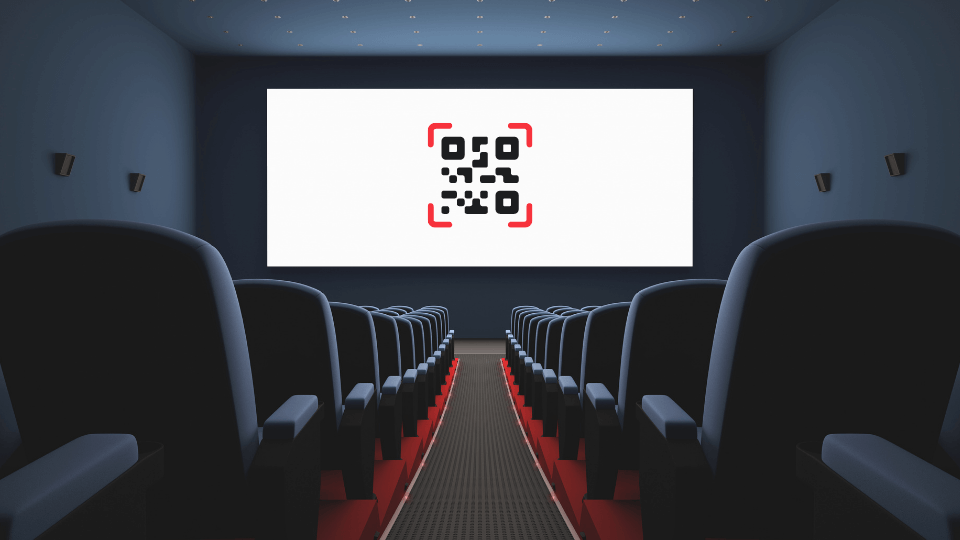
Pre-show ad loops are where on-screen QR Codes actually work: shown before the room dims, they get the same click-through as a code on any screen the audience already has open on their phone, since they're still checking showtimes and texting about seats. Wait until the film starts, and the same code runs into the etiquette problem from above instead of avoiding it.
Netflix's Red Notice used the one on-screen placement that gets around that problem: it showed a QR Code once, briefly, inside a scene in the film itself, leading to a YouTube video of the movie's bloopers. It worked because it was a single scripted moment the audience was already watching, not an ad interruption. A trailer-reel code shown during an active film, outside a moment the story creates, doesn't get that same pass.
Screen placement also changes the sizing math: a code that scans fine on a cup from arm's length disappears at projection distance. The rule is minimum size equals scanning distance divided by 10, so a code read from 30 feet needs to print 3 feet across, not the postcard-sized version on a poster. Our QR Code sizing guide covers the full formula, and the same logic applies to QR Codes on TV screens: check whether the audience watching can act on it right then.
Use cases of QR Codes in cinema advertising
QR Codes show up across nearly every stage of a moviegoer's visit, from the poster in the lobby to the receipt at checkout. Here is where cinema marketing teams are already using them, and what each placement is actually good for.
Movie promotions
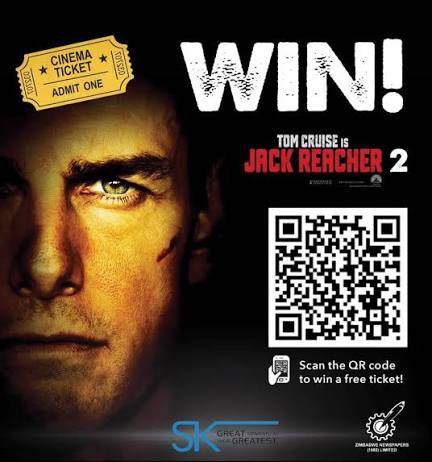
One of Iron Man 2's most prominent posters embedded a QR Code into Iron Man's suit artwork, leading to a page with the release date, photos, the trailer, and social handles, the kind of destination a social media QR Code handles well today. The poster hung in lobbies for weeks, and every scan happened on the viewer's own schedule, not tied to a screening time.
At-home and packaging tie-ins
Agro Tech Foods printed a QR Code on an Act II popcorn tub timed to the trailer premiere for Good Newwz, a Dharma Productions and Zee Studios release, letting people watch the trailer at home while eating the tie-in popcorn. Uniqode's State of QR Codes 2026 report found 40% of consumers already scan codes on product packaging, a behavior that transfers directly to a popcorn tub or a concession cup inside the theater.
Contactless ordering
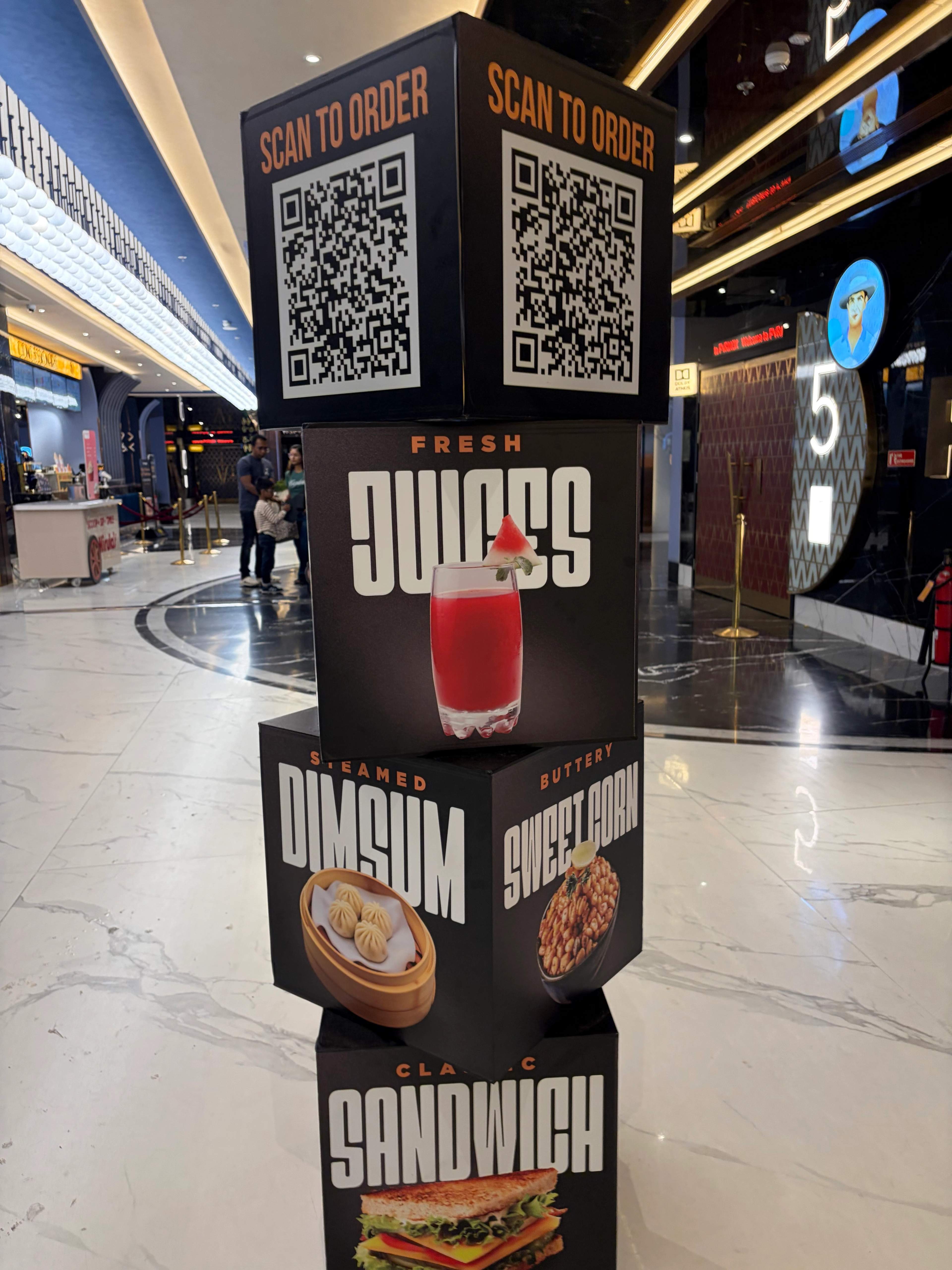
Scanning at the concession counter lets a moviegoer choose snacks on their phone and pay without touching a shared screen or standing in a second line. Orders route straight to the kitchen or counter staff, so the same headcount can handle a bigger rush before a busy showtime. A QR Code generator for businesses handles this without a custom build.
Ticketing and entry. Self-check-in kiosks let moviegoers who booked ahead scan a ticket code and walk straight to their seat, no counter stop required. This is now standard infrastructure at most major chains, not a pandemic-era workaround, and it moves the longest line in the lobby, the one for people who already paid, out of the way entirely.
Feedback collection
A code on a ticket or a popcorn tub takes an exiting moviegoer straight to a short rating form. Two questions beats a follow-up email days later; whoever is asking, theater ops or the studio itself, gets an answer while the visit is still fresh.
Digital marketing and loyalty
Warner Bros Entertainment ran coupon QR Codes tied to Mission: Impossible Fallout merchandise, discounts triggered by a scan instead of a code typed in at checkout. "Scan this QR Code for 20% off your next tickets" beats a generic "scan to learn more": reward and instruction in one line. 52% of consumers scan specifically for a discount or offer, per Uniqode's State of QR Codes 2026 report.
Across all six, the placement changes but the mechanics don't: match the code to a destination the moviegoer actually wants at that exact moment, whether that's a trailer, a menu, a rating form, or a discount. Running these across more than one location adds a wrinkle worth planning for early: a chain managing use cases like these across a dozen theaters needs one dashboard where codes are organized by property, not a folder of image files per venue on someone's laptop.
Static vs. dynamic QR Codes for cinema
A QR Code on a poster, cup, or trailer reel can run for weeks in the field, and the team can't always fix a broken destination without reprinting.
- Static QR Codes are fixed at creation. A broken or outdated destination means reprinting everything already out.
- Dynamic QR Codes redirect from a dashboard after printing, so a broken destination gets fixed the moment it's noticed.
- The shared risk: a static code, or a dynamic one on a lapsed subscription, can die silently, and nobody notices until the wrap report shows near-zero scans against thousands of impressions.
- The data: 45% of marketers report fewer reprints after switching to dynamic QR Codes, and 29% have hit an expired or dead code, per Uniqode's State of QR Codes 2026 report.
- The fix: build codes as dynamic from the start instead of discovering the problem after print.
Cinema QR Codes are a placement decision, not a design one
Where a cinema QR Code goes decides more than what it looks like ever will. A code on the screen mid-film fights an etiquette battle it can't win; the same code on a lobby poster or a concession cup scans on the audience's own schedule. And once a code is printed across a multi-week release, the placement decision only holds if the code behind it keeps working: static links can't be fixed after the fact, and even a dynamic one fails silently if the subscription behind it lapses mid-run.
None of this requires guesswork. Match the placement to a moment the audience can actually act on, and build every code as dynamic from day one so a broken link gets caught before the wrap report does, not after.
Frequently Asked Questions
- What are the benefits of using QR codes in cinema advertising compared to traditional ads?
QR codes in cinema advertising create measurable, interactive experiences that leverage the immersive environment of movie theaters, where large visuals, surround sound, and undivided audience attention result in higher information retention rates. Unlike static traditional ads, QR codes enable direct connections between advertisers and viewers, allowing real-time engagement tracking and immediate action from audiences who can scan codes displayed on screens, popcorn boxes, or movie posters.
- What is the best way to integrate QR codes into movie theater marketing campaigns?
The most effective approach is to embed QR codes across multiple touchpoints including on-screen commercials during intervals, printed materials like popcorn boxes and paper cups, movie posters, and ticketing systems. Dynamic QR codes work best for cinema campaigns as they can be updated to redirect to different landing pages—such as exclusive trailers, merchandise discounts, or feedback forms—without needing to reprint physical materials.
- How do QR codes create engagement opportunities for upcoming movie releases?
Movie producers can launch creative QR code campaigns that reveal exclusive content like behind-the-scenes footage, character reveals, or interactive treasure hunts for highly anticipated releases. These codes can be flashed on cinema screens during intervals or placed on promotional materials, transforming passive viewers into active participants who unlock breadcrumbs of content on their phones, generating buzz and social sharing for upcoming films.
- What are the benefits of using QR Codes in cinema advertising compared to traditional ads?
A scanned code takes a moviegoer straight to a trailer, discount, or feedback form in seconds, instead of asking them to remember a URL from a 30-second screen ad, and it's easier to measure than a print or broadcast ad.
About the Author
Ektha is a QR code expert with years of research and analysis into the evolution of QR codes. Having written over 70 in-depth articles on QR technology, she has developed a comprehensive understanding of how QR codes are transforming industries. Her insights, including The State of QR Report, have been featured in leading publications. With a passion for simplifying complex topics and providing actionable strategies, Ektha helps businesses leverage QR codes to enhance their 'phygital' connections.