
Event ROI: How to Measure, Calculate, and Maximize Return From Every Event Capture Lead

Most event ROI numbers are inaccurate for a simple reason. When leads reach the CRM, they often lose their event tag before the deal closes. As a result, the revenue from that event is credited to another channel. This guide explains the formula, highlights the key metrics to track, and shares solutions to keep your pipeline traceable from the first scan to the closed-won deal.
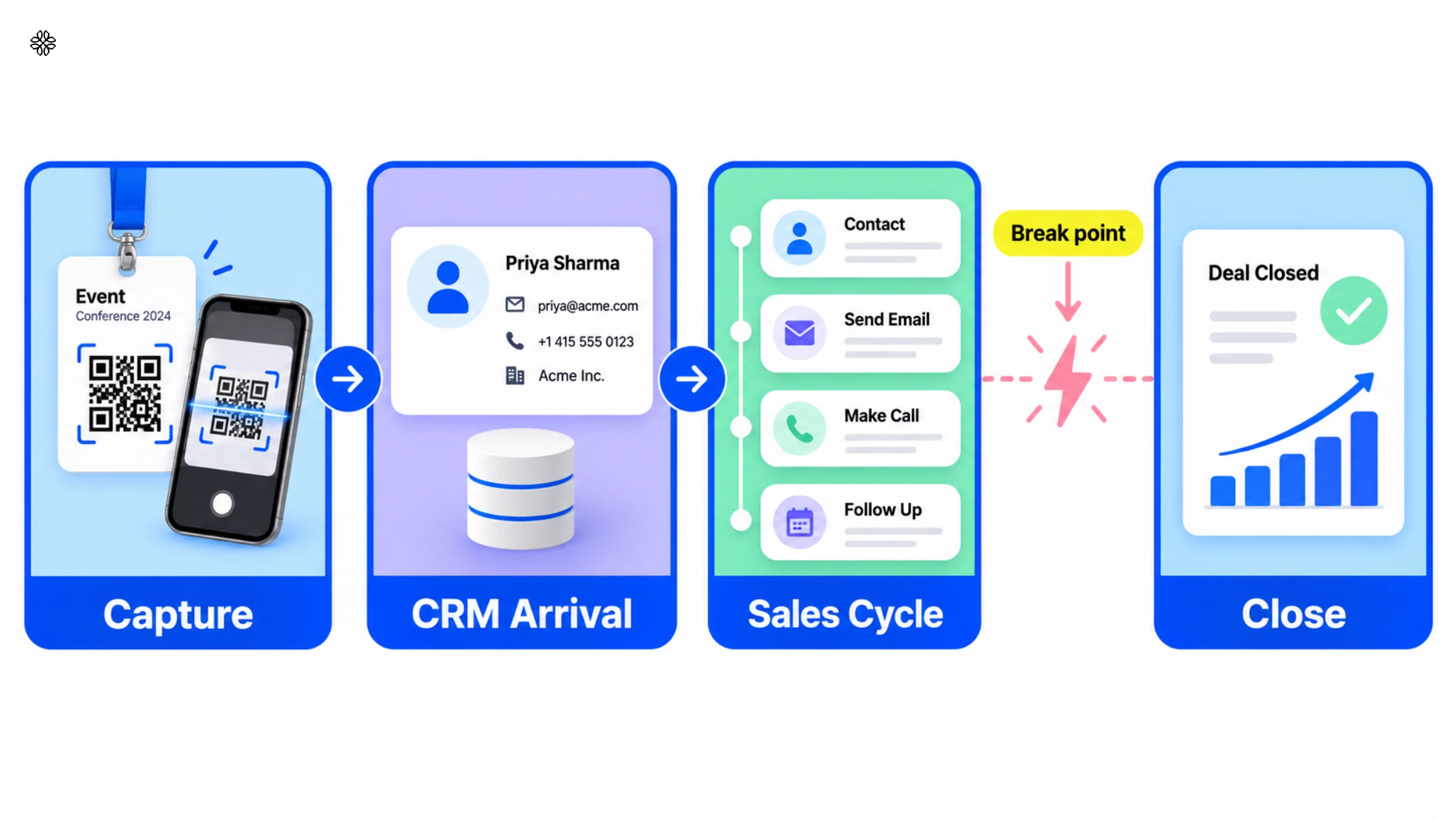
Event lead capture ROI tells you how much value your event generates from the leads you collect, compared to what you spend to capture, process, and follow up with them. It is not about the total cost of the event, just the investment in lead capture. Many teams get this calculation wrong. The issue is not that leads fail to reach the CRM. Instead, the problem is that once leads are in the CRM, they often lose their event tag before the deal closes. As a result, the revenue from these leads is recorded as 'inbound' or 'unknown,' rather than being credited to your event.
In this guide, you will find everything you need to master event lead capture ROI. We break down the essential formula, highlight eight key metrics to track from capture to close, and walk you through the cost factors unique to capturing and processing event leads. Plus, you will discover a practical framework to help you prove pipeline impact to those who hold the purse strings for next year’s budget. Still working on your capture strategy? Start with our section on event lead generation tactics to lay the right foundation.
Key takeaways
- Event lead capture ROI ≠ total event ROI. It isolates the return on capturing, processing, and following up on leads, not venue, sponsorship, or booth costs.
- The real leak isn't capture, it's attribution. Leads that reach the CRM still lose their event tag before the deal closes, so revenue gets misattributed to "inbound" or "unknown."
- The formula only works if the capture cost and event cost stay separate. Mixing them produces a number that defends the wrong budget line to the wrong stakeholder.
- Eight metrics carry the whole story: leads captured, qualified leads, cost per qualified lead, speed to CRM, follow-up readiness, lead-to-opportunity conversion rate, pipeline generated, and closed-won revenue by event.
- CRM tag persistence is the highest-leverage, least-visible factor in whether an ROI number is trustworthy.
Four fixes move the number fastest: qualify at capture, get leads into to CRM within 24 hours, standardize follow-up within 48 hours, and lock the event tag against manual override. - Maximizing ROI means breaking the pipeline down by event and by rep, not reporting a single aggregate number, so budget decisions follow conversion data rather than booth traffic.
What is event ROI? (and why the standard definition undersells the problem)
Event ROI, at its core, is the financial return an event generates relative to its total cost. This includes every expense: venue, sponsorship, booth construction, travel, and even swag. However, if you are a VP trying to justify a lead capture budget, this broad ROI number is not the one you need. That is because costs such as venue and sponsorship remain unchanged, no matter how well your lead capture performs. Instead, event lead capture ROI focuses on a specific part of the picture: the revenue generated from the leads you actually captured, weighed against the cost of capturing, enriching, and following up on them. This is different from event ROO, or return on objective, which measures goals like brand awareness that never enter the lead capture pipeline.
The real challenge with event lead capture ROI is not how you measure it, but how you remember it. Your CRM needs to keep track of which event produced each opportunity, who captured the lead, and when it happened, even months down the line. Unfortunately, the typical sales cycle often erases this information through merges, re-categorization, and manual updates. Ultimately, B2B event ROI is only as reliable as your ability to trace revenue back to the specific leads you captured.
Why calculating event ROI is important
Calculating event lead-capture ROI is crucial, especially when leadership tends to view the capture line item as just another cost. If you want to prove the value of lead capture, you need to show how those leads actually turn into revenue, not just how many badges were scanned at the booth. The real question isn’t whether the event took place, but whether your capture process converted attendees into a measurable pipeline. With paid search or email, you can track cost per acquisition instantly, since every click, conversion, and dollar spent is logged in a single system. Event marketing is different. Here, lead capture is often where the process breaks down: a badge scan and a closed-won deal live in separate systems, sometimes months apart, and are connected only by a tag that must survive the entire sales cycle.
This disconnect is exactly why the capture line item is often the first to go when budgets get tight. If a channel has a live dashboard, it can justify its spend on the spot. But if your capture process takes three months and a CRM export just to produce a number, it starts to look unmeasurable, and unmeasurable spend is the easiest for a CFO to cut. The VP who can walk into a budget review with a clear, defensible ROI for event lead capture has the advantage.
How to measure ROI in event marketing (the framework)
Measuring ROI for event marketing can seem daunting, especially when lead capture is the only lever you can control. The answer to how to measure ROI from live events is straightforward if you break it down into four clear steps. First, set a specific goal for lead capture. Next, make sure you attribute each lead at the moment of capture. Then, maintain that attribution as leads move through your CRM. Finally, compare the revenue generated to the total cost of capturing and processing those leads.
- Define the capture goal before the event, not after it. A pipeline-focused capture target and a badge-count target get measured against completely different baselines, and deciding which one you're running after the fact just guarantees an argument later about what the numbers were supposed to prove.
- Capture attribution at the point of contact. Every lead needs a source tag the moment it's scanned, not a note a rep adds from memory three days later when half the context from the conversation has already faded.
- Preserve that attribution through the CRM lifecycle. This is the step most teams skip entirely, and it's the one that determines whether the final number means anything at all once the deal actually closes.
- Calculate revenue against the fully loaded cost of capture, and expect to do it later than you'd like. Event lead capture ROI is a lagging metric by nature. The true number isn't knowable until one to two full sales cycles after the event closes its doors.
The event ROI calculation formula
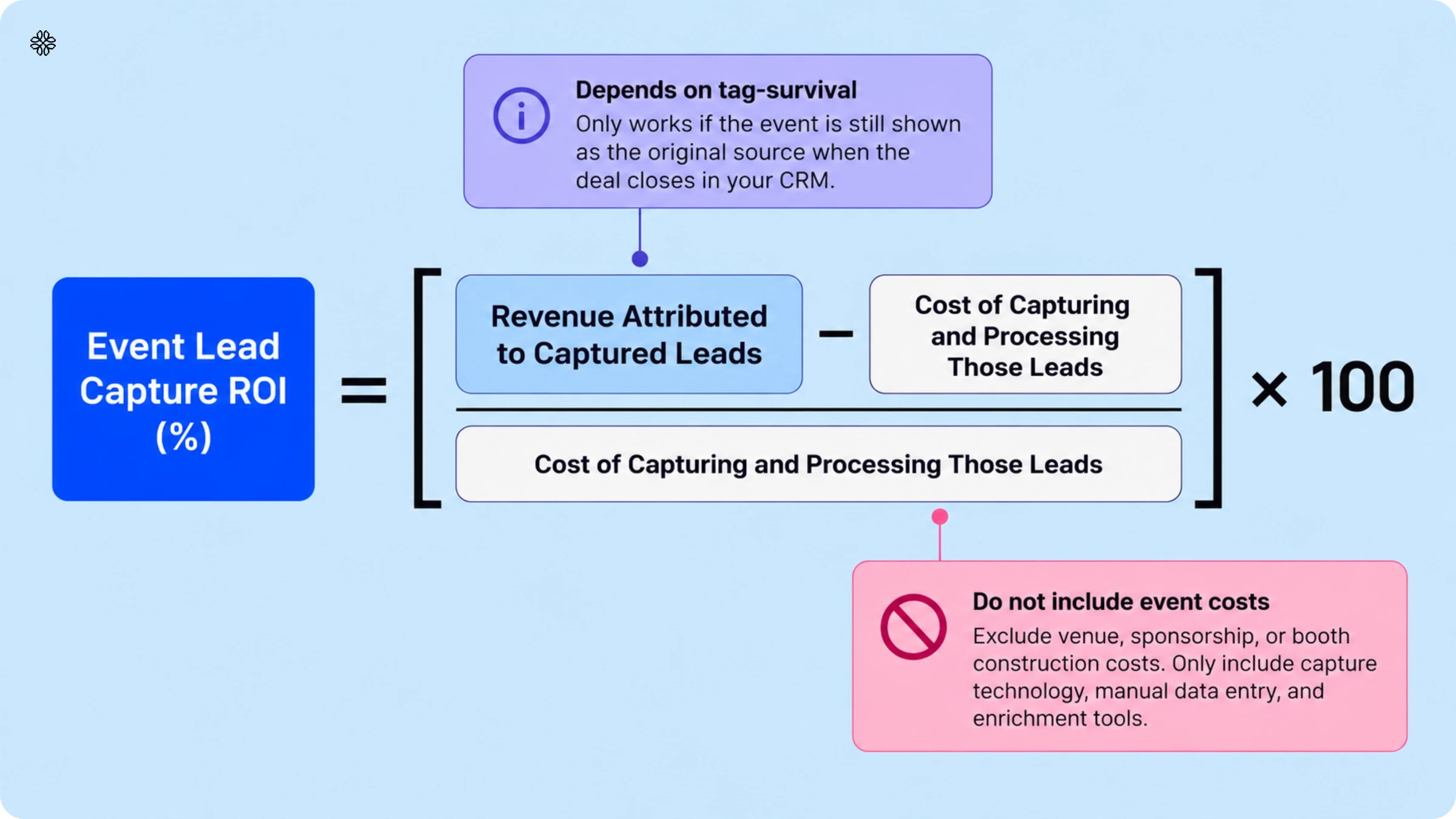
Event Lead Capture ROI (%) = [(Revenue Attributed to Captured Leads - Cost of Capturing and Processing Those Leads) / Cost of Capturing and Processing Those Leads] x 100
That’s the core formula to calculate event ROI. However, isolating these variables is trickier than it seems. The numerator only works if, when a captured lead's deal finally closes, the CRM still shows this event as that deal's original source. The denominator is just as easy to miscalculate. 'Cost of Capturing and Processing Those Leads' should cover capture technology, manual data entry, and enrichment tools. It should not include venue, sponsorship, or booth construction costs, as those belong to the overall event budget, not the capture process. Mixing these up is how teams end up justifying the wrong figures to the wrong people. For example, a CFO interested in lead capture ROI is not looking for details about booth rental.
If you do not yet have full revenue attribution, cost per qualified lead is a useful leading indicator. The formula is simple:
Cost Per Qualified Lead = Cost of Capturing and Processing Leads / Number of Qualified Leads
While this metric does not reveal the actual return from lead capture, it gives your VP a solid number to report while the true results are still working their way through the sales cycle. A live calculator, tailored to your own cost inputs, is much more practical than a spreadsheet that needs to be rebuilt every quarter.
What factors matter to calculate event ROI
Five factors determine whether an event lead capture ROI calculation is trustworthy:
- Capture completeness, whether the tool captures every touchpoint, badge, digital business card, verbal exchange, or only badge scans, changes how many real conversations even enter the ROI calculation in the first place.
- CRM tag persistence determines whether attributed revenue survives from the point of capture all the way to the point of close, and it's the factor with the least visibility of the five.
- Attribution window length increases measured ROI the longer it runs, since more downstream deals get caught in the count, but it delays reporting past the point where leadership wants an answer.
- Lead-to-opportunity conversion timing sets how soon a directional number turns into a real one, and it varies enormously depending on deal size and buying committee complexity.
- Qualification strictness at the point of capture trades raw lead volume for eventual accuracy, since a stricter bar produces fewer leads and a more trustworthy final number.
Event ROI metrics to track
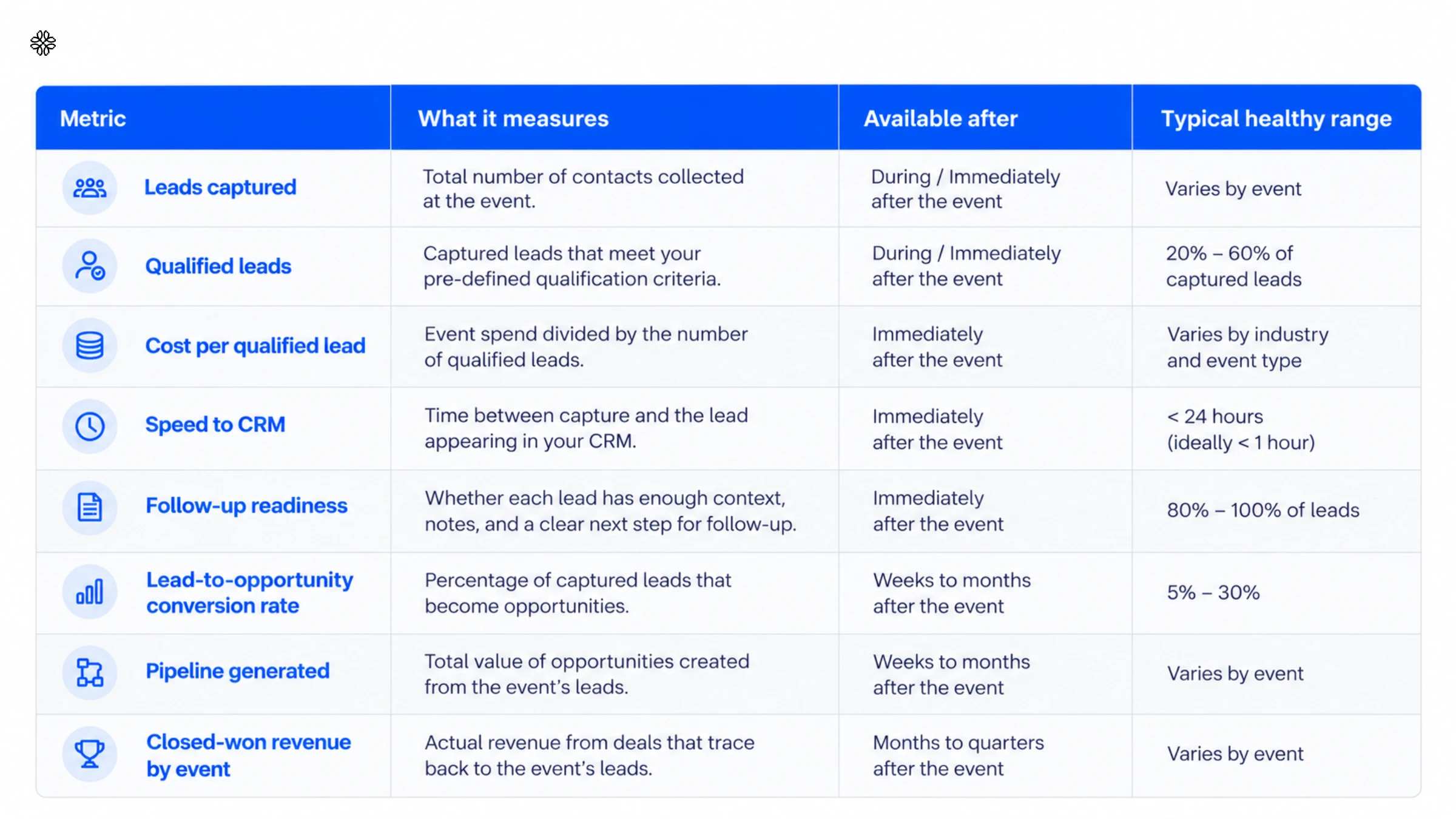
When it comes to tracking event ROI at the lead capture stage, there are eight key metrics you simply cannot ignore. These include leads captured, qualified leads, cost per qualified lead, speed to CRM, follow-up readiness, lead-to-opportunity conversion rate, pipeline generated, and closed-won revenue by event. Whether your event is in-person, virtual, or a blend of both, these eight capture-to-close metrics are your go-to tools for measuring real results, not just vanity numbers.
- Leads captured is the raw count of every contact collected at the event, across badge scans, business cards, and manual entry. It's the top-of-funnel number, necessary to track and nowhere near sufficient on its own to justify next year's budget.
- Qualified leads are captured leads that clear a pre-defined bar: role, company size, or expressed intent set before the event starts, not decided retroactively once the leads are already sitting in a spreadsheet. The qualified-lead share of total leads captured varies widely by event type, audience fit, and how strictly that bar gets enforced at the point of capture, which is exactly why the qualification decision belongs before the event, not after it.
- Cost per qualified lead divides the cost of capturing and processing leads by the number of qualified leads, and it works as a leading indicator while revenue attribution is still lagging behind the sales cycle, giving a team something to report in the gap between the show and the close.
- Speed to CRM measures the time between a lead being captured at the event and that lead appearing as a workable record in the sales CRM. Industry research on B2B follow-up timing consistently shows that response speed has an outsized effect on eventual conversion, which makes speed to CRM one of the metrics most directly tied to whether follow-up happens at all, let alone happens well.
- Follow-up readiness measures whether a lead record carries enough context, notes, tags, enrichment, a clear next step, for a rep to follow up meaningfully within hours. A lead can arrive in the CRM fast and still be useless if it lands as a bare name and email address with nothing to prompt the rep's memory of the actual conversation.
- Lead-to-opportunity conversion rate, pipeline generated, and closed-won revenue by event close the loop: they measure what actually happened to the leads after capture, not just how many arrived on day one. Faster speed to CRM and higher follow-up readiness both increase lead-to-opportunity conversion rate. A low qualification bar decreases it even when the raw lead count looks strong on the post-event recap slide.
- Pipeline generated is the total value of opportunities created from the event's captured leads, tracked by event so a VP can compare one show's downstream value against another's instead of relying on lead count alone.
- Closed-won revenue by event is the final number: actual revenue from deals that trace back to a specific event's captured leads. It's the number every other metric in this list exists to predict, and the only one that settles the ROI argument for good.
3 ways to measure event ROI
Measuring ROI on events at the capture stage is all about timing. Typically, there are three main approaches you can use. First, you can track lead capture in real time while the event is happening. Second, you might use short-cycle attribution by monitoring how quickly leads move through your pipeline stages. And finally, you can look at long-cycle revenue attribution by connecting your captured leads to closed-won deals over time.
Real-time capture tracking
Real-time tracking gives you a quick look at the capture process as the event unfolds. You can see how many badges have been scanned, how this year’s capture rate compares to last year, and whether the booth is turning foot traffic into leads as expected. However, it does not show true ROI, since there is no revenue yet, only capture activity.
Short-cycle attribution
Short-cycle attribution looks at how leads progress through the pipeline within 30 to 90 days after the event. This includes tracking the rate of qualified leads, new opportunities, and early deal movement, all linked back to the leads gathered at the show. This is the first meaningful measure that goes beyond just counting activity, but remember, it is not the final result.
Long-cycle revenue attribution
Long-cycle attribution relies on closed-won data from a full sales cycle after the event. This is the only way to get a truly defensible ROI for the leads you capture at a show. However, most teams rarely see it through. The reason is simple: quarterly budget reviews arrive long before a nine-month sales cycle wraps up, and answers are needed now.
Measuring ROI for virtual and hybrid events
Virtual and hybrid event ROI uses the same three-tier measurement approach, but with one key difference: data is captured through registration details, engagement tracking, and virtual booth interactions rather than badge scans. In a virtual setting, fast CRM updates and lead qualification rely even more on strong integration between the event platform and the CRM, since there is no physical badge to verify whether a record is missing. If a sync fails at an in-person event, you still have a stack of scanned badges to sort through manually. In a virtual event, a missed sync leaves nothing to check, so the attribution challenge described in this guide is even tougher in a hybrid format than on a physical show floor.
What are event ROI strategies
Effective event lead capture ROI strategies operate at three levels: pre-event capture goal-setting, in-event capture discipline, and post-event follow-up protocol.
Pre-event strategy
A solid pre-event strategy starts with a clear definition of what counts as a 'qualified' lead and a plan for capturing them. This needs to happen before the booth is even built, not after the event when you are left staring at a spreadsheet full of names. When your team sets a goal, say, 150 qualified leads, you will know within the first hour of the show whether you are on track or need to adjust your approach.
In-event strategy
An in-event strategy gives reps a simple way to record context, notes, tags, and next steps during each conversation. This helps avoid relying on memory later, when busy booth traffic and long drink lines can make details easy to forget.
Post-event strategy
A solid post-event strategy starts with a clear deadline. Every lead you capture should be synced into the CRM, tags and all, within 24 or 48 hours. Waiting until a rep finds time at their desk just will not do.
One of the biggest mistakes teams make is to treat capture ROI as something you report on after the event, rather than a decision you design before it even begins. If you set qualification criteria and tagging rules after the fact, you are simply retrofitting, and that always leads to lost data. These rules end up being applied unevenly, since leads were captured with different expectations. When a team decides what 'qualified' means just before a budget review, they are really just shaping a story to fit whatever numbers the CRM happens to show.
Sales and marketing alignment is the one strategic lever that most programs overlook. More often than not, event ROI strategies fall short because of a communication gap, not because of poor tools. Reps may not even know an event tag exists, or that it needs to stay with a lead throughout the entire deal cycle. A real strategy means making sure sales understands what 'event-sourced' actually means, why the tag matters long after the event is over, and how losing that tag can impact both the pipeline and the marketing team's next budget.
How to improve ROI of events
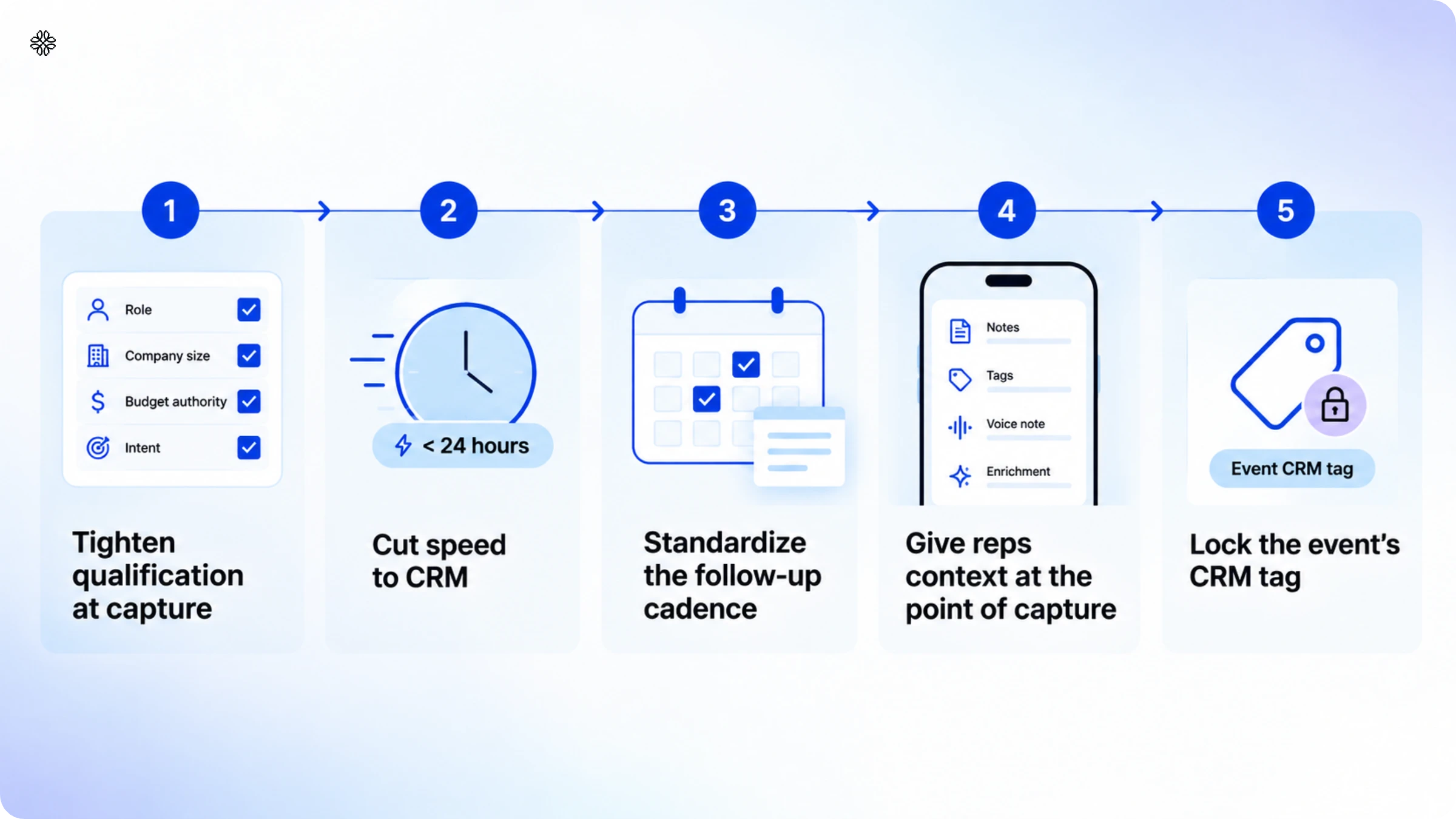
If you want to see a real boost in your event lead capture ROI, start by tightening your lead qualification process right at the point of capture. Next, make sure every lead reaches your CRM in less than 24 hours. Set a consistent follow-up routine with your event lead capture software within the first 48 hours to keep the momentum going. Finally, secure your event’s CRM tag so it stays intact, even if records are merged or re-categorized.
- Tighten qualification at capture by defining the bar, role, budget authority, expressed intent, before the first badge gets scanned, so the qualified count means the same thing on day one of the show as it does in the final report three months later.
- Cut speed to CRM to under 24 hours by removing any manual step between capture and sync. Every hour a lead sits in a spreadsheet or a rep's notebook is an hour it's not getting worked, and cold leads convert at a fraction of the rate warm ones do.
- Standardize the follow-up cadence within 48 hours by giving every rep the same script and the same sequence for the first touch, so follow-up quality doesn't depend on which rep happened to work which lead that particular week.
- Give reps context at the point of capture, not after the fact. Notes, tags, and enrichment attached the moment a lead is scanned close the follow-up-readiness gap directly, because the rep isn't relying on memory of a five-minute booth conversation three days later, once the details of who said what have already faded. Tools that let a rep tag and voice-note a lead at the point of scan solve this in practice: the follow-up context exists before the rep leaves the booth, instead of depending on what they can still remember once they're back at their desk sorting through a stack of business cards.
- Lock the event's CRM tag against manual override wherever the CRM configuration allows it, so the count isn't backfilled once the leads are already sitting in the pipeline.
This is how you improve event ROI without inflating the number. Every item on this list protects the same thing: a number that means the same thing in the boardroom as it did on the show floor, instead of drifting into something unrecognizable by the time anyone reports on it.
How to maximize event ROI
Maximizing event lead capture ROI, or event ROI optimization, is all about making informed decisions on where to invest next. To do this effectively, you need to compare capture-to-pipeline performance across both events and individual reps. Relying on a single aggregate total simply flattens the results, making it impossible to see which shows or team members are truly driving value.
- Track opportunity-creation rate, not just lead count. Opportunity creation happens when a captured lead reaches the stage where sales formally commits to pursuing it, a qualified pipeline stage in the CRM rather than a name sitting in a list. An event with 300 leads and a 15 percent opportunity-creation rate outperforms an event with 500 leads and a 4 percent rate, even though the second event looks more impressive on the post-show recap slide.
- Break pipeline down by event. Pipeline by event tells you which shows produced captured leads worth funding again next year, and which ones to cut regardless of how good the booth traffic felt.
- Break pipeline down by rep. Pipeline by rep tells you whether follow-up execution, not the event itself, is the variable actually holding capture ROI back, since two reps working identical leads from the same event can produce very different opportunity-creation rates from identical lead quality, which points the fix at coaching and process rather than at next year's event calendar.
- Give every lead a persistent event and rep tag that survives the CRM sync. That requires every captured lead to carry its source event and its capturing rep as fields that survive the sync, not metadata that gets stripped the moment a rep updates the record during a routine pipeline review.
- Reallocate budget toward the events and reps that convert captured leads fastest and most reliably, not toward the events with the highest raw lead count. That reallocation is the exact view a VP needs walking into budget review: a recommendation backed by data, not an anecdote about how busy the booth looked on the first morning of the show.
Best practices to measure event ROI
Six best practices help teams move beyond just counting leads and build strong, defensible event ROI numbers. Start by defining qualification criteria before the event. Make sure CRM attribution fields cannot be changed manually. Track how quickly leads get into the CRM as a separate KPI. Report ROI on a regular, mixed schedule. Break down your pipeline by both event and sales rep. Finally, review the cost inputs in your ROI formula every quarter.
- Define qualification criteria before the event, so the qualified count means the same thing in the final report as it did on day one of the show.
- Lock CRM attribution fields against manual override, so the event tag survives merges and re-categorization through the full sales cycle instead of disappearing somewhere along the way.
- Measure speed to CRM as its own KPI, since it's the single metric most directly tied to whether follow-up happens at all, let alone happens fast.
- Report ROI on a blended cadence, pairing this quarter's short-cycle indicators with last quarter's completed long-cycle numbers instead of waiting on one unverified figure.
- Break pipeline down by event and by rep, so budget decisions get made on conversion data instead of raw lead counts or gut feel about which show felt busiest.
- Revisit the formula's cost inputs every quarter, so lead-capture technology costs and follow-up labor don't drop out of the calculation unnoticed and inflate the number.
When a team uses all six steps regularly, they come to a budget review with numbers that hold up to questions from the CFO, the CMO, or anyone who double-checks the math. Teams that skip these steps usually just bring a lead count and hope no one asks how those leads became revenue.
What metrics does Uniqode Event Lead Capture measure?
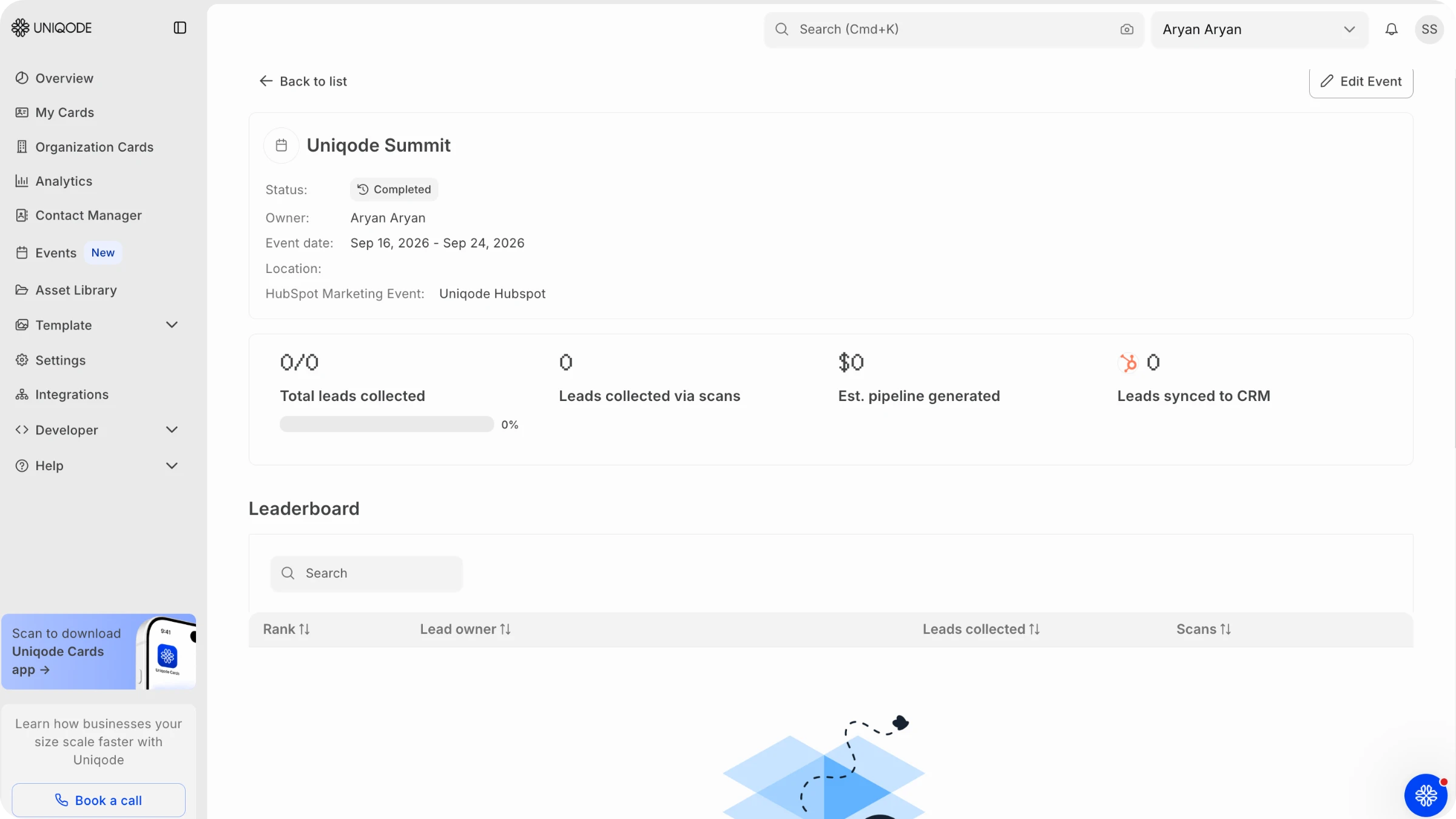
Uniqode Event Lead Capture tracks five essential metrics on its event dashboard: leads collected, total scans, leads synced to CRM, goals achieved, and top performers. With these insights, a VP or Director can see, in real time, both event-level and rep-level data. This is exactly the kind of capture information you need to confidently demonstrate ROI.
Leads collected refers to the total number of contacts gathered throughout the event. Whether a representative scanned a badge, captured a business card, or manually entered a contact after a quick hallway chat, every interaction counts. Think of this as your top-of-funnel metric, but this time, it is tracked in real time and tailored to the event at hand, rather than pieced together from memory later.
Total scans count every scan action, including duplicates and re-scans. Tracking this separately from leads collected is important because total scans show booth traffic and how active each rep is. This helps your sales team compare rep effort at an event and see who is really working the floor.
Leads synced to CRM is a straightforward metric: it tells you how many of your captured leads actually made it into your connected CRM, be it Salesforce, HubSpot, Microsoft Dynamics, Pipedrive, or any other supported platform.
Goals achieved measures your performance against the specific numeric targets you set for the event, whether that is the number of leads collected or the count of qualified leads. This approach puts your pre-event goal-setting into action, ensuring that tracking results is a proactive part of your process, not just an afterthought you stumble upon weeks after the event ends.
Top performers is a rep-level leaderboard that highlights which representatives secured the most or best quality leads during the event. Instead of waiting for someone to sift through CRM reports after the event, you can now see these results instantly. This feature brings the pipeline-by-rep approach to life, making it easy to track performance in real time.
How a composite B2B SaaS company turned event lead capture into defensible pipeline
Consider a hypothetical scenario to bring the framework above to life.
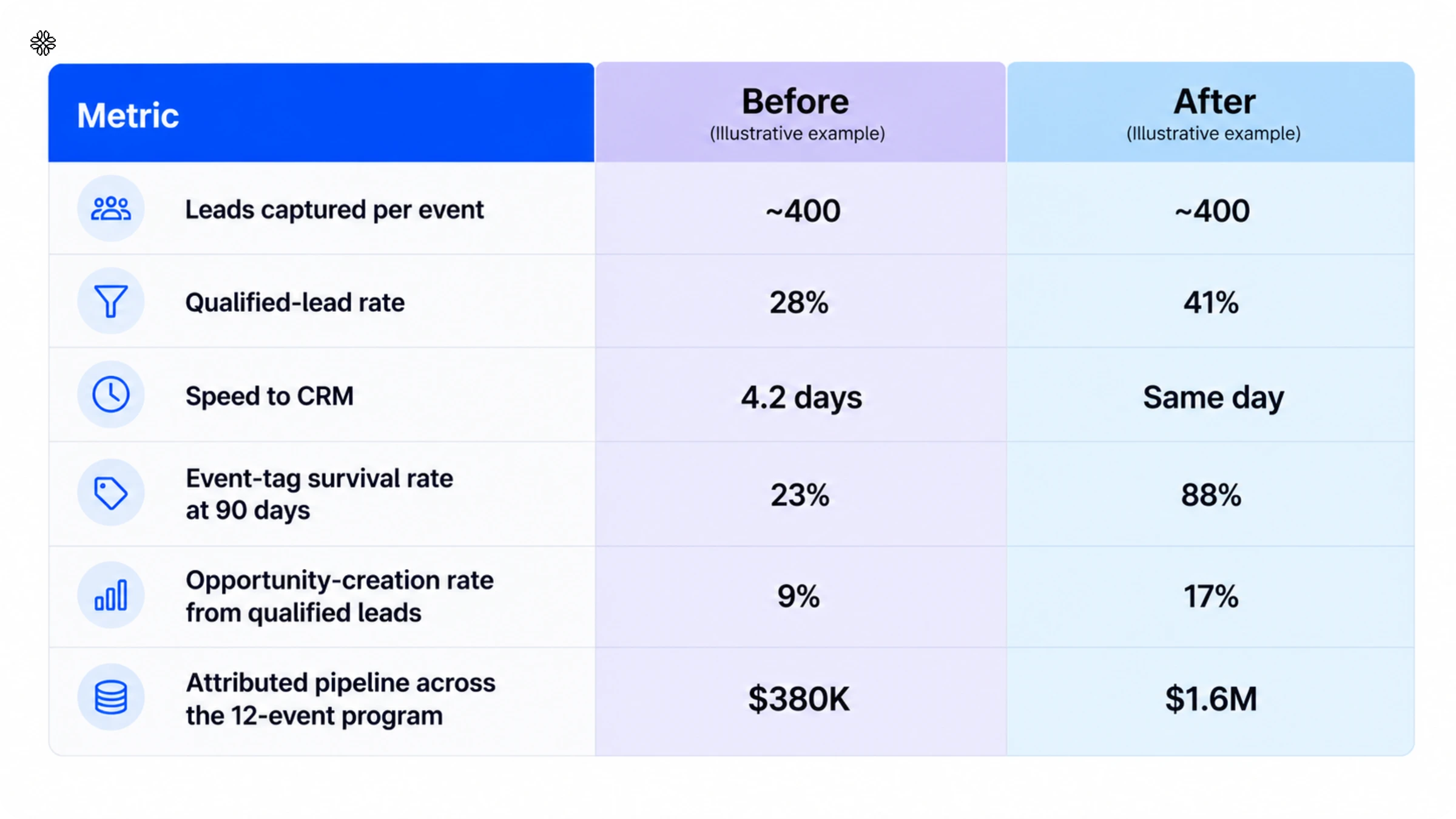
Picture a vertical SaaS company with 900 employees, a field marketing team of just six, and 40 reps spread across three regions, all managing a packed calendar of 40 trade shows. Last year, they pulled in around 4,800 leads from their 12 biggest events. But here’s the catch: ninety days later, only about 1,100 of those leads were still linked to their original event in the CRM. That’s a survival rate of just 23 percent, the very leak we’ve been talking about, and the tough question the VP of event marketing had to answer at budget review.
The solution wasn’t about getting a bigger booth or investing in a fancier scanner. Instead, the team locked the event and rep tags at the moment of CRM sync, making sure they couldn’t be changed manually. They also started tracking speed-to-CRM and opportunity creation rates by event and by rep, rather than relying on a single quarterly number.
| Metric | Before | After |
|---|---|---|
| Leads captured per event | ~400 | ~400 |
| Qualified-lead rate | 28% | 41% |
| Speed to CRM | 4.2 days | Same day |
| Event-tag survival rate at 90 days | 23% | 88% |
| Opportunity-creation rate from qualified leads | 9% | 17% |
| Attributed pipeline across the 12-event program | $380K | $1.6M |
Lead volume per event remained steady, but everything that followed was transformed. The qualification criteria were set before the events, not filled in after the fact. Leads were entered into the CRM the same day, and the event-tag survival rate soared to 88 percent, a number that tells the real story.
Once attribution was completed, the pipeline attributed to the 12-event program jumped from a previously undercounted $380K to nearly $1.6 million. With clear by-event and by-rep data in hand, the VP confidently shifted 15 percent of next year’s budget toward the three top-performing events and away from the two weakest. This time, the decision was based on conversion data, not just booth buzz or the quality of the coffee.
Start measuring event ROI you can actually defend
Event lead capture ROI is not lost at the booth. The real challenge comes later, inside your CRM, when the event tag on a captured lead disappears before it can be linked to revenue. The solution is clear: you need attribution that lasts from the first scan all the way to a closed-won deal, not just impressive lead counts on the show floor.
Before you start planning next quarter’s budget, take a close look at your last event’s CRM records. Did the event tag survive 90 days after the show? If not, the answer is not another follow-up email, but a capture platform designed to keep that tag intact. Uniqode Event Lead Capture scans badges and business cards, enriches every contact, and syncs everything to your CRM in real time, with the event and rep tag firmly in place. This way, the numbers you present at your budget review truly reflect the work your reps did on the show floor.
Frequently Asked Questions
- How do you calculate ROI for an event?
Calculate event ROI by subtracting total event cost from revenue attributed to the event, dividing that figure by total event cost, and multiplying by 100. The formula itself is straightforward. The hard part is trusting the "revenue attributed" number, since it depends on the CRM still showing the event as the deal's source months after capture.
- How is the ROI of an event calculated when the sales cycle outlasts the reporting period?
ROI of an event is calculated the same way, just later. Event ROI is a lagging metric, so a nine-month enterprise sales cycle won't produce a final number by the next quarterly review. Report a blended figure instead: this quarter's short-cycle indicators, qualified-lead rate, early pipeline stage progression, alongside last quarter's completed long-cycle revenue, which has already closed and can be traced back with confidence.
- How do you measure ROI on events before any deals have closed?
To measure ROI on events before any deals have closed, use directional indicators instead of ROI itself: leads captured, qualified-lead rate, and cost per qualified lead. None of these confirm revenue, but they're the leading signals a VP can report while the real ROI figure is still lagging behind the sales cycle.
- What are the best ways to measure ROI beyond the standard formula?
The best ways to measure ROI beyond the standard formula are cost per qualified lead and pipeline broken out by event and by rep are the two most useful supplements to the standard ROI formula. Cost per qualified lead works as a leading indicator when revenue attribution isn't ready yet. Pipeline by event and by rep shows which shows and which follow-up execution are actually driving conversion, information the aggregate ROI percentage alone can't surface.
- Does ROI in event management mean the same thing as ROI in event marketing?
ROI in event management and ROI in event marketing does not necessarily mean the same thing. Event management ROI often folds in attendee satisfaction, logistics efficiency, and operational cost control alongside revenue. Event marketing ROI, the version this guide covers, is narrower: it isolates the revenue a specific event produced against what it cost, for the purpose of defending or growing a marketing budget.
- Can event ROI be calculated for virtual and hybrid events?
Yes, event ROI can be calculated for virtual and hybrid events using the same formula and the same three measurement tiers as in-person events. The one difference is capture: virtual and hybrid events pull attribution from registration and engagement data instead of badge scans, which makes tight integration between the event platform and the CRM even more important, since there's no physical badge to fall back on if a sync fails.
About the Author
Somreeta is a Senior Content Marketer at Uniqode, where she writes about QR Code technology and how teams put it to work in the real world. She brings 8+ years of marketing experience to every piece, with a focus on turning product depth into content people actually use.