How consumers actually scan

Consumers are comfortable with QR Codes. Their expectations have evolved.

Consumers trust QR Codes enough to treat them as default access points to get information. 70% of consumers have scanned QR Codes at least once a month, and only 8% claim they've never scanned one. This level of comfort changes how consumers approach scanning. They no longer evaluate whether a QR Code is worth trying. They assume it will lead somewhere useful, load quickly, and deliver what it promises.

That assumption raises the bar for brands. As QR Codes become more familiar, tolerance for poor experiences drops. A slow page, an irrelevant destination, or an expired link isn’t seen as a technical issue; it’s seen as friction.

How often do you scan QR Codes?

Daily
9%
Weekly
35%
Monthly
26%
Yearly
4%
Rarely
18%
never
8%

If that's not convincing enough, listen to consumers themselves: 71% of consumers describe QR Codes as at least somewhat helpful in their daily lives. Only 12% find them “not useful.”


For brands, that shifts the job from driving adoption to elevating the experience. Every scan is a chance to deliver post-purchase engagement, build an ongoing relationship, or surface information that keeps the consumer coming back.

In your daily life, what role do QR Codes play?

essential
11%
helpful
25%
somewhat helpful
35%
rarely useful
17%
not useful
12%

75% of the customers scan QR Codes “to get more information.” 

Why do you scan QR Codes?

To get more information
75%
To access discounts/offers
52%
To make payments
35%
For security/authentication
28%
To view personalized content
23%
For fun or curiosity
16%

But "information" can mean different things depending on where the QR Code is placed. What someone wants from a QR Code on product packaging is different from what they want at an event badge or an airport kiosk. 

Here's what “information” looks like in different contexts:

  • Product packaging: Ingredients, where it comes from, how to use it
  • Events: Schedules, speaker bios, networking tools, feedback forms
  • Public transport: Directions, tickets, local recommendations
  • Retail displays: Sizing guides, reviews, inventory at other locations

Now let’s go back to Chapter 01. What percentage of marketers use QR Codes to convey information? 36%. That's the gap. 

The mistake most brands make is sending every scan to the same destination, usually a homepage or a generic landing page, regardless of context. The data points to a clear opportunity: brands that match content to context see stronger engagement because they answer the question consumers are already asking.

Note: The percentages presented reflect responses to multiple, non-exclusive options. Respondents may have selected more than one answer, resulting in an aggregate total that exceeds 100%
Restaurant menu QR Code is a playbook, not just a use case.

Restaurants top the list for QR Code scans at 58%, followed by websites at 42% and product packaging at 40%.

Where do you most often scan QR Codes?

Restaurants/cafes/bars
58%
Websites
42%
Product packaging
40%
Physical/digital ads
34%
events
27%
Airports/train stations/cabs
14%
Books/magazines
11%
Office/workplace
11%

QR Code menus in restaurants stuck around after COVID because they fixed a simple problem: instant access to menus, no waiting, no shared surfaces. Many went further with smart dynamic QR Codes that display different menus by time of day, all from a single code. No more reprints. No more swapping physical menus. That's a blueprint other sectors should copy.

Airports and train stations sit at 14%, and offices at 11%. These are places where people have downtime, screens in hand, and plenty of surfaces to place a QR Code. The use cases are infinite: live gate updates, lounge access, guest check-ins, and room reservations.  

The restaurant model's lasting success proves what happens when QR Codes deliver the right information at the right time. Sectors lagging behind can do the same with creative use cases and the right infrastructure. That means smart rules that adapt content by time and location, analytics to measure what's working, branded domains that build trust, and templates that let teams deploy fast without sacrificing consistency.

Note: The percentages presented reflect responses to multiple, non-exclusive options. Respondents may have selected more than one answer, resulting in an aggregate total that exceeds 100%

Trust isn't the barrier anymore.

Nearly six in ten consumers feel somewhat or very confident scanning QR Codes. 29% remain neutral, and only 13% lack confidence.

Compared to last year, momentum is positive: 26% of people now scan and trust QR Codes more, while only 9% report declines in both scanning and trust. Nearly half (47%) see no big shifts. 

When it comes to security specifically, even with news stories about QR Code-based scams (like phishing), most folks feel secure; only 14% have ever run into a scam via a QR Code.

How confident are you that QR Codes you encounter are generally safe to scan?

Very confident
21%
Somewhat confident
37%
Neutral
29%
Somewhat doubtful
7%
Not confident at all
6%

Overall, this data is reassuring for marketers as 58% of consumers feel somewhat or very confident that QR Codes are safe to scan. The real potential lies in winning over fence-sitters. To win over the neutral 29%, you don’t need dramatic changes but visible trust signals that register in the two seconds before someone decides to scan, such as: 

  • Branded short domains: A URL like qr.yourbrand.com feels trustworthy because people spot the familiar name right away, unlike a random, generic short URL.

  • Clear CTA messaging: "Scan for nutritional info" or "Scan to verify authenticity" tells people what they're getting. Otherwise, ambiguity creates hesitation.

  • Fast, mobile-optimized landing pages: A page that loads instantly and looks intentional reinforces safety and that the brand cares about the experience. A slow page or a desktop-formatted site does the opposite.

Consumers trust QR Codes. Don’t let bad scan experiences make you unreliable. 

38% of consumers have never had a negative experience with a QR Code. When they encounter problems, the issues are operational, not security-related.

What common QR Code problems do consumers experience?

Code didn't scan properly
36%
Expired or dead link
29%
Slow loading/broken experience
27%
Irrelevant landing page
17%
Scams or phishing attempts
14%
Unclear content or messaging
12%
Malware or virus risk
9%
No negative experience
38%

The top three failures are all preventable: codes that won't scan (often a printing or sizing issue), links that expired (campaigns that ended without redirect updates), and pages that load slowly (mobile optimization gaps).

The solution boils down to smart habits:

  • Test before printing. Scan every code on multiple devices before it goes to production, as compatibility varies.
  • Optimize for mobile. Every QR Code scan happens on a phone. If your landing page isn't built for mobile-first, the experience fails before it starts.
  • Set up redirects for expired campaigns. A "page not found" error doesn't just lose one conversion; it teaches that consumer not to trust your code next time. Redirect old campaign links to something useful.

Remember, consumers don't separate "the QR Code failed" from "the brand failed." One bad scan costs you the next one.

Note: The percentages presented reflect responses to multiple, non-exclusive options. Respondents may have selected more than one answer, resulting in an aggregate total that exceeds 100%

Context beats design. Every time.

What factors make you more likely to scan a QR Code? When asked what makes them more likely to scan a QR Code, people ranked the factors clearly:

Trusted environment
55%
Clear relevance/context
49%
Code looks legitimate and safe
42%
Visible branding/logo
31%
Quality or appealing design
28%

More than half need to feel they're in a safe, familiar setting before they'll scan. Nearly half need to instantly understand why they should bother. Design quality? It ranks dead last.

The hierarchy is clear: trust and relevance first, aesthetics last. A plain black-and-white code that opens quickly to a clear, relevant page on a trusted domain will outperform an eye-catching design that leads to a generic URL, a slow load, or an unclear destination.

Custom colors and embedded logos can reinforce brand consistency, but only after the fundamentals are in place. 

Note: The percentages presented reflect responses to multiple, non-exclusive options. Respondents may have selected more than one answer, resulting in an aggregate total that exceeds 100%

First-party data follows the scan if you're transparent about how it will be used.

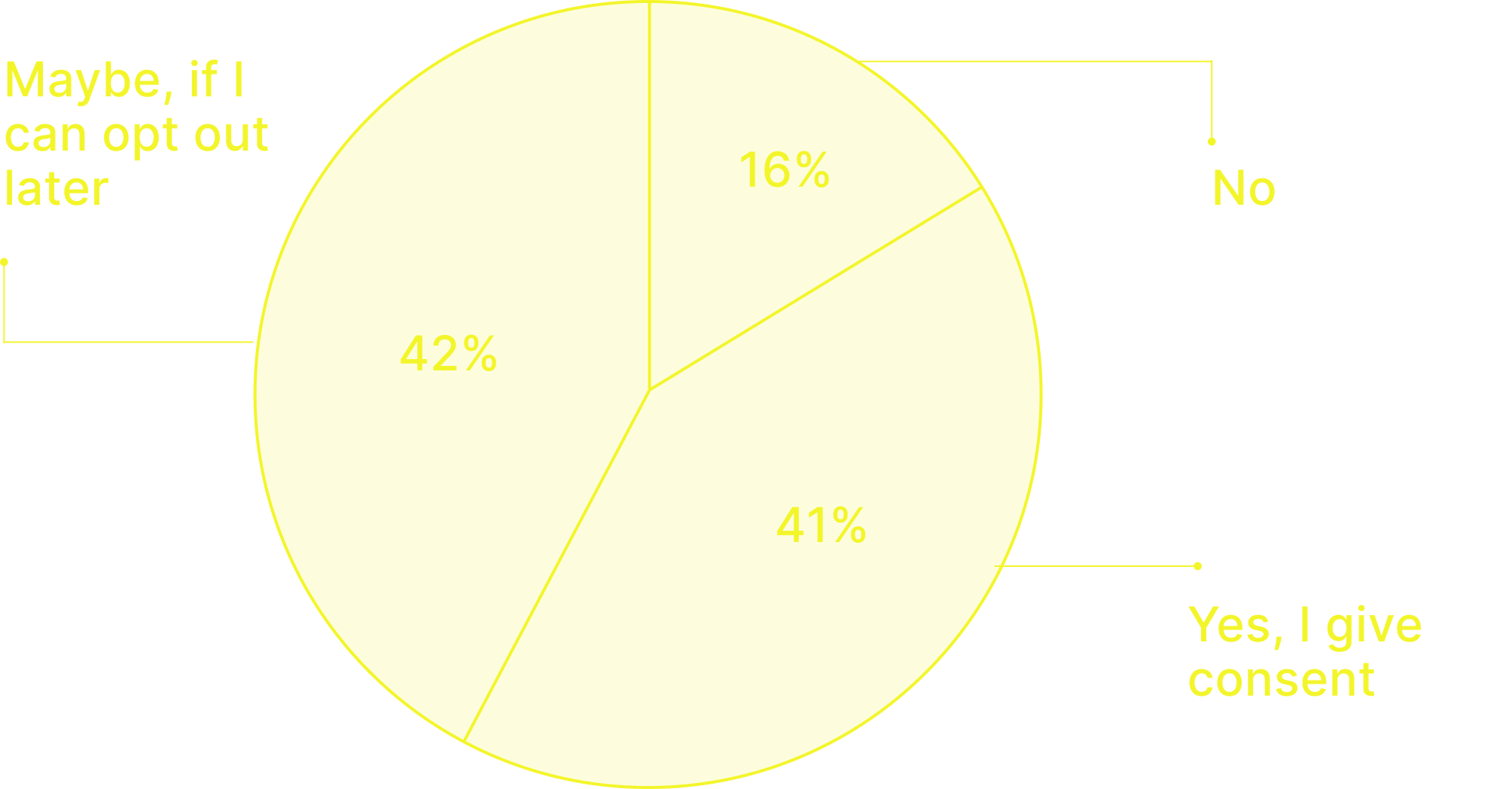
A whopping 83% of consumers are willing to share personal data after scanning a QR Code. But conditions apply. Tell them what you'll do with their information and make it easy to opt out.

37% specifically want more transparency about how their data is used. Yet only 34% of marketers clearly disclose their data practices.

The brands that close this gap will capture the first-party data they need to build personalized relationships. The approach doesn't need to be elaborate:

  • State the value exchange clearly. "Enter your email to get care instructions and exclusive refill discounts" is specific. "Sign up for updates" is not.
  • Show the opt-out path upfront. "You can unsubscribe anytime" is a trust signal that can increase opt-in rates, and not just a legal requirement.
  • Deliver on the promise immediately. If you asked for an email in exchange for a discount code, the discount code should appear within seconds. Delayed value delivery trains consumers to distrust the next ask.

31% Want to Save and Revisit QR Code Content Later

When we asked consumers what improvements they want in QR Code experiences, the top answer was reliability: 42% want codes to load faster and work more consistently. 

The third most wanted improvement points to an under explored opportunity: 31% want scanned information to be easier to save and revisit later.

Load faster, work reliably
42%
More transparency about data use
37%
Easier to save/revisit later
31%
Appear in more useful places
27%
Work offline/low connectivity
23%
More personalized/relevant
21%
Better integration with apps/wallets
21%
Clearer CTAs/instructions
15%
No improvements needed
16%

Think about the typical QR Code interaction: A shopper scans a product in-store and sees a 15% off coupon for their next purchase. By the time they're ready to buy again, that browser tab is long closed, and the offer is forgotten.

The value of QR Codes extends beyond the immediate scan. Consumers want to access information when they need it, not just when they're standing in front of the code. Smart brands are stepping up with these fixes:

  • Wallet passes: A scanned coupon that saves to Apple Wallet or Google Pay stays with the consumer until they're ready to use it.
  • Email capture with delayed delivery: "We'll send you this guide so you can read it later" respects the consumer's time while creating a touchpoint.
  • Save-for-later prompts: A simple "Bookmark this page" or "Add to your account" option acknowledges that not every scan converts immediately.

Note: The percentages presented reflect responses to multiple, non-exclusive options. Respondents may have selected more than one answer, resulting in an aggregate total that exceeds 100%

What does the consumer survey data tell us?

70% scan at least monthly. 71% describe them as helpful. 58% feel confident they're safe. The data points to three specific opportunities. 

  1. Context: 75% of consumers scan to get information, but only 36% of marketers use QR Codes to convey it. The brands matching content to context will see stronger engagement than those sending every scan to a homepage. 
  2. Trust: 29% of consumers are neutral on QR Code safety, not skeptical, just unconvinced. Branded domains, clear CTAs, and fast-loading pages convert them. 
  3. Persistence: 31% of consumers want scanned information to be easier to save and revisit. Most QR Code experiences still treat the scan as the finish line when it should be the starting point.

A scan is just the start. Let our team help you design post-scan journeys that drive repeat engagement and customer loyalty.

Where do you stand in the industry?

Chapter 03