


.png)

From Hype to Habit: QR Codes in Their Mature Adoption Era


QR Code engagement has plateaued.
Uniqode's State of QR Codes 2026 found that 70% of consumers scan QR Codes monthly, and 47% report their scanning habits haven't changed. This stability signals a shift: QR Codes have moved from novelty to infrastructure.
The question is no longer whether consumers will scan, but whether brands are treating QR Codes with the same rigor they apply to product design. When 75% of scans are driven by the need for information, every failed scan (whether from a dead link, slow page, or irrelevant promotional pop-up) erodes trust at the exact moment it matters most. In their mature adoption era, QR Codes should make every scan both useful and reliable.
Let’s dive deeper into what consumers expect and how brands can meet those expectations in that moment, rather than losing them.
What mature QR Code adoption demands
Despite widespread adoption, execution remains inconsistent. 36% of consumers have experienced improper scans, 29% have hit dead links, and 27% have waited through slow-loading pages. These aren't edge cases but symptoms of brands still treating QR Codes as marketing add-ons rather than core product infrastructure.
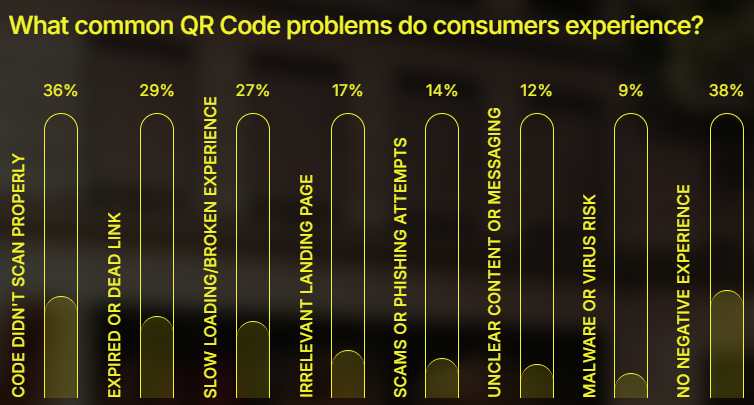
Most consumers are comfortable scanning when a QR Code is present. The gap isn't a lack of willingness but a lack of execution. The difference between a trusted QR Code and one that gets ignored comes down to scan reliability and contextual relevance.
Here's what infrastructure-grade QR Code systems must deliver:
Clear and context-specific information
75% of consumers say gaining information is their primary reason for scanning, well ahead of discounts or payments. Also, 49% are likely to scan when the code clearly fits the context.
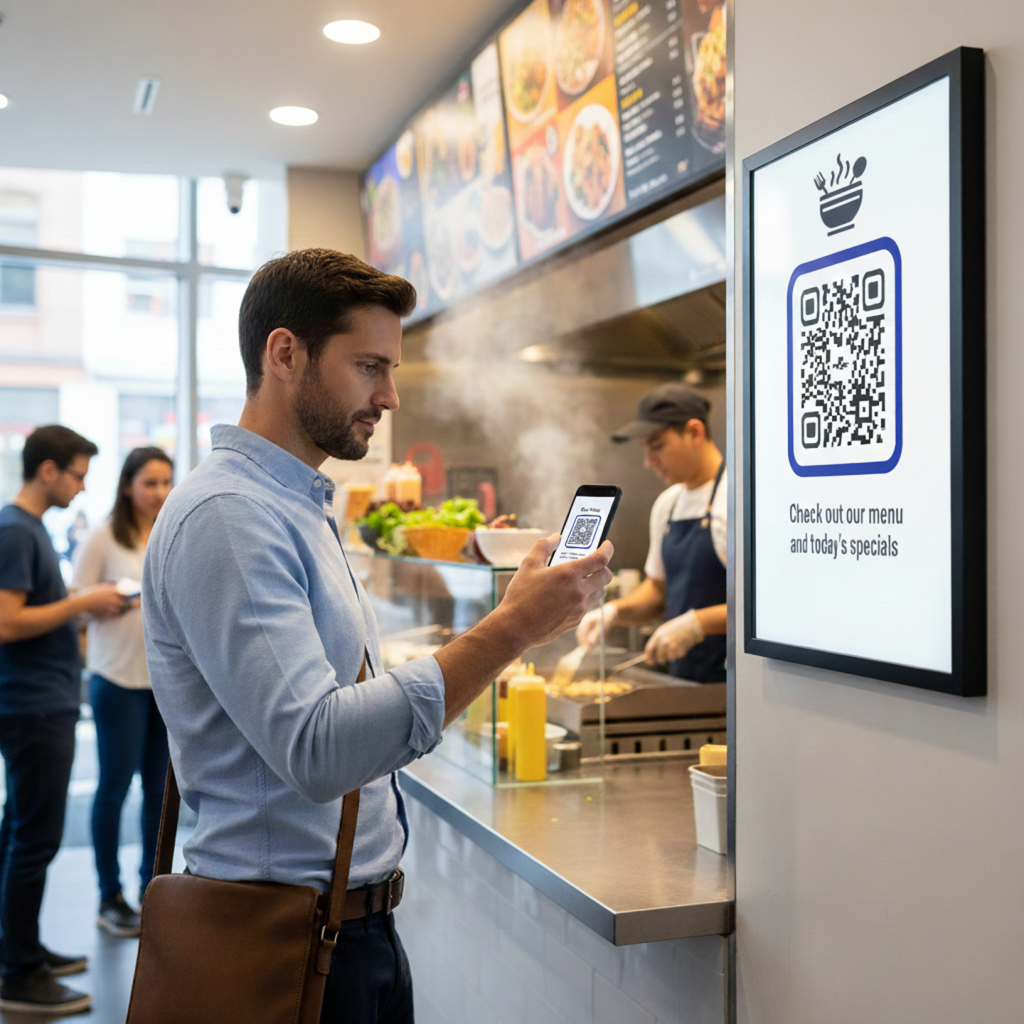
The physical context of a QR Code should determine what a consumer sees after they scan it. Restaurant QR Codes that deliver menus work because they’re relevant to the consumer at the moment. Product packaging QR Codes work when they provide answers to product questions after purchase. Once the content matches the context, the scan feels intentional rather than forced.
Consistent experience across touchpoints
Scanning occurs in familiar, everyday settings across various industries, and trust is built through repetition. According to the 1,000 consumers surveyed for the report, 55% said they are more likely to scan in trusted environments, and 42% look out for QR Codes that appear safe and legitimate.
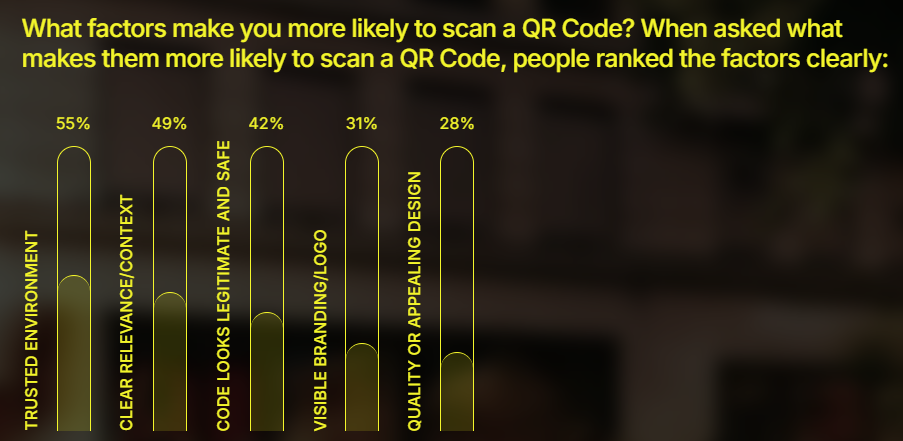
Having the same branded codes repeated across packaging, receipts, signage, and websites is what creates trust here. When a consumer scans a QR Code on your packaging, they are borrowing trust from every other place they see your brand. A sloppy or off-brand experience can erode the trust you've earned, making the brand feel less trustworthy.
Pages that load fast
When people scan, they expect the page to open quickly and function smoothly.
42% of consumers want QR Codes to load faster and work more reliably to improve the scanning experience.
A QR Code feels sensible when the information behind it is swift to access. If the page is slow, breaks, or disappears later on, the scan feels unreliable. These delays do not just hurt that one interaction, but can stop repeated scans if they constantly happen.

A scan that will lead somewhere useful
With 47% of consumers saying their scanning habits haven’t changed, there’s a solid baseline of confidence for brands to build on.
For consumers who scan to solve a problem or get information, their confidence grows in the brand when they know the QR Code will lead to what they need. Using QR Codes for promotions is not a problem; the risk arises when promotional destinations fail to meet consumer expectations after scanning and erode their confidence.
Bridging the gap between consumer expectations and QR Code execution
Many brands still deploy QR Codes as campaign accessories that are printed for a product launch, used in a seasonal promotion, and then abandoned once the campaign ends. This approach might have worked during the novelty phase, but it's fundamentally at odds with how consumers now use QR Codes.
Closing the gap between mature scanning behavior and inconsistent brand execution requires treating QR Codes as permanent infrastructure rather than temporary marketing tactics. Here's how:
Make information the first value
Consumers scan first because they need something. That need might be practical, such as setup instructions, sizing guidance, or care information. It may be time-sensitive, such as confirming authenticity or checking a service schedule.
When a scan leads instead to a generic landing page, newsletter signup form, or promotional overlay that is disconnected from the product context, it interrupts the task rather than completing it. This is the tax brands pay for treating QR Codes as marketing real estate instead of service infrastructure.
Brands that design for mature QR Code usage prioritize information before persuasion. They treat the QR Code as a shortcut to answers consumers are already seeking and not as a detour through unrelated promotions.
Treat QR Codes as part of the product experience
QR Codes perform best when they are embedded into the product experience, rather than layered on top of it for marketing purposes. They should extend beyond campaign calendars or seasonal activations.
When QR Codes are designed as part of the product system, they become places customers return to over time. They support ownership, usage, and service, rather than one-off interactions. Over time, this consistency builds trust and sets expectations about what a scan will reliably provide.
This requires cross-functional ownership. Product, CX, operations, and marketing should all influence what lives behind the QR Code and how it evolves. Without that shared responsibility, QR Code experiences tend to fragment.
So, for example, a furniture brand can print a single QR Code under each dining table that always leads to a “table hub” for that model: assembly steps, spare-part ordering, finish and cleaning guidance, warranty details, and even layout ideas or extension-leaf instructions.
Over the years, the brand can update those resources, such as adding new care tips, compatibility notes, or sustainability information, without changing the code on the furniture, so the same scan continues to support ownership long after the purchase.
Pro tip: Dynamic QR Codes are very helpful for this; you can change the destination without replacing the QR Code itself.
Build durable use cases that support long-term needs
Tie QR Codes to needs that don't disappear after a launch or campaign. Think about moments consumers return to repeatedly:
- Checking authenticity on a high-value item,
- Pulling up a manual months after purchase,
- Confirming warranty coverage,
- Initiating a repair, or
- Understanding how a product was sourced.
That’s why the strongest use cases tend to sit deeper in the product lifecycle. For example, you can place one QR Code on a packaging that resolves to a product-specific hub, where customers can verify legitimacy, access onboarding content, view service timelines, or initiate a return, depending on their needs at that point in time.
Mr. Apple, New Zealand’s largest apple grower, is a clear example of how QR Codes can support brands’ long-term needs. They placed codes on PLU stickers (product labeling) that scan to a hub delivering transparency information, language-localized content, and company details, effectively bridging B2B to direct consumer engagement. This setup drove over 50% of their website traffic, helping them with consumer connections despite their wholesaler model.
When one scan supports multiple long-term tasks instead of a single promotion, the QR Code starts earning its place as part of the product’s infrastructure.
Maintain a dynamic information layer
Once QR Codes are tied to long-term use cases, the next step is to keep the information behind them useful over time. You can use scan data and support patterns to continuously refine the QR Code.
This approach also addresses the data exchange consumers are willing to make. According to the report, 83% consumers are willing to share their data to receive rewards, personalized offers, and support, as long as they give consent (42%), can opt out later (41%), or receive transparency about data use (37%).
If regulations change, materials are updated, or instructions are improved, the QR Code layer should reflect these changes without requiring a physical update. When brands maintain dynamic, personalized content behind QR Codes, they can deliver on this value exchange effectively.
Design the post-scan journey with product-level rigor
The post-scan journey must start immediately. The QR Code must lead somewhere with value, and brands should be deliberate about what consumers see first, what they can do next, and how easily they can complete the task that led them to scan in the first place.
This is especially critical given that 29% remain neutral when it comes to scanning. Seamless, fast-loading experiences with clear security signals, like secure branded domains and “Scan to verify” messaging, can convert neutral scanners into confident, repeat users.
Understanding QR Code adoption for the long haul
QR Codes are now embedded in consumer behavior. The brands that win in this mature phase won't be the ones deploying the most codes but will be the ones whose codes work every time.
When QR Codes function as reliable product infrastructure rather than disposable marketing tools, they create compounding value. Each successful scan builds trust for the next one. Over time, these codes become reference points that consumers return to, rather than promotional interruptions they learn to avoid.
The cost of an outdated QR Code strategy is measurable: broken links train consumers to skip your codes entirely, slow pages erode confidence, and irrelevant destinations damage brand credibility. Meanwhile, competitors who treat QR Codes as durable systems will capture the attention, trust, and repeat engagement you're leaving on the table.
The opportunity is clear. Consumers are ready to scan. The question is whether your QR Codes are ready to deliver.
As we move from hype to habits, consumer behavior matters more. The State of QR Codes 2026 covers how marketers are using QR Codes, what consumers actually want from a scan, and how your QR Code performance stacks up against industry benchmarks.