


.png)

How Packaging QR Codes Turn Retail Customers Into Owned Contacts


A shopper picks your brand’s shampoo off the shelf at Target. Pays. Walks out.
The sale is complete, but what happens next is invisible to your brand. Target knows who bought it because the purchase is tied to a loyalty account that tracks every return visit. Your brand does not see any of that unless you pay for it.
If you want to reach that customer again, you pay the retailer. Target, Amazon, or Walmart owns the relationship with the customer. You just rent access to it. Retail media networks have become multi-billion-dollar businesses, funded in part by brands paying to reach customers who already bought from them.
For years, brands could work around this through digital retargeting, including cookies and third-party data that followed customers after checkout. But the infrastructure is disappearing. Privacy regulations and platform changes are killing off the workarounds, leaving brands more dependent on retail access than ever.
Meanwhile, the product is sitting in someone's bathroom right now. Used daily. Trusted enough to be part of a routine. The brand still doesn't know who that customer is.
Packaging is one of the few things that survives the retail handoff. It stays with the product, shows up at the moment of use, and isn't controlled by any retailer. A QR Code on that packaging creates a direct line from product to customer, right when they're actually using it. That's where an anonymous transaction becomes a relationship you own.
Why this moment matters for packaging QR Codes
QR Codes are now part of everyday behavior. According to The State of QR Codes 2026, around 70% of consumers scan QR Codes monthly, and product packaging is the third most common place they scan, after restaurants and websites.
Packaging’s value as a direct channel shows up after purchase, when the product is in hand, and the brand has a rare, uninterrupted presence.
Despite this, brands have been slower to adapt. According to a marketer survey part of the same report, only 16.8% treat QR Codes as central to their strategy. 24.2% still use static QR Codes that cannot be updated once the packaging is printed. 35.5% provide clear calls to action only sometimes, leaving scan intent unclear when it matters most.
This creates a visible gap. Consumers approach scans with intent, while brands often deploy packaging QR Codes as an afterthought. Between the scan and a customer connection sit barriers many brands haven’t cleared.
The three barriers between scan and relationship
These barriers appear after the scan, when customer intent is present, and the next steps shape how the engagement unfolds. Together, they determine whether a single scan remains transactional and one-time or becomes an ongoing connection with the brand.
Barrier 1: The information gap
75% of consumers scan QR Codes to get more information. A 2024 GS1 US survey found that 79% of shoppers are more likely to purchase products with a QR Code that provides information they want. Product packaging has limited space, and regulatory requirements take priority. QR Codes extend what the label cannot include.
Many brands, however, route these scans to generic product pages that focus on marketing copy, high-level features, and brand positioning. That often misses the reason the scan happened.
At the point of scan, customers are looking for details tied to the product they already bought or are seriously considering buying, such as instructions, ingredient clarity, sourcing, or verification. For example, someone scanning a supplement bottle at home is not looking for the brand story. They want dosage instructions or confirmation that the product is legitimate.
When the scan destination does not resolve that need, the interaction stops.
Barrier 2: The trust deficit
According to a Consumer survey part of the same report, 55% consumers say they scan only in environments they trust. Packaging has a natural advantage here: the product is already in the consumer's hand, and the QR Code appears within an existing interaction with a brand they chose to buy. That context creates baseline trust that web ads or unsolicited emails don't have.

However, that advantage depends on the scan experience holding together. Improper scans are the most common QR Code-related complaint, cited by 36% of consumers. When a QR Code fails to load or leads to a broken destination, the interaction ends before any information is consumed. If someone tries to access setup instructions and the link is dead, they’re not scanning your next product.
Barrier 3: The transparency gap
83% of consumers say they are willing to share data in exchange for rewards, personalized offers, or support. That willingness, however, is conditional. 42% consumers said they will share data only with explicit consent and 41% only if they can opt out later.

Marketers see this opportunity, and about 94% agree that QR Codes capture first-party data. The breakdown appears at disclosure. Only 34% explain data practices clearly at the point of scan, while 33.2% bury disclosure in privacy policies. Another 28.6% either don’t disclose how scanned data is handled or are unsure of their own practices.
This gap shows up at the moment of conversion. Customers arrive for information. Brands either ask for data before delivering value or defer disclosure to a generic privacy policy. In both cases, conversion rates drop and few customer relationships form.
What the three barriers reveal
The barriers come from a single moment. Brands collapse relevance, trust, and permission into a single moment. A scan intended to answer a practical question turns into a data request. A trusted context leads to a broken link. A willingness to engage is undermined by unclear disclosure practices. Each break prevents the next step from forming.
Packaging QR Codes function as a persistent customer channel, enabling repeated interactions beyond the point of sale. The brands that clear these barriers separate information delivery from data collection. They answer the question first, build trust through reliability, and ask for permission only after delivering value. Each step unlocks the next.
How dynamic packaging QR Codes build customer relationships
Unlike ads or campaigns, packaging stays with the product over time, which makes it possible to separate information delivery from engagement and engagement from data collection.
Progressive profiling, which is collecting data gradually across multiple interactions rather than all at once, increases form completion rates by an average of 35% and reduces abandonment by up to 45%. The principle applies directly to dynamic packaging QR Codes: match what you ask for to the value you’ve already delivered.
Stage 1: Anonymous value delivery
The first job of a packaging QR Code is to answer the question that triggered the scan. Someone scans a product they just bought because they need help using it.
Asking for an email before showing setup instructions adds friction at the wrong moment. The scan itself is the request for information, and it needs to be met immediately. High-performing brands treat this moment as only information delivery, and not lead capture. No gates. No forms. No asks.
For example, Ocean Spray uses packaging QR Codes to route customers to recipe ideas tied to the product they just bought. The scan leads directly to practical usage inspiration and not a generic brand page. This resolves the information gap by addressing the reason the scan happened.
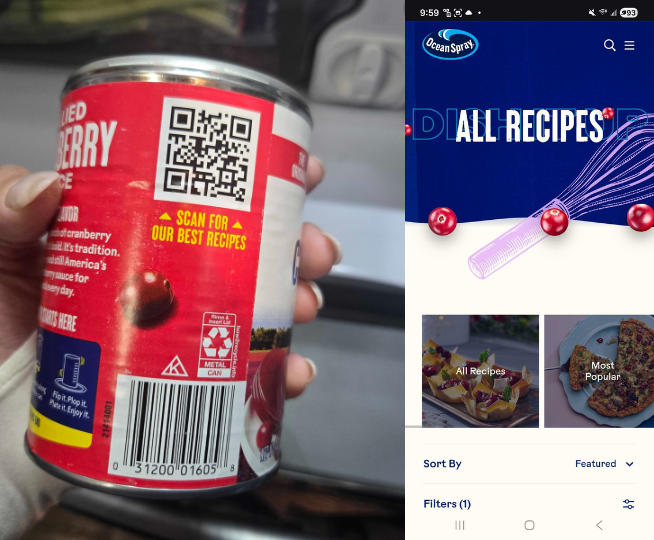
Even without collecting contact details, the interaction generates actionable data: scan volume by geography (revealing strong vs. weak markets), time-of-day patterns (showing when customers use the product), and repeat scan behavior (indicating product satisfaction or confusion).
Most importantly, it establishes the brand as helpful and trustworthy, setting expectations for what comes next.
Stage 2: Lightweight opt-in
Once immediate value has been delivered, some customers are open to continuing the interaction. At this stage, the scope of exchange stays narrow: ongoing utility in return for a single identifier. Not a full profile. Just an email or a phone number.
Effective offers feel like upgrades to what the customer already found useful, such as refill reminders, product-care tips, and periodic usage ideas tied to the item in hand.
When you ask matters as much as what you ask for. Someone who just used a setup guide or troubleshooting page is far more likely to opt in for follow-up content than someone who was asked before receiving value.
This step clears the transparency barrier by making both the ask and the benefit explicit. The scan moves from anonymous to known without requiring more commitment than the moment (and value delivered) supports.
Stage 3: Deepened engagement
More detailed data collection makes sense only after establishing a customer relationship. At this stage, the customer has already opted in and engaged. Additional information is requested only when it clearly enables something in return.
For example, loyalty programs rely on preferences to offer relevant rewards. Warranty registration requires purchase details. Personalized recommendations depend on product usage history.
This progression unfolds over time, and each new data point unlocks tangible benefits for the customer, such as point tracking, extended coverage, or early access to new products. For the brand, it means owned customer relationships that drive repeat purchase without paying retail media networks for access.
Progressive profiling only works when earlier stages have built trust consistently. Skip steps, and the system breaks.
From retail dependency to relationship ownership
As retail media networks expand and privacy rules narrow digital targeting, brands face a choice: continue paying intermediaries to stay visible to customers they already converted, or use the touchpoints they already control to build direct relationships over time.
The three-stage approach with QR Codes on packaging works. Deliver value first, request opt-in after trust is established, and deepen engagement when the relationship justifies it.
Brands building direct customer channels from packaging are pulling ahead. Everyone else is renting access to customers they already won.
The State of QR Codes 2026 covers how marketers are using QR Codes, what consumers actually want from a scan, and how your QR Code performance stacks up against industry benchmarks.